The Pufferfish Paradox: Nature’s Ultimate Biological Dreadnought

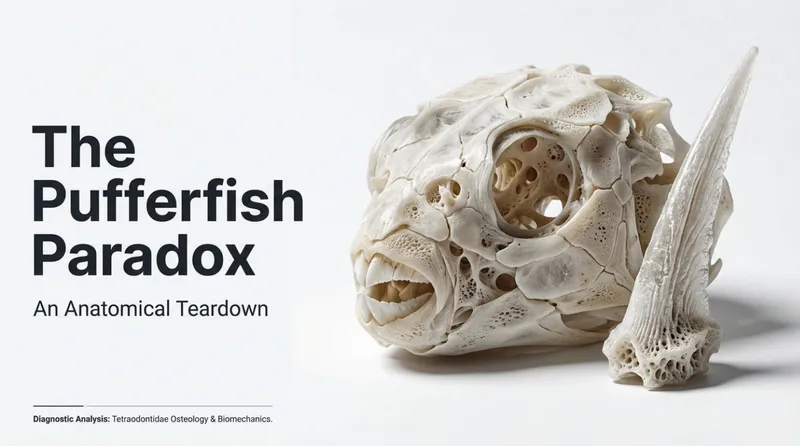
When we think of a pufferfish, we usually imagine a cute, slow-swimming fish that occasionally turns into a prickly ball. But from a biological perspective, the pufferfish is a radical rebel. It has broken almost every rule of fish anatomy to become a "biological dreadnought" - a living fortress that trades speed for absolute impenetrability. Let's take a look under the hood of this evolutionary marvel.
An Anatomical Teardown
The pufferfish belongs to a family called Tetraodontidae. While most fish rely on being fast to escape predators, the pufferfish is built like a heavy-duty machine designed for a single purpose: volumetric expansion. It is a masterpiece of biomechanics where every part of the body has been redesigned to allow it to grow several times its original size in seconds.
This "teardown" reveals that the pufferfish isn't just a fish that gets big; it is a highly engineered hydraulic system. By looking at its osteology (bones) and specialized tissues, we can see how it transformed from a vulnerable swimmer into the ocean's most famous defender.
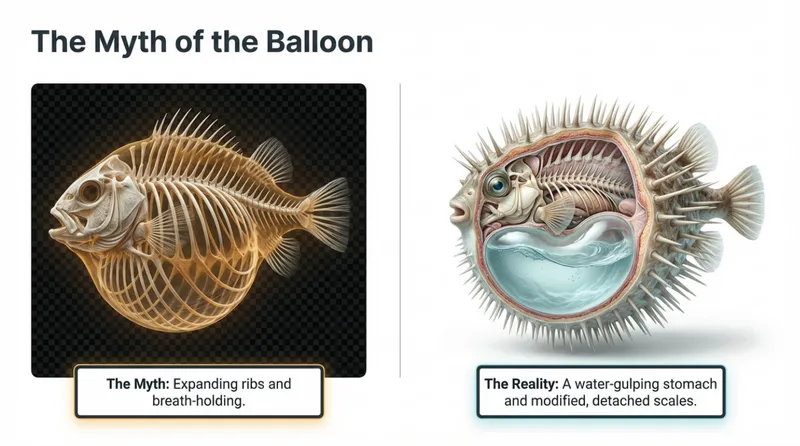
The Myth of the Balloon
Many people believe that pufferfish fill themselves with air like a birthday balloon or hold their breath to stay inflated. This is actually a myth. In reality, a pufferfish is a master of hydraulics. It uses a "water-gulping" technique to fill its specialized stomach with seawater.
To make room for all that water, the fish has completely changed its outer armor. Instead of the hard, overlapping scales you see on many other fish, the pufferfish has modified, detached scales that stay tucked away until the moment of inflation. This allows the skin to be flexible and ready to stretch at a moment's notice.
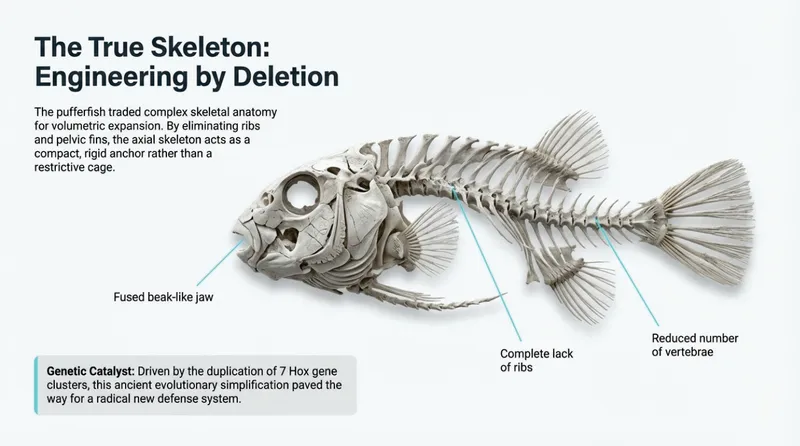
Engineering by Deletion
To become the ultimate "balloon," the pufferfish had to get rid of some very important bones. Most fish have a rib cage to protect their organs, but a rib cage would act like a "restrictive cage," preventing the fish from expanding. Evolution solved this by simply deleting the ribs entirely.
By eliminating ribs and pelvic fins, the pufferfish created a "compact, rigid anchor" out of its spine. This was driven by a massive genetic change - the duplication of 7 Hox gene clusters. This simplification of the skeleton paved the way for a defense system that no other creature on Earth can replicate.
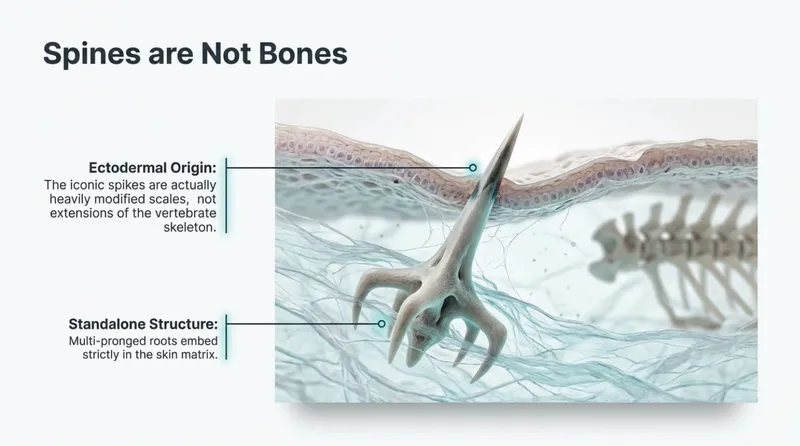
Spines are Not Bones
If you look closely at a pufferfish’s spikes, you might think they are connected to its skeleton. They aren't! These iconic spines are actually heavily modified scales that come from the "ectoderm" (the same layer of cells that creates skin).
These spines are "standalone structures". They have multi-pronged roots that are embedded strictly in the skin matrix rather than being extensions of the vertebrate skeleton. This allows the spines to move and point outward as the skin stretches, without being held back by the internal skeleton.
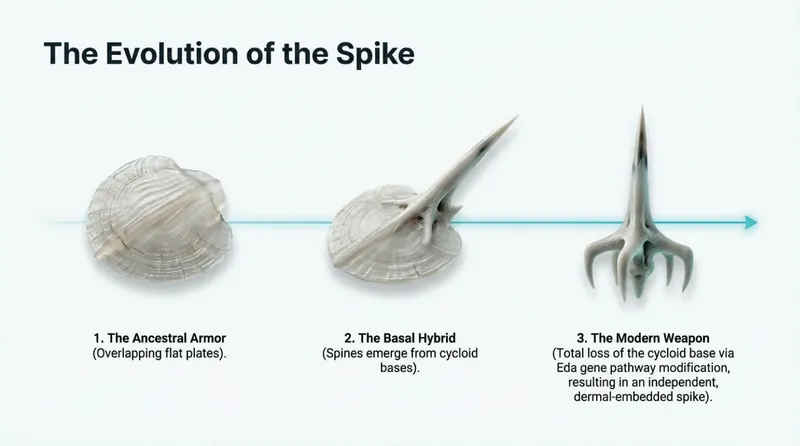
The Evolution of the Spike
The pufferfish didn't always have these independent spikes. It started with "Ancestral Armor," which were flat, overlapping plates. Over millions of years, these evolved into "Basal Hybrids," where a small spine began to grow out of a flat, cycloid base.
In the modern version of the pufferfish, a specific genetic pathway (the Eda gene) modified the scales even further. It got rid of the cycloid base entirely, leaving behind the "Modern Weapon": an independent, dermal-embedded spike that sits deep in the skin.
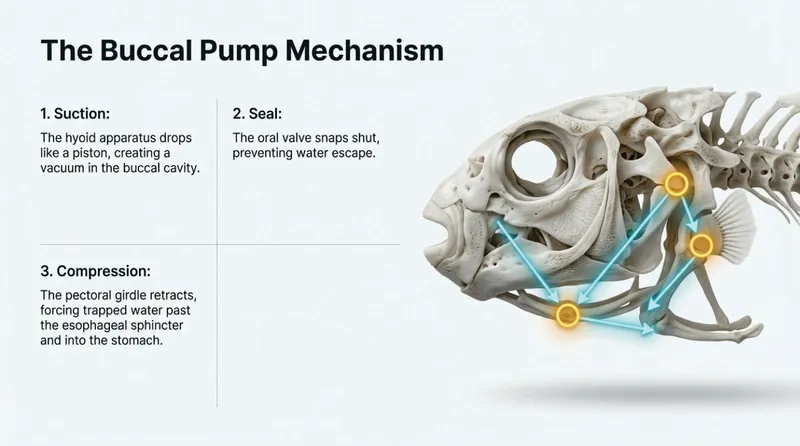
The Buccal Pump Mechanism
How does the fish pump water so quickly? It uses a "Buccal Pump". First, a part of the throat called the hyoid apparatus drops down like a piston, creating a powerful vacuum that sucks water into the mouth.
Then, a special oral valve snaps shut to prevent water from escaping. Finally, the pectoral girdle retracts, forcing the trapped water past the esophageal sphincter and straight into the stomach. It’s like a high-speed manual water pump!
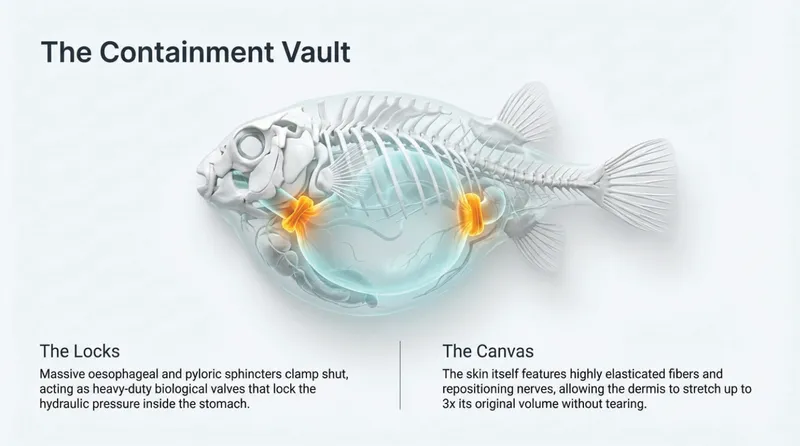
The Containment Vault
Once the water is inside, the pufferfish needs to keep it there under high pressure. It uses massive esophageal and pyloric sphincters which act like heavy-duty biological valves to lock the hydraulic pressure inside the stomach. This creates a "containment vault" that keeps the fish round and hard.
The skin itself is just as impressive. It is made of highly elastic fibers and has repositioning nerves. This allows the skin (the "dermis") to stretch up to 3 times its original volume without tearing, protecting the fish even when it is under extreme tension.
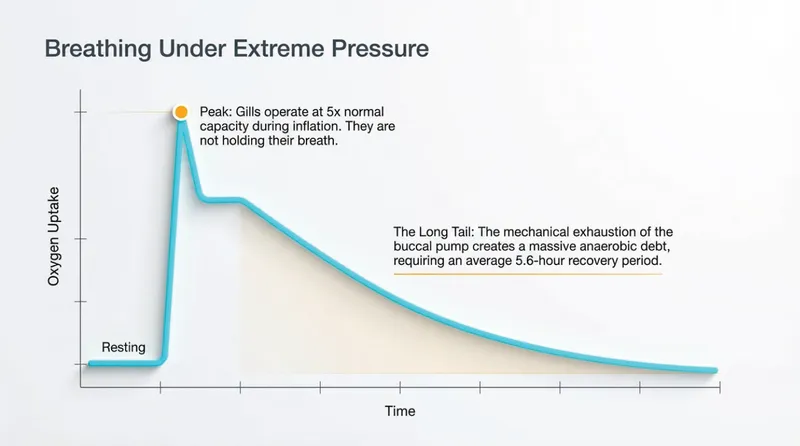
Breathing Under Extreme Pressure
You might think that being a giant ball makes it hard to breathe, but pufferfish are actually "hyper-aerobic" during inflation. Their gills don't stop; in fact, they operate at 5x their normal capacity to keep the fish oxygenated while it works hard to stay inflated.
However, this incredible feat comes at a cost. The mechanical effort of pumping and holding all that water creates a massive anaerobic debt. After the fish deflates, it is completely exhausted and needs an average of 5.6 hours to fully recover and get its energy back.
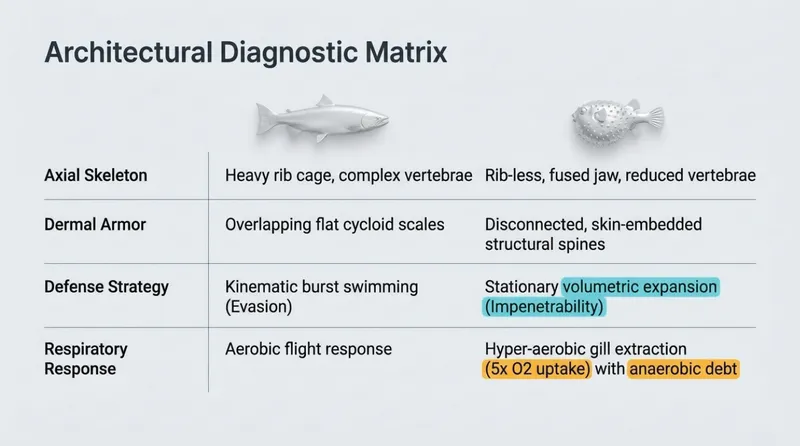
Architectural Diagnostic Matrix
When we compare a "normal" fish to a pufferfish, the differences are staggering. While a normal fish uses a heavy rib cage and "burst swimming" to escape, the pufferfish uses "stationary volumetric expansion". It doesn't run away; it just becomes an impenetrable fortress.
The pufferfish traded complex skeletal anatomy for a rib-less, fused-jaw design that allows for maximum expansion. It moved from having overlapping scales to having skin-embedded spines. It is the difference between a fast, evasive swimmer and a heavily armored tank.
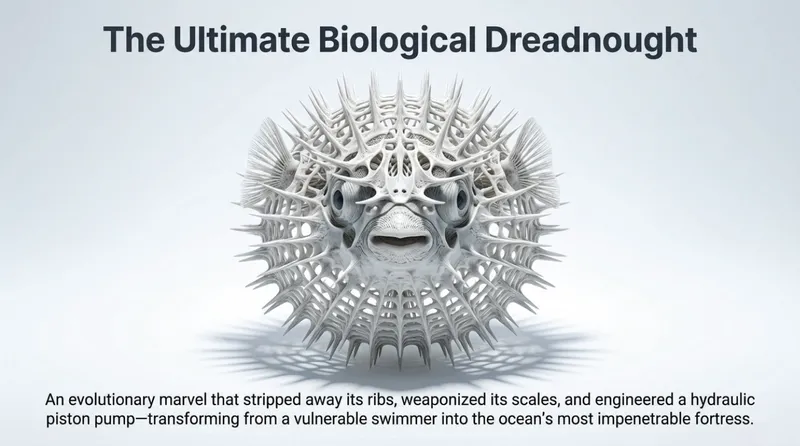
The Ultimate Biological Dreadnought
In the end, the pufferfish is an evolutionary marvel. It stripped away its ribs, weaponized its scales, and engineered a hydraulic piston pump to survive in a world of predators. It is a reminder that in nature, sometimes the best way to move forward is to simplify.
By transforming from a vulnerable swimmer into the ocean's most impenetrable fortress, the pufferfish has earned its title as a biological dreadnought. Next time you see one, remember: you’re looking at one of the most advanced pieces of biological machinery in the ocean.
PADI Divemaster and underwater storyteller with over 7 years of hands-on Red Sea diving experience, documenting marine life, mapping dive sites, and promoting responsible ocean conservation.