
ReptilesReptilia
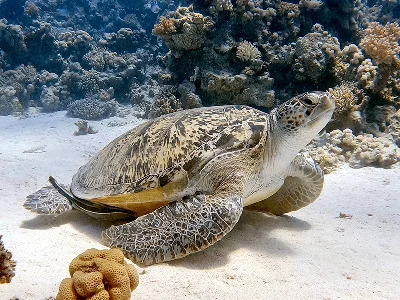
A reptile that lives in the sea has one problem ahead of all the others: salt comes in with everything it eats, and a reptile kidney cannot make urine saltier than seawater. Drinking the sea is therefore not an option, and every marine reptile lineage had to grow a separate pump to get rid of the excess. In sea turtles it is a large gland behind each eye that drains into the corner of the socket, which is why a turtle on a nesting beach appears to be weeping. The tears are concentrated brine, and she sheds them at sea too, where nobody is watching.
Almost no reptile lineage ever managed the crossing at all. There are thousands of reptile species on land; the ones that went fully marine can be counted on a hand, and every one of them still breathes air. The sea's great reptiles are all in the fossil record instead: the fish-shaped ichthyosaurs, the long-necked plesiosaurs, the mosasaurs. What swims today is what is left.
The egg is the wall most of them could not get past. A reptile egg has a shell built to breathe air and it drowns in water. Sea snakes solved it by giving birth to live young and never coming ashore. Turtles never solved it, which is why every generation has to haul itself up a beach and dig, and why the future of a turtle population is settled on land rather than in the water.
None of them keeps its own temperature the way a dolphin does; a marine reptile runs at whatever the water runs at, which sets a hard limit on how cold a sea it can use and is part of why the warm, stable water here suits turtles so well.
In practice this class means turtles in the 🌊 Red Sea. Green and hawksbill turtles are routine on the reefs, loggerheads appear, and the remaining two are strays. Sea snakes, common enough in the Gulf and off 🇴🇲 Oman, do not occur in this sea, and there are no marine crocodiles. A banded, snake-shaped animal on a night dive is a snake eel or a moray out hunting.
- regular surface trips to breathe air
- body covered in scales or hard bony scutes
- no fins; locomotion by flippers or sinuous body movements
Browse by category

Related groups
Nearby in the catalogue.




Last Update: August 23, 2026