All Creatures
1,337 documented species across 5 groups — fishes, invertebrates, mammals, reptiles and sea plants of the Red Sea.
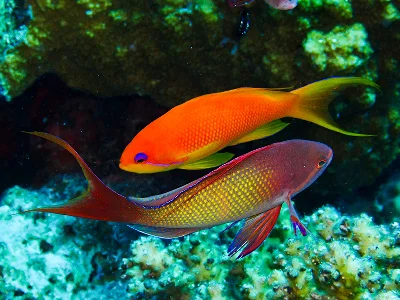
Fish is not one group of animals, and it never has been. The split between the sharks and rays on one side and the bony fishes on the other happened before there were trees on land, and it is older and deeper than the split between you and a bird. Everything in this part of the catalogue, from a goby shorter than a fingernail to a whale shark, sits somewhere inside that gap. What they do share is the hard problem: pulling oxygen out of water. A given volume of water holds a small fraction of the oxygen the same volume of air does, and it is heavy and slow to move. The solution is to run the water one way across the gill filaments and the blood the other way through them. Because the two flows oppose, blood meets water that is always slightly richer in oxygen than the blood is, the whole length of the exchange, and a fish strips far more oxygen out of a mouthful of water than your lungs take from a breath of air. Lungs work by tidal in and out, and leave most of it behind. They also have a sense you do not. A line of pores runs down each flank and branches over the head, opening onto hair cells that read water movement. It amounts to touch at a distance: the pressure wave bouncing off a wall, the wake of something approaching from behind, the exact position of the fish alongside. It is what lets a school of hundreds turn as one body with no leader and no lag, and it works in total darkness. Nearly all of them run at the temperature of the water around them, which in a sea this warm means animals that are fast and hungry all year. The Red Sea holds well over a thousand species, and the striking thing about the list is how much of it is local: a large share of the reef fishes here live nowhere else, the legacy of a basin that has been repeatedly cut off at its southern end during ice ages and then refilled.

Invertebrate is a word for everything that is not us. It carries no biological content at all: it sorts animals by a bone they do not have, in the way that non-elephant would sort animals by a trunk they do not have. What it gathers up is more than thirty phyla, which is to say more than thirty fundamentally different ways of building an animal, sharing nothing except the absence. The distances inside the category are enormous. A sponge, which has no organs and not one nerve cell, and an octopus, which solves puzzles and recognizes individual people, are filed together here. The gap between those two is far wider than the gap between a shark and a human, and yet the shark and the human end up on opposite sides of the line while the sponge and the octopus stay together. Vertebrates are one subgroup inside a single phylum, and nearly every animal species alive sits on the other side of the line. With no frame inside the body, support had to be solved some other way, and each answer became a whole lineage. Anemones and worms use water: fluid held under pressure inside a muscular wall, which is why an anemone can stand up when full and slump when empty. Molluscs grow a shell from the outside, laid down by a sheet of tissue. Arthropods wear a jointed suit that has to be climbed out of and rebuilt every time the animal grows. Echinoderms carry a mesh of calcite plates under the skin. On a reef the invertebrates are not the wildlife. They are the place. The rock itself is a skeleton, the color on the wall is animals, much of the sand is animals ground down, and the fish everybody comes to look at are moving through a structure that invertebrates built and are still building around them.

Every marine mammal in this sea is descended from an animal that walked, and none of them ever finished undoing it. Inside a dolphin's flipper are the bones of a hand: an upper arm, a forearm, a wrist and five fingers, shortened and bound in tissue. A whale still carries a pelvis with nothing attached to it. They breathe air, they hold a fixed body temperature, they nurse their young, and they do all of it in water that pulls heat out of a body far faster than air can. Breathing is a decision for them, not a reflex. Every breath is taken deliberately, which makes ordinary sleep lethal, and the answer is to shut down one half of the brain at a time with the opposite eye open and keep swimming. The nostrils have migrated to the top of the head, and the airway is plumbed straight through to the lungs past the throat, so a whale cannot breathe through its mouth at all and cannot choke on what it swallows. Birth happens in open water, usually tail first, and the calf's first task is to reach the surface for a breath, often nudged up by the mother. Milk is taken from slits rather than exposed teats, in short bursts, and it is thick with fat, enough to hold together in water and enough to build a layer of blubber on a calf quickly. Three lineages of them live here and they are not equally easy to meet. Dolphins are the real encounter: bottlenose along the reefs, spinner dolphins resting through the day in a few sheltered lagoons. Large whales are genuinely rare in this basin and are almost always a boat sighting rather than a dive. The dugong is rarer still, scattered across the seagrass bays of the mainland coast, and it is not a whale but a grazing animal from an entirely separate branch. There are no seals or sea lions in the Red Sea at all.

A reptile that lives in the sea has one problem ahead of all the others: salt comes in with everything it eats, and a reptile kidney cannot make urine saltier than seawater. Drinking the sea is therefore not an option, and every marine reptile lineage had to grow a separate pump to get rid of the excess. In sea turtles it is a large gland behind each eye that drains into the corner of the socket, which is why a turtle on a nesting beach appears to be weeping. The tears are concentrated brine, and she sheds them at sea too, where nobody is watching. Almost no reptile lineage ever managed the crossing at all. There are thousands of reptile species on land; the ones that went fully marine can be counted on a hand, and every one of them still breathes air. The sea's great reptiles are all in the fossil record instead: the fish-shaped ichthyosaurs, the long-necked plesiosaurs, the mosasaurs. What swims today is what is left. The egg is the wall most of them could not get past. A reptile egg has a shell built to breathe air and it drowns in water. Sea snakes solved it by giving birth to live young and never coming ashore. Turtles never solved it, which is why every generation has to haul itself up a beach and dig, and why the future of a turtle population is settled on land rather than in the water. None of them keeps its own temperature the way a dolphin does; a marine reptile runs at whatever the water runs at, which sets a hard limit on how cold a sea it can use and is part of why the warm, stable water here suits turtles so well. In practice this class means turtles in the Red Sea. Green and hawksbill turtles are routine on the reefs, loggerheads appear, and the remaining two are strays. Sea snakes, common enough in the Gulf and off Oman, do not occur in this sea, and there are no marine crocodiles. A banded, snake-shaped animal on a night dive is a snake eel or a moray out hunting.

Sea plants is a gardening heading, not a biological one, and the things filed under it are not one kind of thing. The honest dividing line is plumbing. A seaweed has none: no roots, no vessels, no stem in any working sense, and every cell trades gas and nutrients straight with the water touching it. That is why a seaweed can be thin and flat, why it needs no soil, and why the pad at its base is glue rather than a root. Seagrasses and mangroves are true plants with pipes inside them, and pipes need an anchor and a rooting medium, which is why they grow in sand and mud while the algae grow on rock. Everything here is governed by one physical fact: light does not last in water, and it does not fade evenly. Red is gone within the first few meters, then orange, then yellow, and what remains at depth is blue. Anything photosynthetic below the shallows needs pigments tuned to catch blue light, which is the real reason the sea's plant life is not uniformly green and why the deepest growth is a thin crust rather than a leafy thing. This section is where the food on a reef starts. The parrotfish scraping rock, the surgeonfish shoal, the urchin under a ledge, the green turtle in a bay and the dugong on a meadow are all living directly on what grows here, and everything that eats them is living on it one step removed. On this coast the three are not spread evenly, and none of them is abundant. Algae are everywhere and largely unnoticed, because they are cropped as fast as they grow. Seagrass forms real meadows only in sheltered sandy bays. Mangroves need still water and something more than bare desert shore, so they stand in scattered patches where wadis reach the sea. The Red Sea has no rivers and almost no rain, and that shortage sets the ceiling for all of it.