
RaysBatoidea
A ray is a shark that took to lying down.
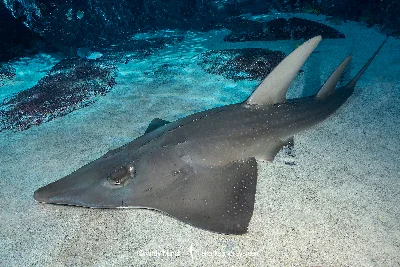
The materials are the same throughout: a skeleton of cartilage with no bone anywhere in it, no swim bladder, skin covered in tooth-shaped denticles, five gill slits on each side. What separates a ray is one structural change with consequences everywhere. The pectoral fins are fused to the sides of the head, running forward past the gills and usually past the eyes, so fin, head and body are a single disc with no neck and nothing that reads as a fish. Sharks get the attention, and there are more species of ray than there are of shark.
Flattening moved the gill slits onto the underside, which is awkward for an animal that spends its life resting on the exact surface it needs clean water from. The fix is a hole on top. Behind each eye sits a spiracle, a valved opening that takes water in, passes it over the gills and pushes it out below. A ray can bury itself completely, leave two eyes and two spiracles showing, and breathe for hours without taking in sand.
The eyes went up and the mouth stayed down, so a feeding ray cannot see what it is about to eat. It works by smell, by touch, and by reading the faint electrical fields of animals hidden under the bottom.
There are two ways to drive a disc, and they sort the group in front of you. Mantas and eagle rays flap: long slow beats of the wing tips, a stroke that carries an animal across open water for very little effort. Stingrays, torpedoes and butterfly rays undulate: a wave runs from the front edge of the disc to the back while the rest of the animal holds still, which is slower, far more precise, and works in water too shallow to swim in. Watch the edge of the disc and you can name the family before you have seen the tail.
- flattened body, disc or diamond-shaped
- broad, wing-like pectoral fins fused to head
- gill slits visible on underside of body
- long, slender tail, often whip-like
Browse by category



Other groups in Fishes
Nearby in the catalogue.


Last Update: August 23, 2026