
StingingCnidaria
A coral, a sea anemone and a jellyfish are one animal built two ways up. The body is a bag with a single opening: food goes in through the mouth and what is left of it comes back out the same way, because there is no second hole. The wall of that bag is two layers of cells with a jelly filling between them. No heart, no blood, no gills, no brain; the nervous system is a net spread evenly through the tissue with no head to run it, and nothing in the group has a front or a left side, only a middle and an outside.
The two ways up are called the polyp and the medusa. A polyp is fixed down with its mouth facing the water and its tentacles held out around it, which is a coral, an anemone, a hydroid, a zoanthid. A medusa hangs the other way, mouth and tentacles trailing under a swimming bell, which is a jellyfish. Turn either one over and you are looking at the plan of the other.
Many species are both, one after the other. A moon jelly starts as a larva that settles on the underside of a rock and grows into a polyp a few millimeters tall, no more impressive than a speck of fuzz. It can hold there for years. When the water tells it to, that polyp divides crossways into a stack of discs like saucers in a cupboard, and the discs peel off the top one at a time and swim away as small jellyfish. Corals and anemones gave up the swimming stage altogether and stay polyps for life; the true jellyfish kept both halves of the arrangement.
All of them are armed, which is what the phylum is named for, and it is the reason a group with no jaws, no speed and no brain was not simply eaten out of the sea. The arrangement has held for more than half a billion years, which is longer than there have been fish. Here it also built the ground itself: the reef is the skeleton of one cnidarian order, and everything from a fire coral on a wreck to a bell drifting past the boat is a variation on the same two-layer bag.
- body typically with radial symmetry
- central mouth opening surrounded by tentacles
- tentacles that sting on contact
- either a polyp fixed to the reef or a free-swimming bell
Browse by category


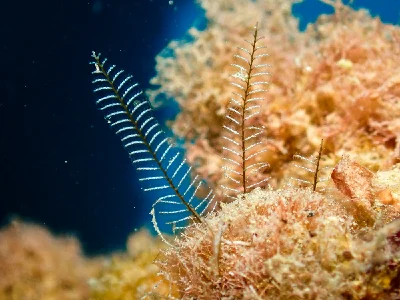


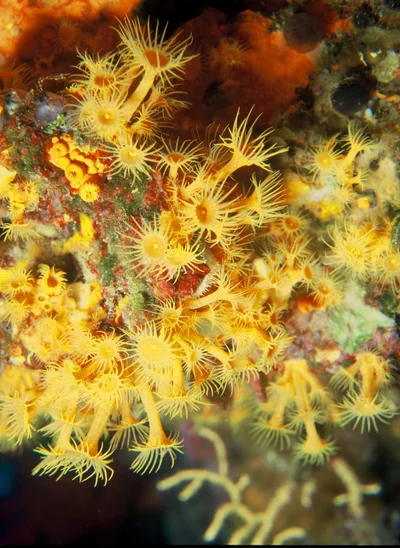
Other groups in Invertebrate
Nearby in the catalogue.



Last Update: August 23, 2026