
WhalesBalaenopteridae
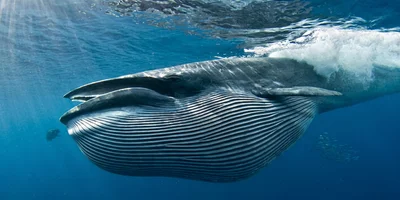
A rorqual eats by swallowing the sea. It accelerates into a krill swarm or a packed ball of small fish, opens its jaws past a right angle, and the pleated skin running from chin to navel unfolds like a bellows until the animal has taken in a volume of water that in the largest species weighs about as much as the whale itself. Then the mouth shuts and the throat squeezes the water back out.
What holds the food back is baleen: rows of plates hanging from the upper jaw, frayed along the inner edge into a coarse mat. It is not bone and not tooth. It is keratin, the same material as your fingernails and hair, and like a fingernail it grows continuously from the base because the working end wears away.
A lunge is fast, violent and effectively blind, and rorquals carry an instrument for it that no other animal has. In the joint at the tip of the lower jaw, where the two halves meet, sits a dense bundle of nerve endings that senses how far the jaw and the throat pleats have opened, feeding back the timing of the closure. It was only described in 2012, which is a fair measure of how little of a large whale has been watched from the inside.
Lunge feeding is expensive. It only pays where prey is packed densely enough to be worth the effort of the lunge, and it pays better the larger the mouth, which is the accepted explanation for why this family contains the largest animals that have ever lived.
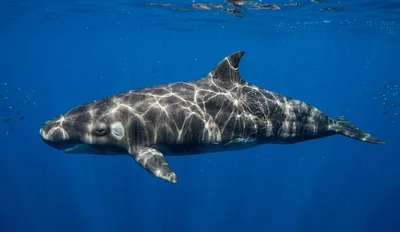
This is not their sea. The 🌊 Red Sea is narrow, warm and short of the dense cold-water swarms a lunge feeder needs, and records here are few and scattered. Bryde's whale is the most likely of them; Omura's whale, a small rorqual, was only recognized as a separate species in 2003 and remains barely known anywhere. Encounters come from boats in open water, not from dives. The dwarf sperm whale filed alongside them is not a rorqual at all but a small toothed whale, known here mostly from strandings.
- horizontal tail flukes
- very large size, typically over 5 meters long
- smooth body, no scales or external limbs
- characteristic spout of water or air from top of head
4 species in Whales


Other groups in Mammals
Nearby in the catalogue.


Last Update: August 23, 2026