
DolphinsDelphinidae
A dolphin assembles the world out of sound. The clicks are made in the nasal passages under the blowhole, not in the throat, and are focused forward through the melon, the fatty dome of the forehead, which works as an acoustic lens. The returning echo is not collected by an outer ear, because there is none; it enters through a thin panel at the back of the lower jaw and travels to the inner ear through a channel of fat inside the jawbone itself.
Sound passes through soft tissue and bounces off hard surfaces and air spaces, so what comes back is not a silhouette. A dolphin scanning a sand flat locates fish buried underneath it, and there is good reason to think that scanning another animal registers its skeleton and the air in its lungs. Darkness and murky water cost a dolphin almost nothing, and a pod can hunt at night as well as it hunts at noon.
Each animal invents a whistle for itself in its first months and keeps that whistle for the rest of its life. Others learn to copy it, and playback work has shown that a dolphin hearing a copy of its own whistle answers, while it ignores copies of other whistles. That is about as close to a name as anything outside human language gets.
The killer whale is in this family. So is the false killer whale. Orca is the largest dolphin there is, and the whale in both names is a leftover from whalers who sorted animals by size rather than by kinship.
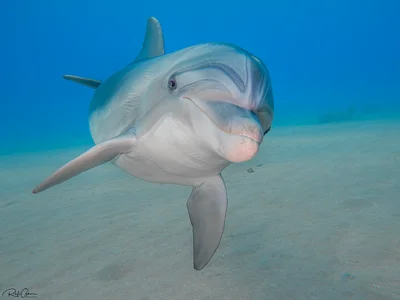
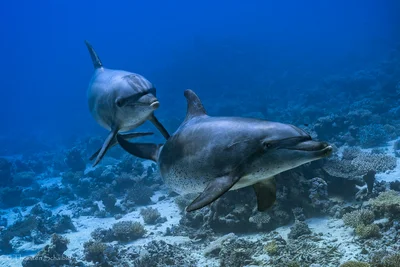
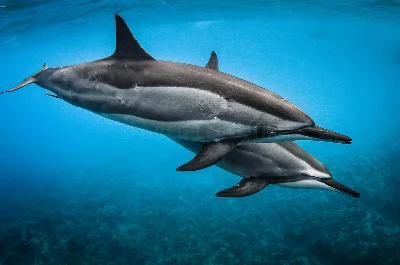
On this coast, spinner dolphins hunt offshore at night and spend the day resting inside a few shallow, sheltered lagoons, which is why a handful of named sites can more or less promise them while the rest of the sea cannot. Bottlenose are the ones that turn up along the reef walls and around boats. Whether an encounter happens is entirely the pod's decision, and a group that comes to the bow is usually there for the pressure wave rather than for the company.
- robust, torpedo-shaped body
- prominent dorsal fin
- grey upper body, lighter belly
- large size, over 1.3 meters long
- fast, agile swimming, often in social groups
8 species in Dolphins




Other groups in Mammals
Nearby in the catalogue.


Last Update: August 23, 2026