Inside the Sea Turtle Shell: Secrets of Ancient Ocean Survival Revealed

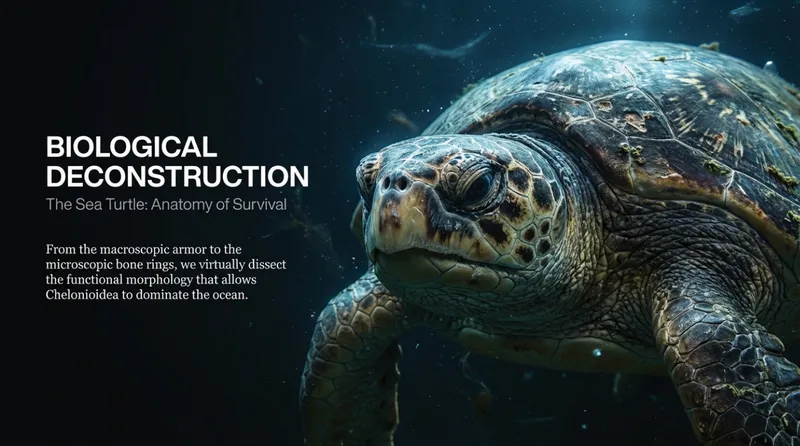
Sea turtles are among the most resilient travelers on Earth, navigating thousands of miles of open ocean with a grace that suggests they are timeless. But how do they survive, and how do we know how old they are? To find out, we have to look beneath the shell.
Sea turtles are a masterclass in functional morphology - which is just a fancy way of saying their bodies are perfectly built for their jobs. While they look like they haven’t changed in millions of years, every part of a sea turtle, from their heavy armor to the microscopic rings in their bones, is designed to help them dominate the ocean. To understand them, marine biologists perform "virtual dissections" to see how these ancient voyagers work from the inside out.
For scientists, these turtles are a bit of a mystery because they don't show their age on the outside. They don’t get grey hair or wrinkles like we do! To unlock their history, we have to look at their skeletons, which act like a secret diary of their lives spent at sea.
The Armor: A Sandwich Composite
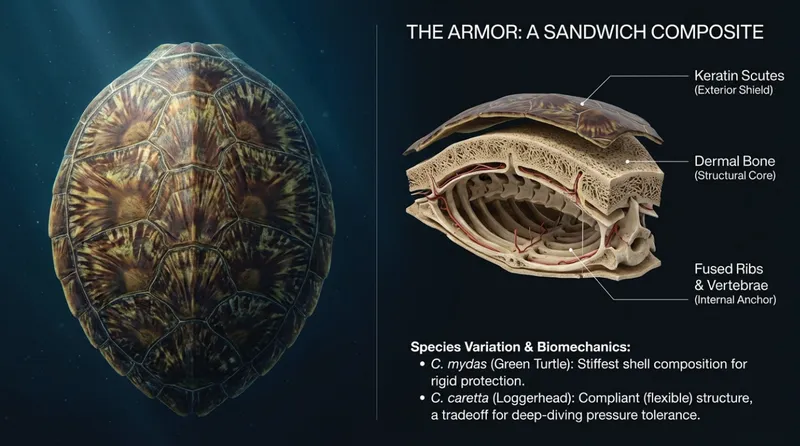
Think of a sea turtle's shell not as a single shield, but as a high-tech "sandwich." The top layer is made of keratin scutes (the same stuff as your fingernails), followed by a core of dermal bone, and finally an internal anchor where their ribs and spine are actually fused to the shell! This design is built for pressure. While a land turtle has a very stiff shell, sea turtles have "compliant" or slightly flexible shells. This allows them to dive deep without their armor cracking under the heavy weight of the ocean.
Different species have different "specs." For example, the Green Turtle has the stiffest, strongest shell for maximum protection - like a heavy tank. On the other hand, the Loggerhead has a more flexible shell, which is a clever trade-off that helps them handle the intense pressure of deep-sea diving.
The Cranial Vault: Built for Power
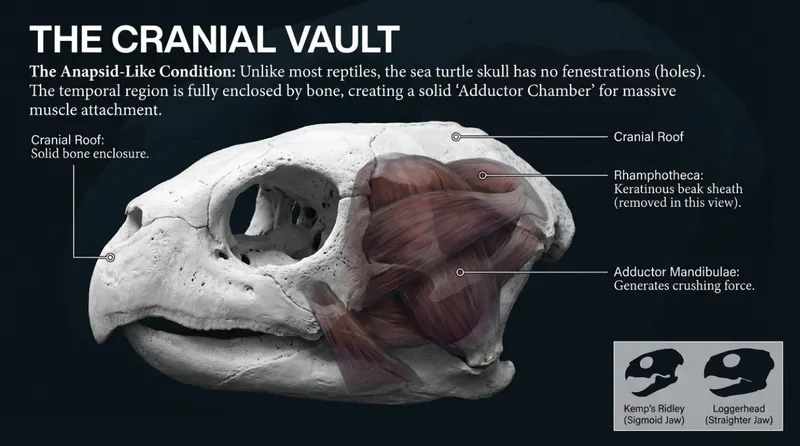
The skull of a sea turtle is very different from most reptiles. It is "Anapsid-like," meaning it has no extra holes or windows in the bone behind the eyes. This creates a solid "Adductor Chamber," which is essentially a giant room for massive jaw muscles. This solid bone enclosure protects the brain while allowing the turtle to generate enough crushing force to snap through tough seagrass or hard-shelled prey.
Even within this group, shapes vary. The Kemp’s Ridley has a "sigmoid" or curved jaw, while the Loggerhead has a much straighter, heavier jaw line. This "Cranial Vault" is their primary tool for feeding and defense, acting as a sturdy helmet for their most important sensory organs.
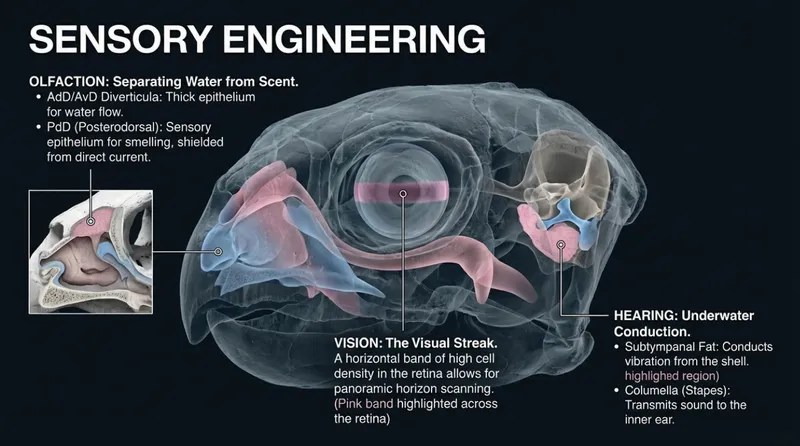
Sensory Engineering: Underwater High-Tech
Sea turtles "see" and "smell" the world in incredible ways. Inside their nose, they have special diverticula that separate water from scent, allowing them to track food across vast distances. Their eyes feature a "Visual Streak" - a horizontal band of high cell density in the retina. This gives them a panoramic view of the horizon, perfect for scanning the open ocean for predators or mates.
Hearing is just as cool. Instead of external ears, they use "Subtympanal Fat." This special layer of fat conducts vibrations directly from their shell and the surrounding water to their inner ear. It’s like their whole body is a giant microphone, helping them hear the low-frequency rumbles of the ocean.
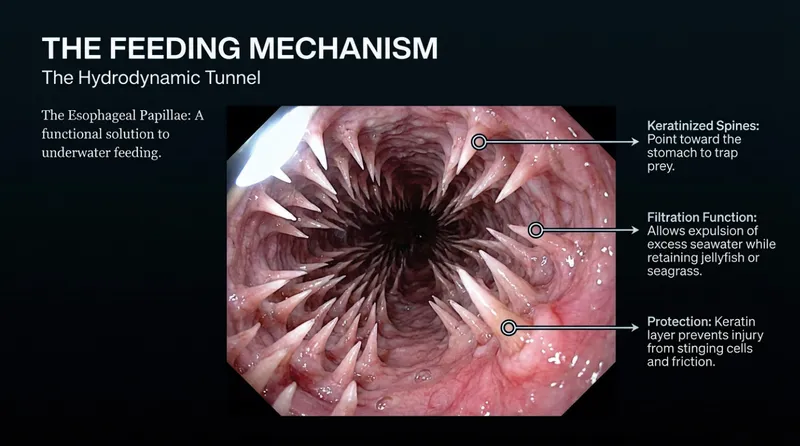
The Feeding Mechanism: The Hydrodynamic Tunnel
If you looked inside a sea turtle's throat, you might be scared! It is lined with "Esophageal Papillae," which look like sharp, white spikes. These are actually made of keratin and point toward the stomach. When a turtle swallows a jellyfish and a gulp of seawater, these spikes trap the food while the turtle "spits out" the excess salt water.
These spikes also protect the turtle's throat from the stinging cells of jellyfish. This "Hydrodynamic Tunnel" is an elegant evolutionary solution to the problem of eating underwater without swallowing the entire ocean or getting stung from the inside!
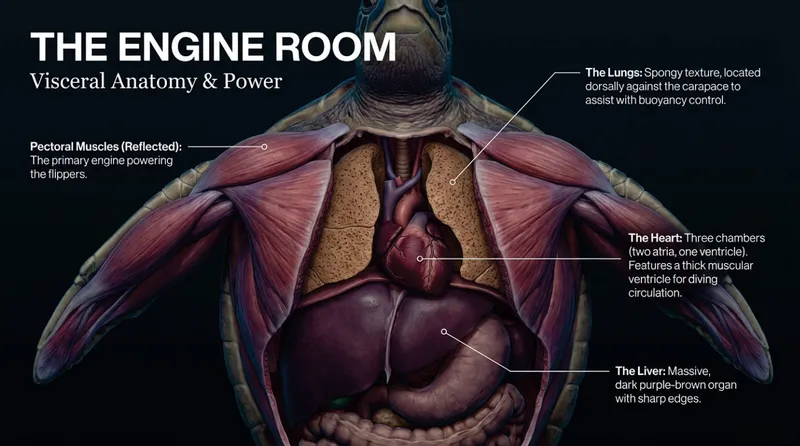
The Engine Room: Visceral Anatomy
Under the shell lies the "Engine Room." The massive pectoral muscles are the primary engines powering those long, graceful flippers. Because they need to stay underwater for a long time, their lungs are located dorsally (on their back) right against the shell. This position helps them stay balanced and provides extra buoyancy control, acting like a built-in life jacket.
Their heart has three chambers - two atria and one very thick, muscular ventricle. This specialized heart allows them to redirect blood flow during deep dives, conserving oxygen so they can stay submerged for hours. It’s a high-efficiency system designed for a life on the move.
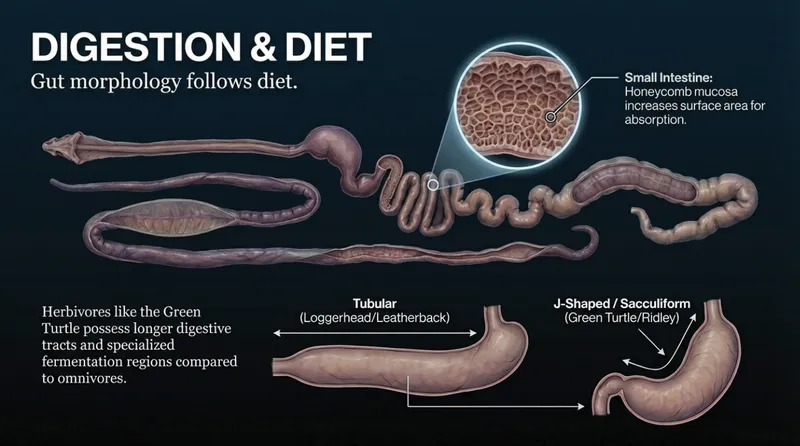
Digestion and Diet: You Are What You Eat
A turtle's gut tells the story of its diet. Herbivores like the Green Turtle have much longer digestive tracts and specialized "fermentation regions" to help them break down tough seagrass. Their small intestines have a "honeycomb" texture to increase the surface area, ensuring they absorb every bit of nutrition from their leafy meals.
The shape of the stomach changes too! Some turtles have tubular stomachs, while others have "J-shaped" or sac-like stomachs. These variations allow different species to occupy different niches in the ocean - some eating sponges, some eating jellyfish, and others grazing on the underwater meadows of the Red Sea.
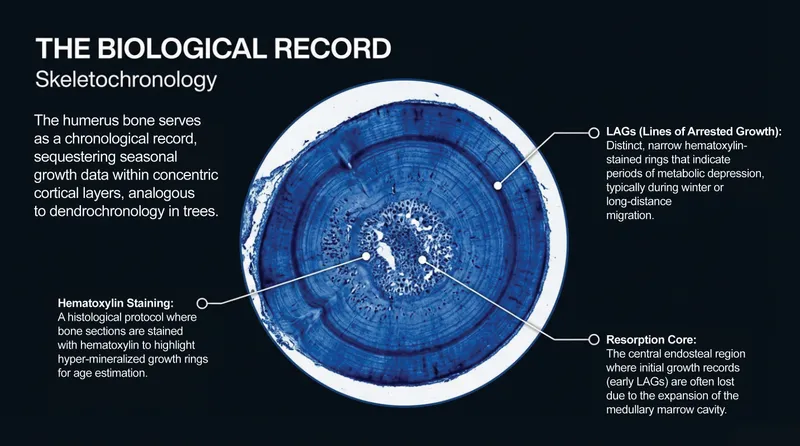
The Biological Record: Turtles Have "Tree Rings"
Much like an ancient oak tree, a sea turtle’s life story is etched into its bones. This science is called Skeletochronology. By looking at a cross-section of the humerus (the flipper bone), scientists can see concentric rings. Each ring represents a year of growth. The dark, narrow rings are called LAGs (Lines of Arrested Growth), which happen during winter or long migrations when the turtle isn't growing much.
To see these "clocks," scientists have to "slow-cook" the bones to clean them, then treat them with a blue dye called hematoxylin. This makes the layers pop out under a microscope. While most turtles keep these records in their flippers, the Leatherback turtle is so unique that its flipper rings disappear! To find their age, scientists have to look at tiny bones inside their eyes called scleral ossicles.
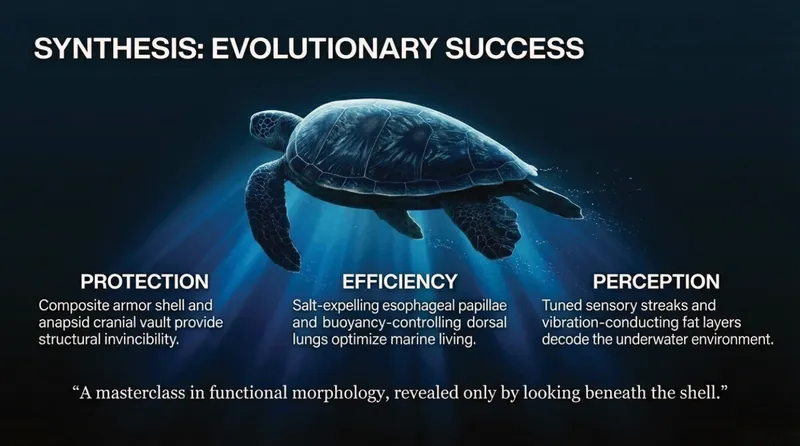
Synthesis: Evolutionary Success
Everything we’ve seen - the sandwich-armor shell, the salt-expelling throat spikes, the vibration-conducting fat, and the secret bone clocks - comes together to create one of nature’s most successful designs. Sea turtles don't just survive in the ocean; they dominate it.
By studying these "masterclasses in functional morphology," we learn how to better protect them. Knowing how fast they grow and how long they live helps us predict if their populations are healthy. The next time you see a sea turtle gliding through the water, remember: there is a world of high-tech engineering hidden just beneath that beautiful shell!
PADI Divemaster and underwater storyteller with over 7 years of hands-on Red Sea diving experience, documenting marine life, mapping dive sites, and promoting responsible ocean conservation.