
MolluscsMollusca
An octopus, an oyster and a garden snail are the same kind of animal. Molluscs are the second largest group in the animal kingdom after the arthropods, and nothing about their shapes holds them together: a clam is a filter with no head, a cone snail is a venomous hunter, an octopus solves puzzles. What unites them is a set of parts, not a silhouette.
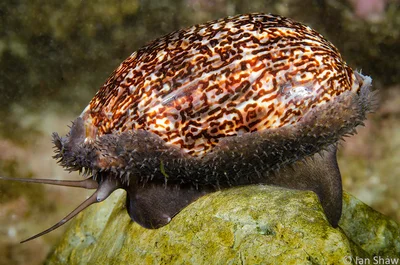
The first part is the mantle, a sheet of tissue draped over the body that secretes shell. A mollusc shell is not a skeleton and it is not shed and regrown like a crab's: it is added at the open edge, ring by ring, so the animal carries every stage of its own growth on its back and can never swap it for a bigger one. Break it and the mantle patches it from the inside.
The second part is the radula, and it is the invention that made the phylum. It is a ribbon of teeth on a conveyor, drawn over a stiff base and licked back and forth against food, with worn teeth falling off the front and new rows pushed up from behind for the whole of the animal's life. The shape of the teeth is the diet: rakes for scraping algae off rock, blades for cutting weed, a drill for boring through another mollusc's shell. The bivalves are the exception. They gave up the radula and the head with it, and let their gills do the feeding.
That toolkit produced a snail that fires harpoons, slugs that run on stolen chloroplasts, and animals with eyes set into their own armor. On a 🌊 Red Sea reef most of them work at night: the shelled snails leave plowed tracks across the sand by morning, the slugs sit out on the algae they eat, and the clams are the ones you have already looked at without seeing, built into the coral with nothing showing but a line of colored mantle.
- unsegmented body, often appearing soft
- many carry an external shell of one or two pieces
- broad muscular foot used to crawl, burrow or cling
- movement slow, or none at all where the animal is fixed in place
Browse by category






Other groups in Invertebrate
Nearby in the catalogue.



Last Update: August 23, 2026