
EchinodermsEchinodermata
Nothing else in the sea is built on five.
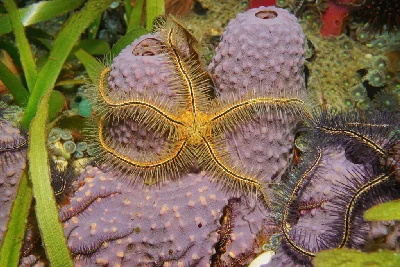
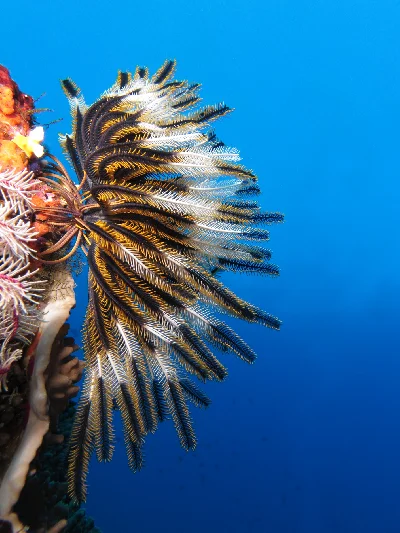
A sea star, a sea urchin, a sea cucumber, a brittle star and a feather star look like five different animals and are one animal rearranged: a body laid out in five identical parts around a center, with no head, no front and no left or right. Even the odd shapes keep the count. A sea cucumber is the same plan stretched along its axis and laid on one side, and the five rows of tube feet still run the length of it. None of them starts out that way, though. An echinoderm hatches as a small bilateral larva with a left and a right, swims in the plankton like anything else, and then settles, takes that body apart and rebuilds itself around a five-part axis. The animal you find on the reef is the second draft.
It runs on seawater. In place of blood there is a water vascular system: seawater enters through a sieve plate on the surface, the pale button you can see on the back of most sea stars, fills a ring canal around the mouth and branches into the arms, where it drives thousands of tube feet. Each foot is a hydraulic cylinder with a muscle bulb behind it. They are slow, they work in relays and they never tire, which is how an animal with no jaws opens a clam.
There is no brain, only a nerve ring around the mouth and a cord down each arm. Turn a sea star over and you can watch the arms disagree, pulling against each other until enough of them choose the same direction. The skin settles arguments of its own: echinoderm connective tissue shifts from rigid to nearly liquid and back under nervous control, without muscle, which is how a brittle star drops an arm cleanly and how a sea cucumber pours itself into a crack and then sets solid again.
All of them are marine. Not one species in the phylum has ever managed fresh water or dry land. And the group sits on an unexpected branch of the animal tree: the earliest divisions between animals are drawn by what the embryo does with its first opening, and by that test an urchin went the same way vertebrates did, while insects, crabs and snails all went the other. The five-part animal on the rock is on our side of that split.
- body parts arranged radially around a central point
- no distinct head or tail
- body often covered with spines, plates, or leathery texture
- slow, deliberate movement along the substrate
Browse by category



Other groups in Invertebrate
Nearby in the catalogue.


Last Update: August 23, 2026