The Living Torpedo: Nature’s High-Voltage Predator

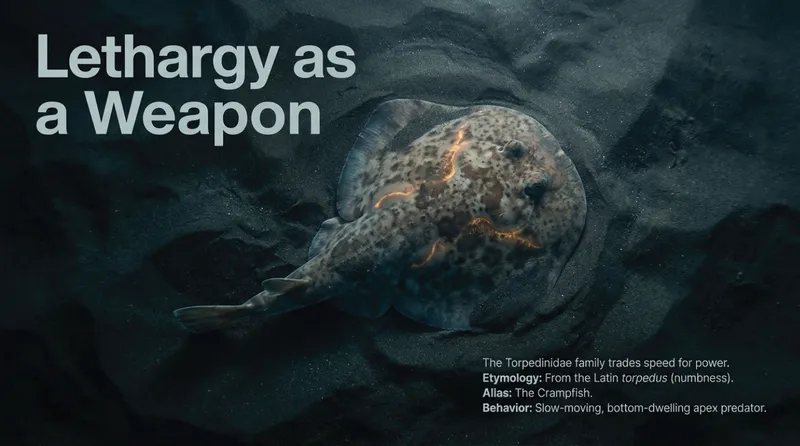
Welcome to the world of the Torpedo Ray, an underwater marvel that proves you don't need speed to be an apex predator. Often referred to as the "Crampfish," this slow-moving bottom dweller belongs to the Torpedinidae family. The family name is actually derived from the Latin word torpedus, which literally translates to "numbness". While other marine predators rely on swift chases and agility to catch their meals, the Torpedo Ray took a completely different evolutionary path, trading physical speed for raw, electric power. Let's dive deep into the biology of this living battery.
The Twin Generators
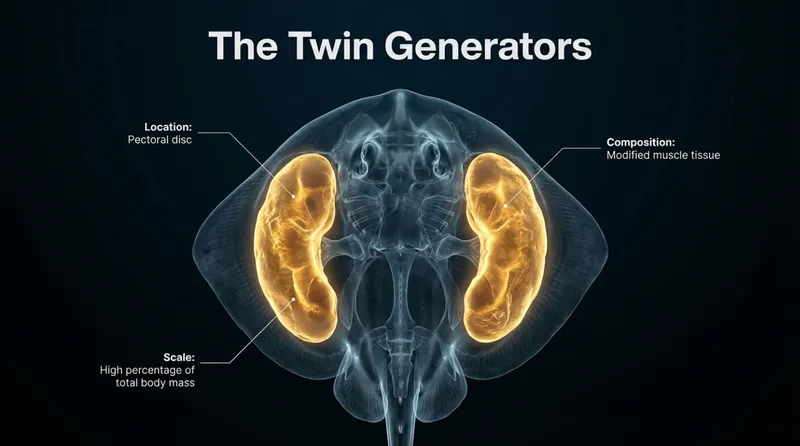
At first glance, the Torpedo Ray might look like an ordinary flat fish, but hidden within its pectoral disc are two massive power plants. These twin generators are not just small accessory organs; they are incredibly dense and take up a remarkably high percentage of the ray's total body mass.
Fascinatingly, these electric organs are made entirely of modified muscle tissue. Over millions of years of evolution, these specific muscles lost their ability to contract for movement, transforming instead into dedicated biological batteries capable of producing powerful electricity.
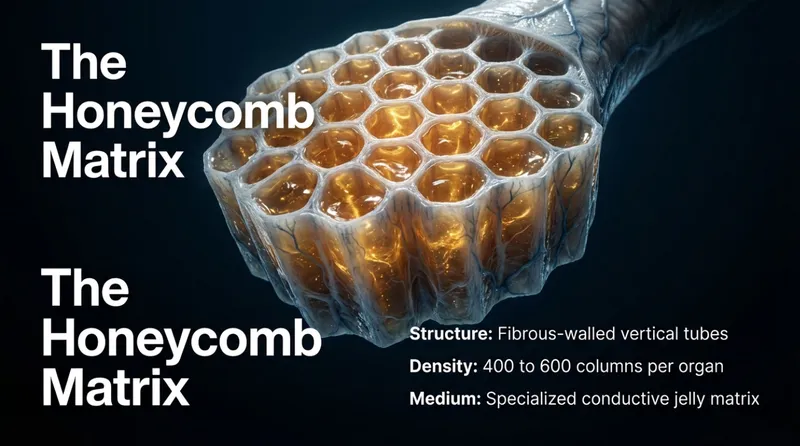
The Honeycomb Matrix
If we were to look inside these organic generators, their structure closely resembles a complex honeycomb matrix. The organ is built from vertical tubes that feature tough, fibrous walls.
Each of the two electric organs is densely packed with 400 to 600 of these vertical columns. To help conduct the electricity as efficiently as possible, these tubes are filled with a specialized, highly conductive jelly matrix. This natural gel ensures that the electrical charge flows smoothly and quickly when the ray needs it most.
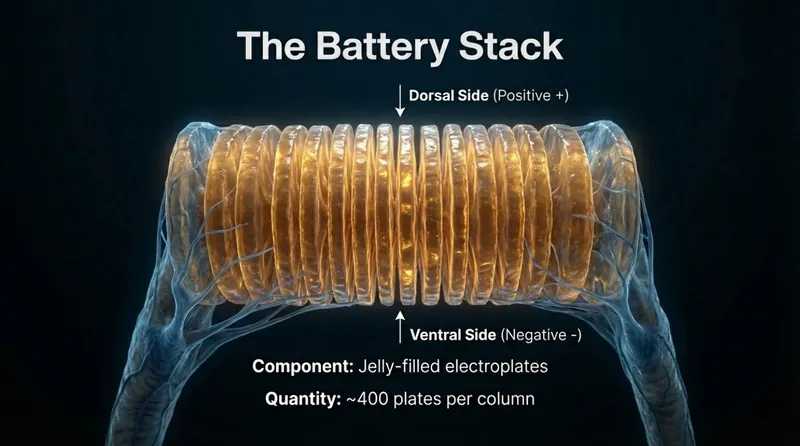
The Battery Stack
Inside every single vertical column is a biological "battery stack" made of tiny, jelly-filled discs known as electroplates. There are approximately 400 of these plates neatly stacked within each column.
Just like a standard battery you would put in a flashlight, the Torpedo Ray has defined electrical poles. The top (dorsal) side of the ray carries a positive (+) charge, while the belly (ventral) side carries a negative (-) charge. When all these microscopic plates fire at exactly the same time, they create a massive electrical wave.
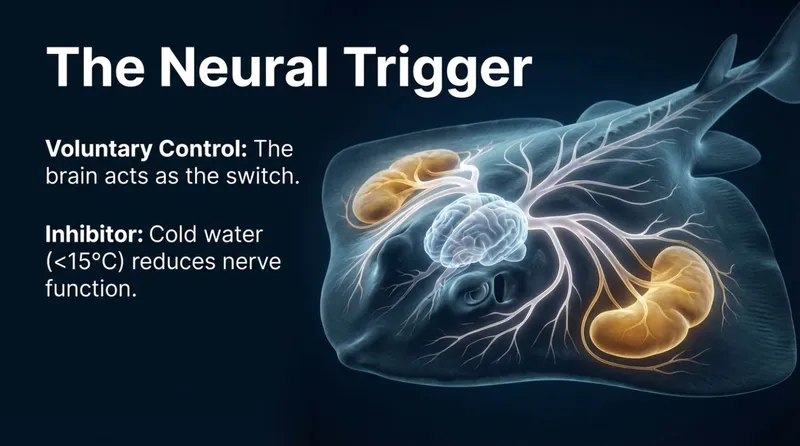
The Neural Trigger
How does the ray safely control this incredible power? The answer lies in its nervous system. The ray has complete voluntary control over its electric organs, using its brain as a direct biological switch to trigger the shock.
However, because this system relies entirely on nerve signals, the environment plays a crucial role in the ray's abilities. Cold water acts as a natural inhibitor; if the water temperature drops below 15°C, it significantly reduces the ray's nerve function and slows down its ability to fire its weapons.
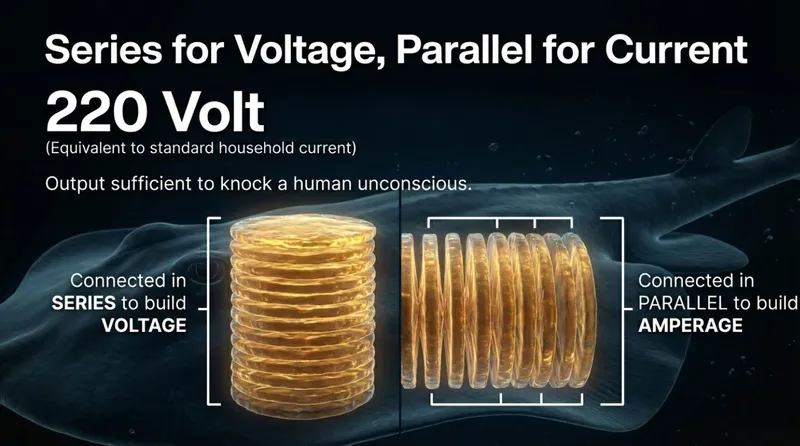
Wired for Maximum Output
The natural engineering of this biological battery is truly astonishing. The electroplates within each column are connected in a "series" circuit, which allows the animal to build up a high voltage. Meanwhile, the hundreds of separate columns are connected in "parallel," which builds up the amperage, or the actual flow and weight of the electric current.
This brilliant dual-wiring system allows the Torpedo Ray to generate an incredible 220 volts of electricity - equivalent to the standard electrical current flowing through the wall outlets in a house. This output is so powerful that a full discharge is sufficient to knock a human adult completely unconscious.
The Strike Dynamics
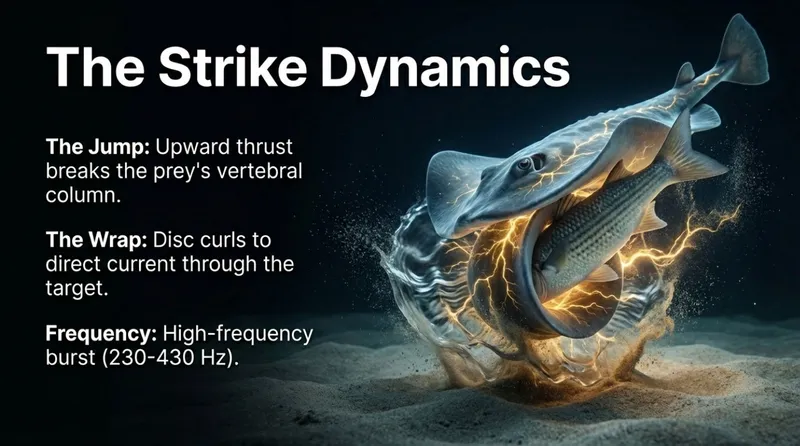
When a Torpedo Ray hunts, it executes a precise, lightning-fast, and deadly sequence. The strike begins with "The Jump," a sudden upward physical thrust combined with a high-frequency electrical burst of 230 to 430 Hz. This shock is so sudden and intense that it causes a tetanic contraction, often breaking the prey's vertebral column instantly.
To maximize the efficiency of the shock, the ray uses a maneuver called "The Wrap." It actively curls its pectoral disc around the stunned fish, ensuring that the full force of the electrical current is directed straight through its target.
The Metabolic Cost
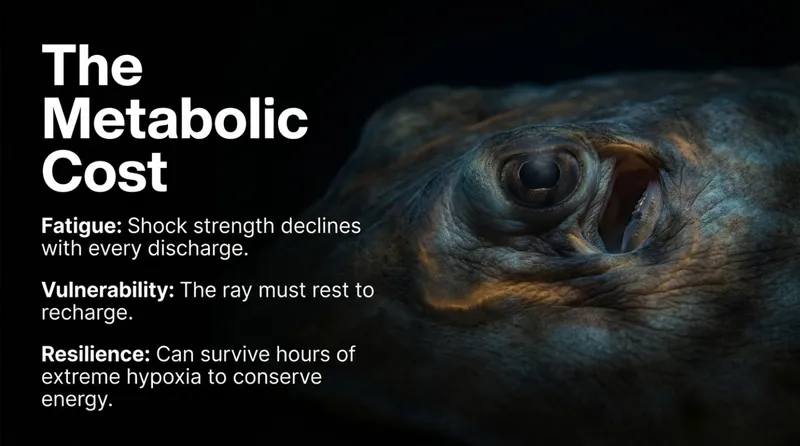
Producing such explosive, high-voltage power comes with a heavy metabolic cost to the animal. Generating electricity is exhausting, and the ray's shock strength noticeably declines with every successive discharge, leading to physical fatigue. After a hunt or defending itself from a predator, the ray becomes highly vulnerable and must rest quietly to recharge its internal batteries.
To survive these low-energy periods on the ocean floor, the ray has evolved incredible physical resilience. It can survive for hours in a state of extreme hypoxia (a severe lack of oxygen), slowing down its bodily functions to conserve energy while it recharges.
The Original Anesthetic
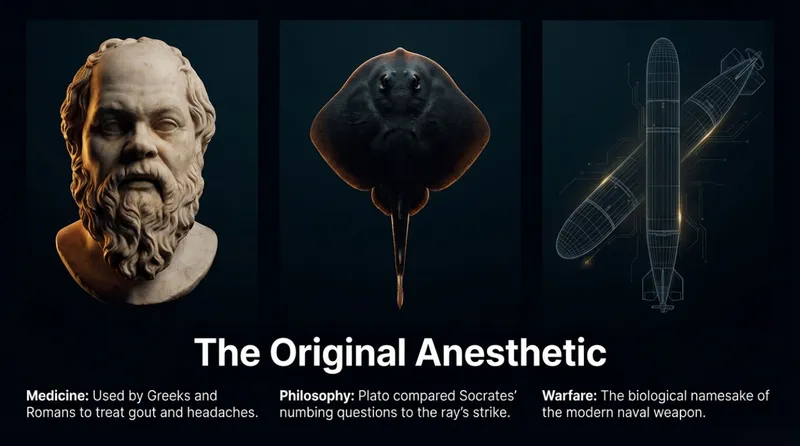
Long before the invention of modern medicine or electrical grids, ancient humans were well aware of the Torpedo Ray's unique power. The ancient Greeks and Romans actually used live rays as a primitive form of medicine, applying them to patients to deliver mild shocks to treat severe headaches and gout.
The ray even made its way into classical philosophy. The philosopher Plato famously compared his teacher, Socrates, to a Torpedo Ray, writing that Socrates' difficult and probing questions stung people into a state of numbness and mental confusion. Furthermore, humanity was so impressed by this creature that the modern naval weapon - the torpedo - was biologically named directly after this fish, not the other way around.
A Perfect Biological Machine
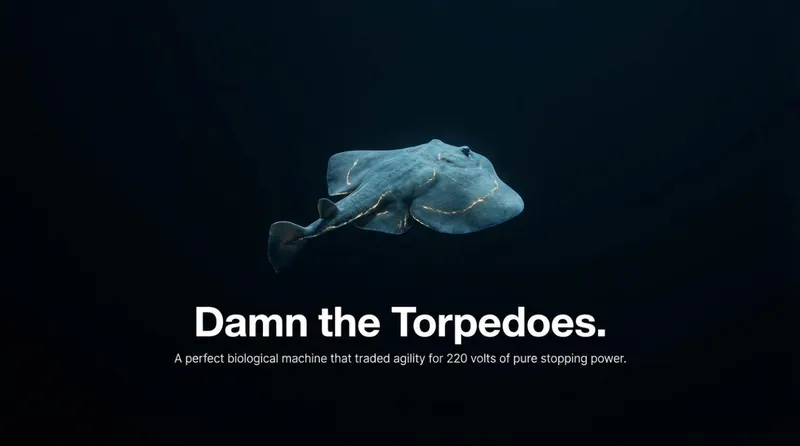
In the end, the Torpedo Ray is a perfect biological machine. It is a master of the deep that successfully traded physical agility for 220 volts of pure, unparalleled stopping power. So, the next time you hear the famous naval phrase, "Damn the torpedoes," you'll know exactly which shocking ocean creature inspired it all.
PADI Divemaster and underwater storyteller with over 7 years of hands-on Red Sea diving experience, documenting marine life, mapping dive sites, and promoting responsible ocean conservation.