The Mantis Shrimp: Nature’s Supersonic Boxer and Optical Genius

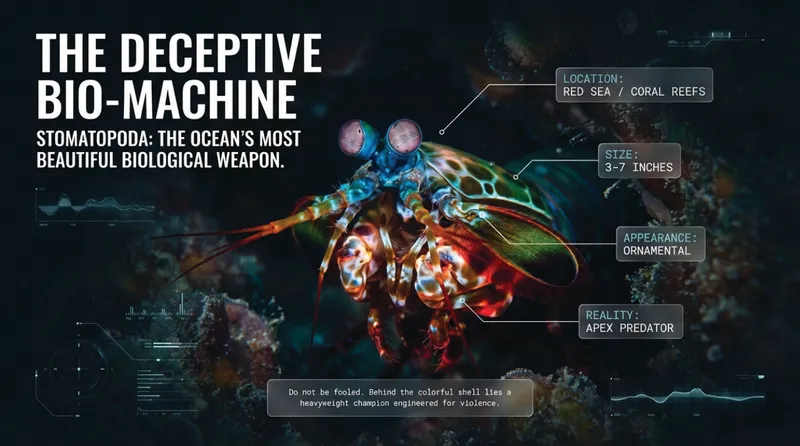
If you carefully scan the sandy rubble and coral crevices during a dive in the Red Sea, you might catch a glimpse of a brightly colored, lobster-like creature darting into a burrow. At just a few inches long, the Mantis Shrimp (Stomatopoda) looks like a harmless, beautiful aquarium pet.
Do not be fooled. You are looking at one of the most highly engineered, terrifyingly efficient predators on planet Earth.
Behind its colorful shell lies a biological weapon that breaks the laws of physics, paired with an optical system so advanced that human engineers are still trying to copy it. Let’s dive into the anatomy of the ocean's ultimate heavyweight champion.
The Weapon: A Biological .22 Caliber Bullet
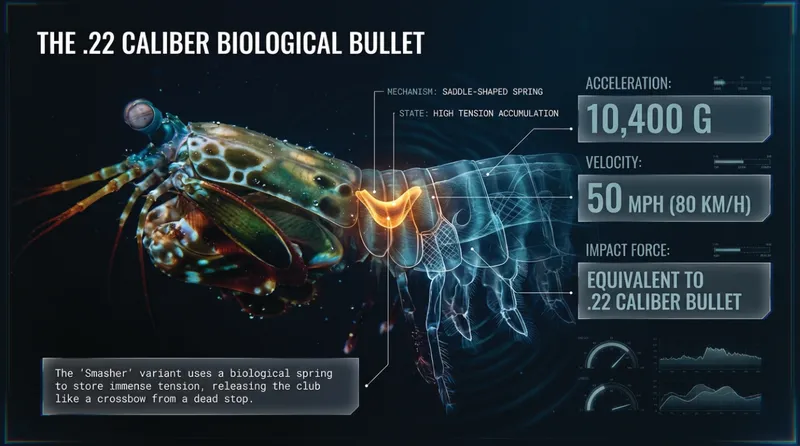
Mantis shrimp are generally divided into two categories based on their hunting style: "spearers" (who impale soft prey) and "smashers" (who crush hard shells). The smashers are the ones that hold the ocean's most extreme records.
Their front appendages are modified into heavy, calcified "dactyl clubs." When a mantis shrimp spots a crab or a snail, it releases these clubs with mind-bending speed. A biological spring mechanism, shaped like a saddle, stores immense tension. When released, the club accelerates at 10,400 g - reaching speeds of 50 mph (80 km/h) from a dead stop. That is the exact acceleration of a .22 caliber bullet leaving a gun barrel.
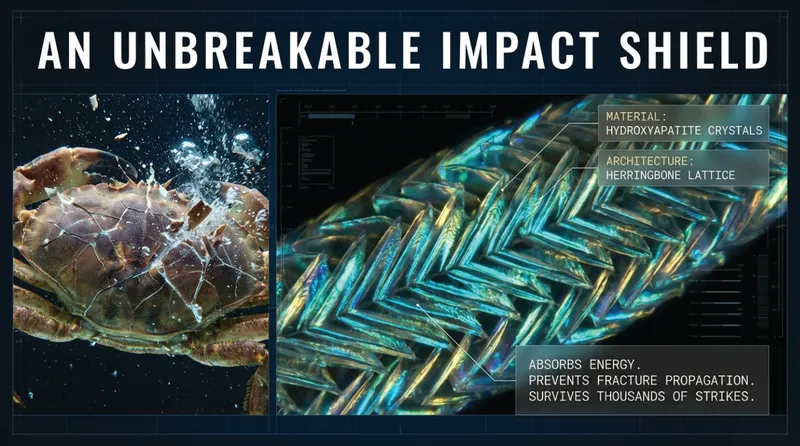
But how does their own arm survive an impact that easily cracks heavy clam shells and aquarium glass? Their clubs are coated in a specialized, shock-absorbing structure of hydroxyapatite crystals, arranged in a herringbone pattern that prevents micro-fractures from spreading.
Cavitation: Boiling Water and Flashes of Light
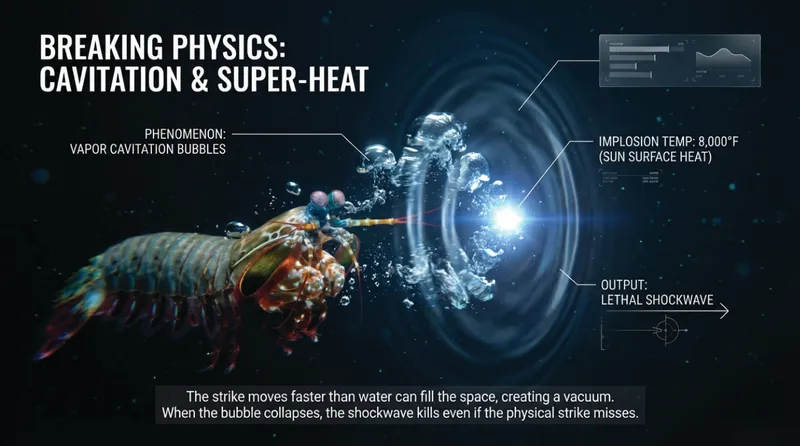
The mantis shrimp strikes so fast that the laws of fluid dynamics break down. As the club punches through the water, it moves faster than the surrounding water can fill the space behind it. This literally tears the water apart, creating a boiling vacuum cavity known as a cavitation bubble.
When this vacuum bubble collapses a microsecond later, the implosion releases a massive underwater shockwave. The forces are so extreme that the implosion generates temperatures approaching 8,000°F (about 4,400°C) - nearly as hot as the surface of the sun! It also emits a tiny, brief flash of light, a phenomenon called sonoluminescence.
Because of this shockwave, the mantis shrimp doesn't even need to hit its target to kill it. If the physical club misses by a fraction of an inch, the resulting cavitation shockwave is powerful enough to stun or instantly kill the prey anyway.
The Eyes: A 16-Channel Alien Vision System
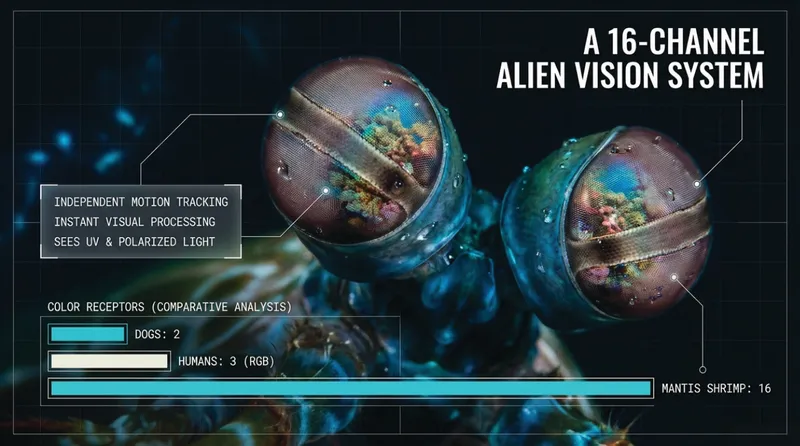
If you think their punch is impressive, look at their eyes. Mounted on mobile stalks, each eye can move completely independently, scanning the reef for danger and dinner.
Humans have a decent visual system. We have three types of color-receptive cones in our eyes (Red, Green, and Blue), which blend together to create every color we see. Dogs only have two.
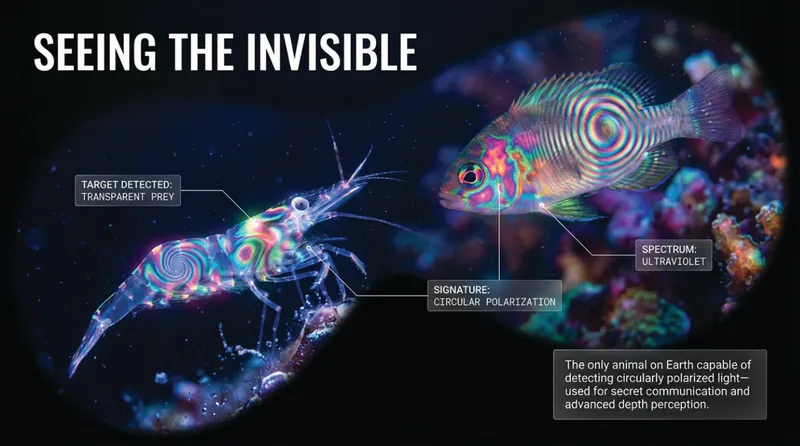
The mantis shrimp? It has up to 16 types of photoreceptor cells. Not only do they see a rainbow of colors we cannot even begin to comprehend, but they can also see deep into the ultraviolet (UV) spectrum. Furthermore, they are the only animals on Earth known to detect circularly polarized light - a type of light wave that spirals as it travels. Researchers believe this unique vision allows them to see completely transparent prey, communicate with each other using secret light signals reflected off their shells, and process visual information instantly without wasting brain power.
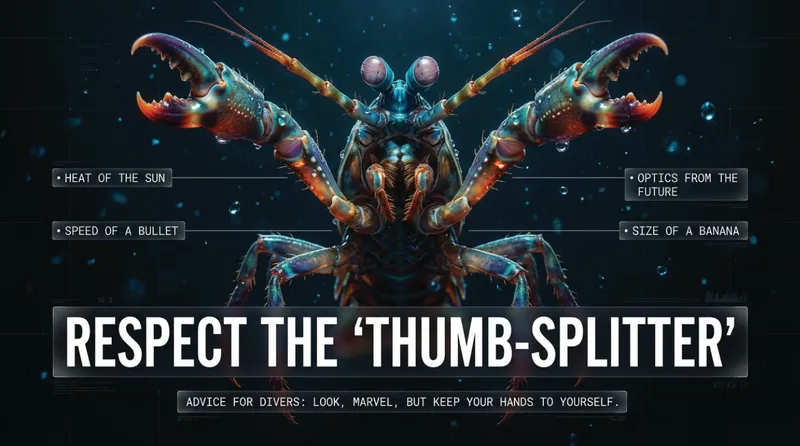
Respect the "Thumb-Splitter"
The mantis shrimp is a masterclass in extreme evolution. It packs the heat of the sun, the speed of a bullet, and an optical system from the future into a body the size of a banana.
So, the next time you are hovering over a patch of rubble on a Red Sea reef, keep your eyes peeled for a pair of complex eyes watching you from a hole. Just remember the golden rule of local fishermen, who call this animal the "thumb-splitter": look, marvel, but keep your hands to yourself!
PADI Divemaster and underwater storyteller with over 7 years of hands-on Red Sea diving experience, documenting marine life, mapping dive sites, and promoting responsible ocean conservation.