Sea Cucumbers' Shocking Superpowers: Ejecting Guts, Liquefying Skin, and Ultimate Ocean Survival Secrets

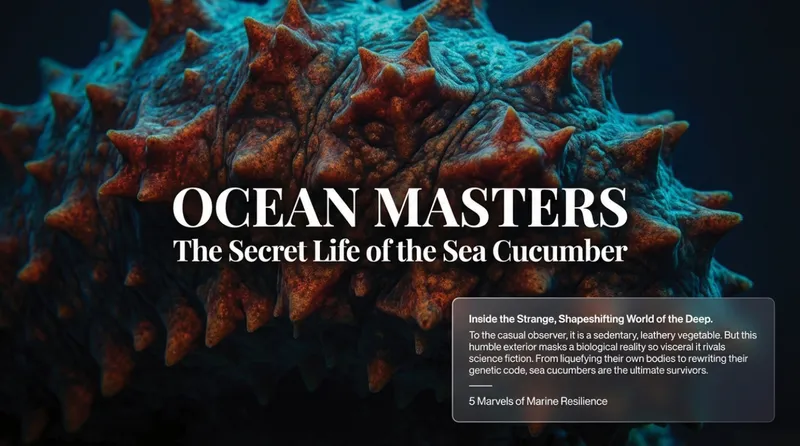
To the casual observer, a sea cucumber is a sedentary, leathery vegetable - a lump of ocean floor décor with the charisma of a bruised zucchini. But this humble exterior masks a biological reality so visceral it sounds like a dispatch from a distant galaxy. These are the "Ocean Masters," creatures that can liquefy their own skin to vanish into rock crevices, rewrite their internal chemistry to survive heatwaves, and even vomit their own skeletons to repel an enemy. By looking closer at recent marine research, we discover that these underdogs are the ultimate survivors of the deep.
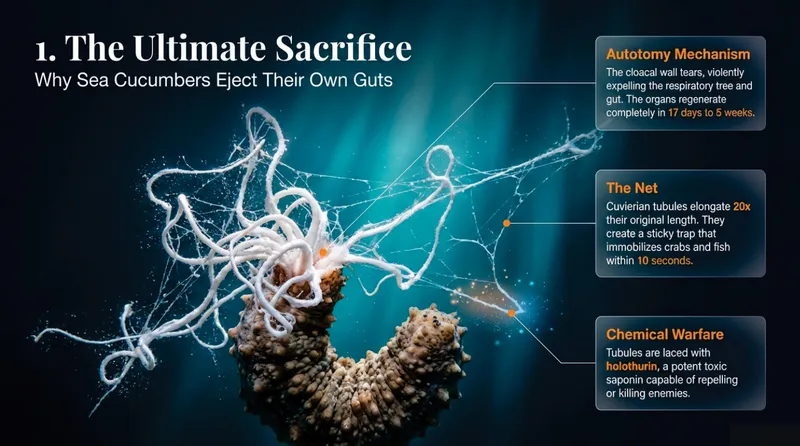
1. The Ultimate Sacrifice: Why Sea Cucumbers Eject Their Own Guts
In the world of defensive maneuvers, few strategies are as high-stakes as evisceration. When a sea cucumber is harassed by a crab or a predatory fish, it doesn't just flee; it undergoes a process of autotomy that is both horrific and hypnotic.
The process begins at the "introvert" - the dexterous, extensible anterior portion of its body. As the creature contracts its body wall muscles, internal pressure builds until the introvert swells like an overinflated balloon. Eventually, the tissue ruptures, and the sea cucumber expels its gut, tentacles, and sometimes its respiratory trees through the gap. This "vomited skeleton" serves as a distracting meal or a sticky trap for the predator.
While losing one’s internal organs sounds fatal, sea cucumbers are masters of regeneration. Holothuria leucospilota can regrow its complex internal systems in just 17 days, while Holothuria forskali completes the feat in about five weeks. Some species even deploy specialized "sticky bombs" during the process:
Several hundred Cuvierian tubules (part of the respiratory tree) may be expelled. Water from the respiratory tree is forced into these tubules causing a rapid expansion and they elongate by up to 20 times their original length. They have great tensile strength and become sticky when they encounter any object. The adhesive is unique among marine invertebrates and a firm grip is obtained in under ten seconds. - Evisceration (autotomy) - Wikipedia
2. Genetic Shape-Shifting: How Temperature Flips a Biological Switch
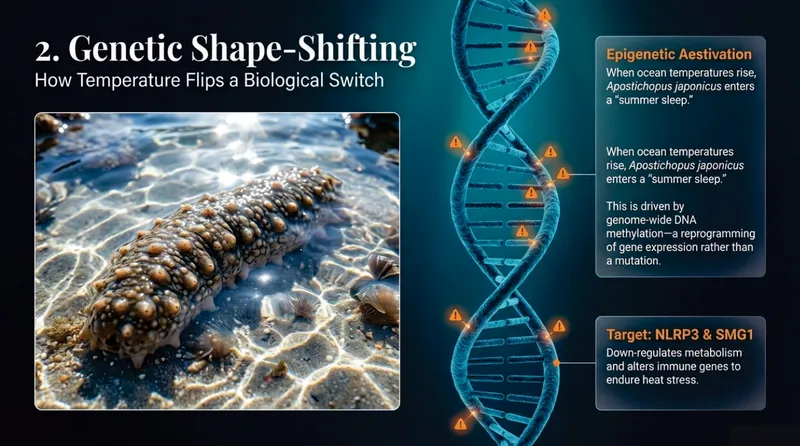
Beyond their physical defenses, sea cucumbers possess a hidden superpower: the ability to change how their genes are expressed without altering their DNA sequence. This is known as epigenetics. Think of DNA as a library of instructions and DNA methylation as the chemical "volume knobs" that determine which instructions are shouted and which are whispered.
Recent studies on the species Apostichopus japonicus show how these knobs turn in response to warming oceans. When water temperatures exceed the creature’s preferred range (0-25°C), it enters aestivation, a state of summer hibernation, to avoid physiological decline or death. To facilitate this survival pivot, the sea cucumber "rewrites" its chemistry:
- NLRP3 (Immunity): Methylation levels of this gene increase under temperature stress, effectively turning down the "volume" on inflammatory responses to maintain a healthy state.
- SMG1 (Cell Activity): Methylation levels decrease, allowing the creature to regulate cell activity and apoptosis. This helps the sea cucumber physically "shrink" and enter a low-energy state, preserving its life until the waters cool.
3. Living Liquid: The Magic of Catch Connective Tissue
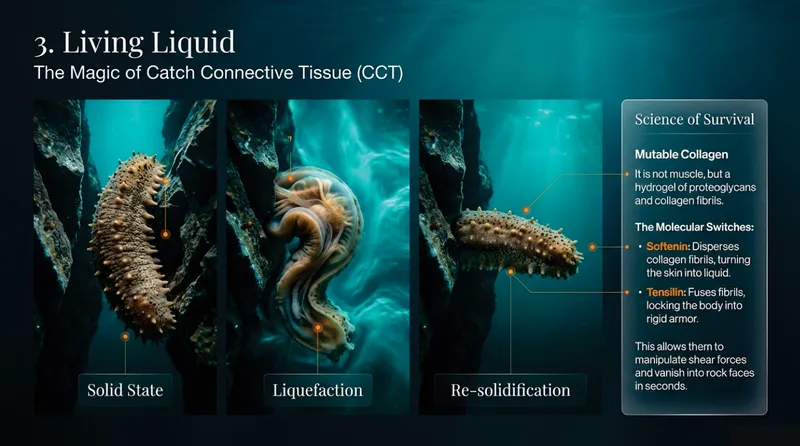
The most startling physical trait of the sea cucumber is its mutable collagenous tissue (MCT). Within seconds, a sea cucumber can transform its dermis from a rigid, "locked" state to a near-liquid form. This allows it to flow into tiny rock crevices that would crush a more rigid animal, then "lock" its collagen to become as hard as stone, making it impossible for a predator to extract.
This transformation is governed by the number of microscopic cross-bridges (or arms) that connect collagen fibrils. When these arms multiply, they create a continuous network that stiffens the entire animal.
|
State
|
Mechanical Description
|
Biological Trigger
|
|---|---|---|
|
Soft (Sa) |
Low stiffness; allows for "liquefying" and squeezing through gaps. |
Inhibited by softenin; triggered by repetitive strain. |
|
Standard (Sb) |
The basal, non-stimulated "resting" state. |
Tensilin (increases cohesive forces between fibrils). |
|
Stiff (Sc) |
Highest stiffness; the "locked" state with no toe region. |
Novel Stiffening Factor (NSF) and water exudation. |
The transition to the stiffest state (Sc) is particularly unique; it involves the physical exudation of water, causing the tissue to shrink and the collagen fibrils to pack closer together, maximizing the number of resistive cross-bridges.
4. The Sea Apple: Inflation as a Travel Strategy
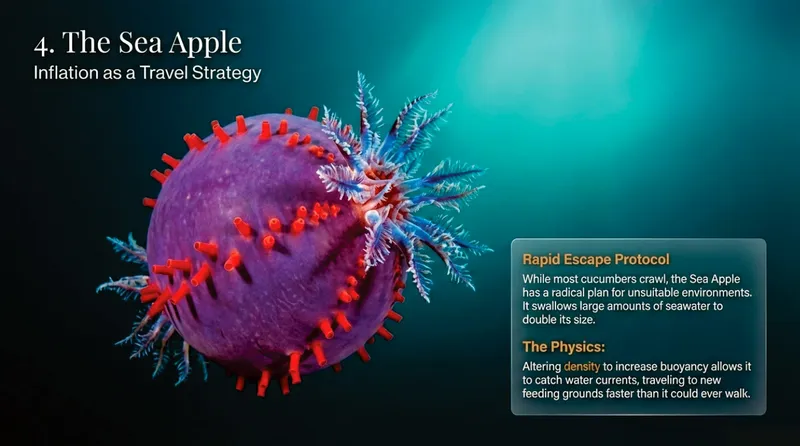
While most sea cucumbers are drab, the Sea Apple (Pseudocolochirus) is a vibrant exception. The Australian species is a psychedelic marvel, sporting a primarily purple body, bright red feet, and feathery tentacles of purple and white.
Because the Sea Apple is an ovate filter feeder, it lacks the streamlined shape for fast crawling. Instead, it has mastered "current surfing." When it finds itself in an unsuitable environment, it consumes massive amounts of seawater to swell to nearly double its size. This dramatic inflation makes the creature buoyant enough to be lifted by water currents, allowing it to tumble and float to a new home much faster than its tube feet could ever carry it. However, this beauty is dangerous; the Sea Apple contains holothurin, a toxic saponin that can poison entire aquariums if the creature is harassed or stressed.
5. Vacuum Cleaners of the Deep: The Ecosystem Recyclers
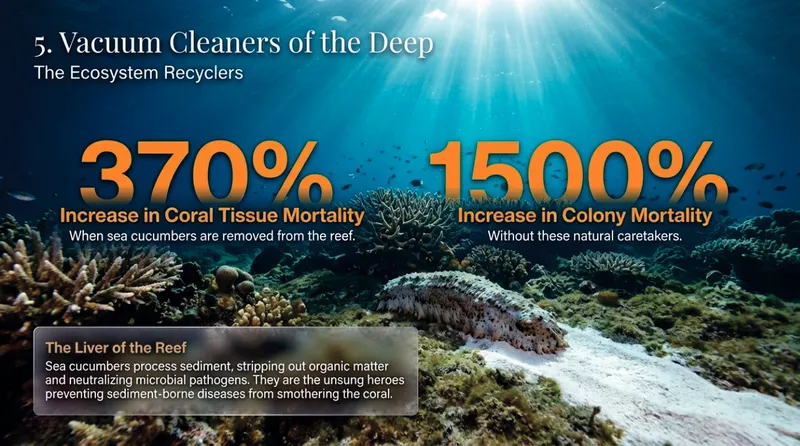
Individual marvels aside, sea cucumbers are the unsung heroes of the global ocean. Often called "nutrient factories," they act as massive biological vacuum cleaners. By filtering vast quantities of sediment and breaking down organic matter, they recycle essential nutrients back into the food chain for primary producers.
Without these "bioprocessors," the seabed would struggle to process waste, leading to stagnant, barren ecosystems. This makes the current trend of overfishing - often for the high-demand medicinal markets in China - a threat to the very foundation of marine life. If the sea cucumbers disappear, the entire sea ecosystem and food chain risk turning into an underwater desert.
Conclusion: A Final Thought on Resilience
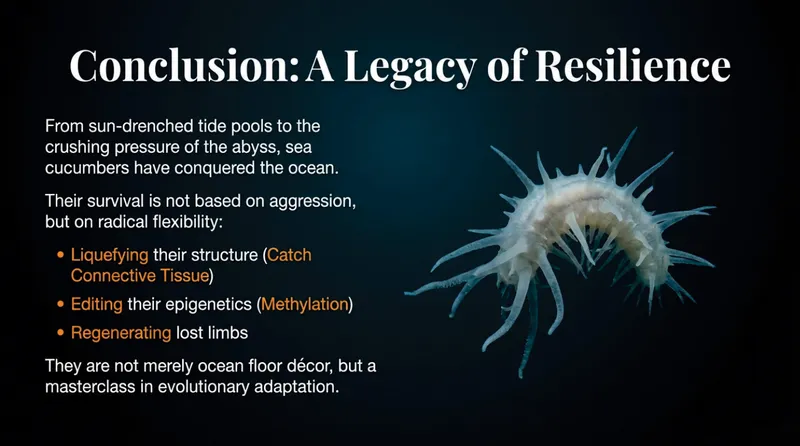
The sea cucumber is far from a passive lump; it is a masterpiece of biological resilience. From the mechanical "arms" that lock its skin to the epigenetic switches that manage heat stress, it is an expert at navigating a changing world. As we face a future of rapidly warming oceans, we must ask: In an era of climate instability, could the sea cucumber’s ability to rewrite its own genetic expression be the ultimate blueprint for survival?
PADI Divemaster and underwater storyteller with over 7 years of hands-on Red Sea diving experience, documenting marine life, mapping dive sites, and promoting responsible ocean conservation.