Red Sea Lionfish: Stunning Beauty, Killer Biology, and the Ultimate Reef Predator Divers Must Know

Picture this: you're gliding through the crystal waters of the Red Sea, and there it is - a slow-moving marvel of feathers and stripes, like a living feather duster with attitude. To the newbie diver, the Common Lionfish, or Pterois miles, is pure eye candy. But dig deeper, and it's a master predator, perfectly tuned to reef life. And over in the Atlantic? It's public enemy number one for conservationists.
Whether you call it the Devil Firefish or just Lionfish, this bad boy is a must-know for Red Sea explorers. We've pulled the latest from redseacreatures.com and hardcore anatomical studies to break it all down - from the wild physics of its venom to how to handle it without regret.
The "Soldier" of the Reef
That scientific name, Pterois miles? It's got history baked in. Pteron means "wing" in Greek, nodding to those epic fins, and miles is Latin for "soldier" - think the bright red tunics of old British troops. This fish looks regal, like it's patrolling the coral kingdom.[4]
Hovering in crevices by day, it bursts into action at night, stalking smaller fish with sneaky precision. It's reddish-tan or gray, decked out in thin dark vertical bars that help it vanish against the reef. And those massive pectoral fins? They fan out like wings, herding prey into a watery trap before one gulp seals the deal.[1][3][4]
Here's the quick facts rundown:
- Scientific Name: Pterois miles
- Max Size: Up to 35-43 cm (14-17 inches) - not a giant, but packs a punch[1][4]
- Depth Range: 1 - 85 meters, from shallows to deeper reefs[1][2]
- Activity: Mostly nocturnal; chills in rocky hideouts during daylight[1]
Native Guardian vs. Global Invader
Context flips the script on this fish. In the Red Sea and Indo-Pacific, Pterois miles is right at home - a key player balanced by eels, groupers, and sharks. It's been evolving here forever, munching on damselfish and cardinalfish without wrecking the vibe.[2][6]
But hop the Suez Canal, and things get spicy. It's pulled off a Lessepsian migration into the Mediterranean, setting up shop.[2][6] Worse? In the Caribbean and US East Coast, it's an invasive monster. No natural enemies means it devours native fish, crashing ecosystems. Divers there hunt 'em like it's open season.[3][5][6]
Red Sea rule: admire from afar with respect. Unless you're in a managed cull, let the soldier do its thing.
Anatomy of a Sting: What is Safe and What is Not?
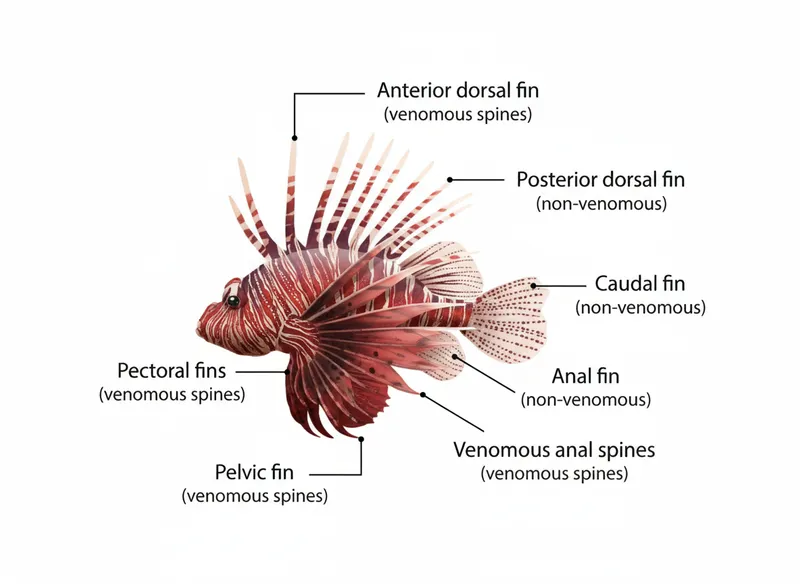
Snapping pics or spearing? Know your danger zones. Not every fin's a weapon, but the venomous ones pack heat.
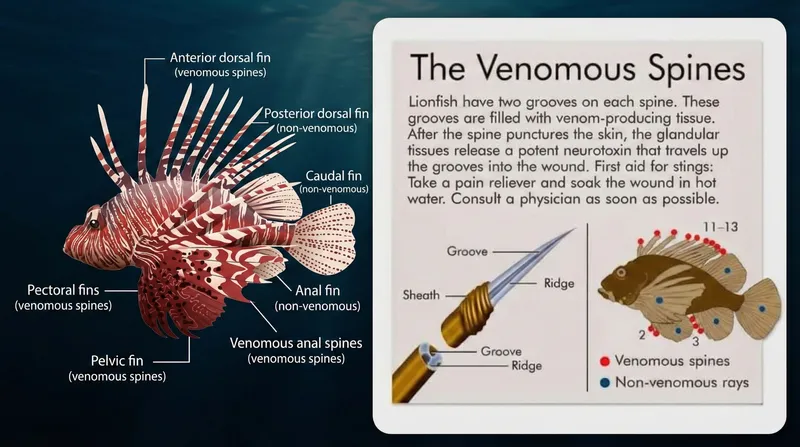
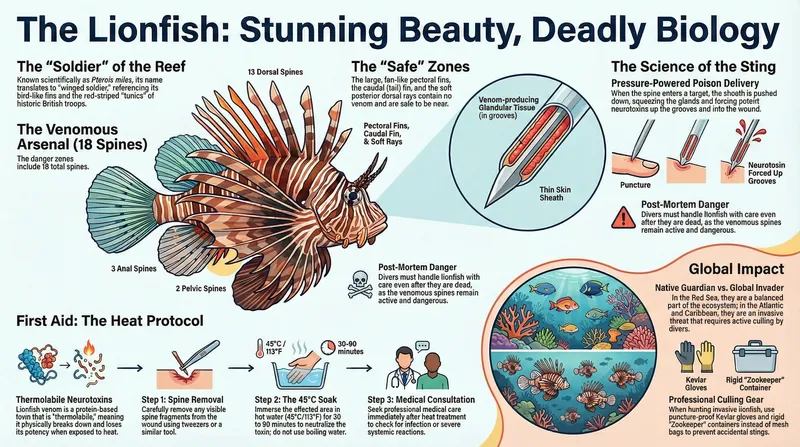
The Venomous Arsenal: Total of 18 spines ready to rumble - 13 long dorsal spines along the back, 3 anal spines under the tail, and 2 pelvic spines on the belly fins. One prick, and you're in for pain.[6]
The "Safe" Zones:
- Pectoral Fins: Those huge, fan-like wings on the sides? Totally harmless and perfect for that dramatic photo.
- Caudal Fin: Soft tail fin - no threat there.
- Posterior Dorsal Fin: The floppy rays behind the spines are sting-free.
How the Venom Works
Forget snake fangs - these spines are sneaky engineers. Each has grooves lined with venom glands under a skin sheath. Puncture happens, sheath slides down, squeezes the glands, and bam - neurotoxin floods the wound. It's a pressure-powered poison delivery, causing agony, swelling, even nausea.[1]
Short version: don't test it. This carnivorous night hunter's built to defend itself fiercely.[1][3]
First Aid: The Heat Protocol
Stung? Fire-like pain hits fast. The venom's a protein-based neuromuscular toxin - brutal but beatable with heat, since it's thermolabile (breaks down at high temps).
Action Plan:
- Remove Spines: Tweak out any fragments carefully - tweezers if you've got 'em.
- Apply Heat: Dunk in 45°C (113°F) water - not boiling! Soak 30 - 90 minutes to nuke the toxin.
- Medication: Pop ibuprofen or similar for pain.
- Medical Care: See a doc ASAP for infection checks or worse.[1]
A Note for Hunters (Culling Safety)
If you're in invasive zones greenlit for culling, gear up right. Dead lionfish spines still sting - handle the body at your peril.
- Containment: Ditch mesh bags; spines poke through. Grab a "Zookeeper" or rigid box for the ascent.
- Gloves: Neoprene? Useless. Go Kevlar for puncture proofing.
Even post-mortem, respect the soldier. Knowledge keeps you safe and the reefs thriving.
By giving the Devil Firefish its due, we dive smarter. Snap it in Egypt's reefs or spear it in the Caribbean - either way, you're armed with the know-how to thrive.
Big thanks to Dr. Mel for inspiring this article!
References
PADI Divemaster and underwater storyteller with over 7 years of hands-on Red Sea diving experience, documenting marine life, mapping dive sites, and promoting responsible ocean conservation.