Red Sea's Hidden Dangers: Deadly Defense Mechanisms and Safe Diving Tips for Sharks, Urchins & More

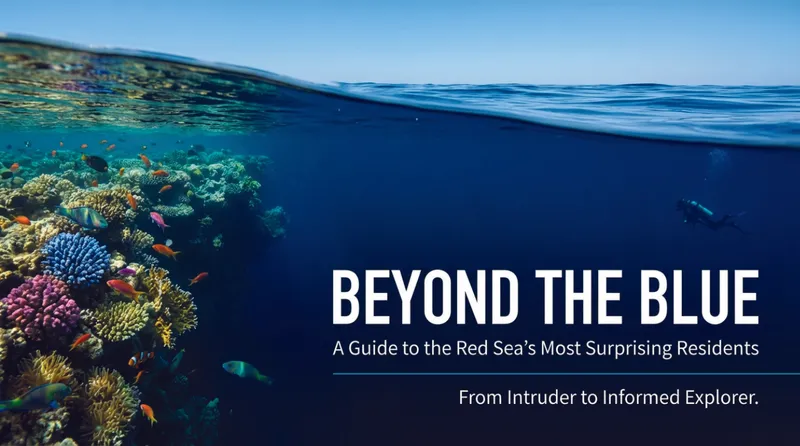
The Red Sea is a masterclass in biological contrast. To the casual observer, it is a kaleidoscopic paradise of vibrant coral gardens and tranquil azure waters. However, as an advanced dive specialist, I see the Red Sea through a different lens: it is a high-stakes arena where survival is earned through ingenious defense mechanisms. Many of the reef’s most iconic residents carry "biological weaponry" - from sophisticated neurotoxins to surgical-grade blades - designed to repel the curious and the predatory alike.
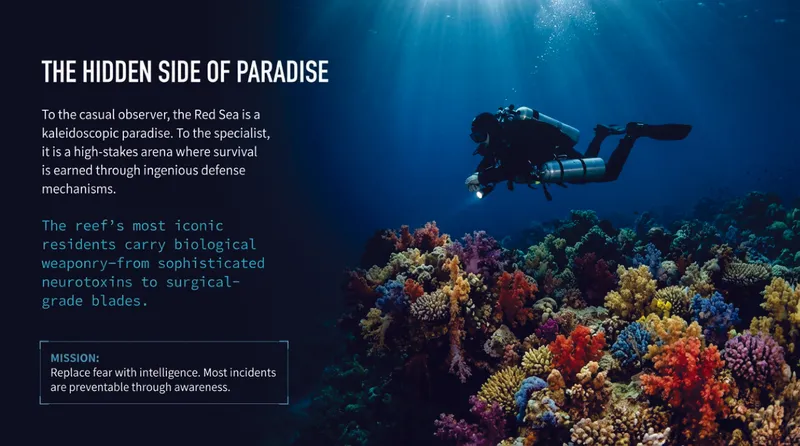
It is a common misconception that the Red Sea is "dangerous." In reality, most incidents are entirely preventable through awareness and respect rather than fear. By understanding the behavior and biology of these creatures, we transition from being intruders to being informed explorers. This guide isn't meant to keep you out of the water; it’s meant to ensure you dive with the intelligence and grace that this fragile ecosystem demands.
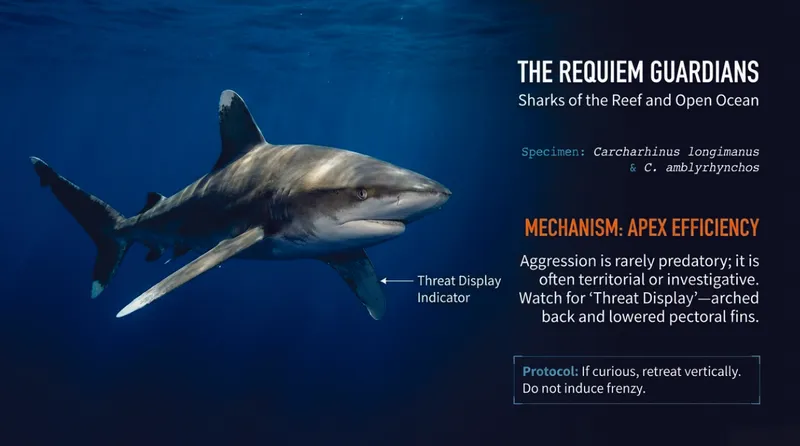
The Requiem Guardians: Sharks of the Reef and Open Ocean
Sharks are the apex of the Red Sea’s hierarchy, yet human-shark encounters are rarely fatal. Respecting them requires understanding their distinct habitats. The Tiger Shark (Galeocerdo cuvier) is the primary large predator that regularly ventures onto the reef; while it patrols deep seaward slopes during the day, it may move into shallower waters under the cover of night. Conversely, the Oceanic Whitetip Shark (Carcharinus longimanus) is a creature of the open blue, typically visiting offshore reefs and remote islands.
The species divers encounter most frequently is the Grey Reef Shark (Carcharinus amblyrbynchos). These sharks are highly territorial. As a dive specialist, I look for their specific "threat display" - a series of ritualized movements including an arched back and significantly lowered pectoral fins. This is a clear communication that you are perceived as a competitor or a threat.
If any shark starts behaving overly curious or persistent, the best course of action is to retreat calmly or exit the water entirely.
The Red Sea is home to a diverse array of requiem and predatory sharks, including:
- Bignose Shark (Carcharhinus altimus)
- Blacktip Reef Shark (Carcharhinus melanopterus)
- Blacktip Shark (Carcharhinus limbatus)
- Bull Shark (Carcharinus leucas)
- Dusky Shark (Carcharhinus obscurus)
- Great Hammerhead (Sphyrna mokarran)
- Shortfin Mako Shark (Isurus oxyrinchus)
- Sicklefin Lemon Shark (Negaprion acutidens)
- Silky Shark (Carcharhinus falciformis)
- Silvertip Shark (Carcharhinus albimarginatus)
- Spinner Shark (Carcharhinus brevipinna)
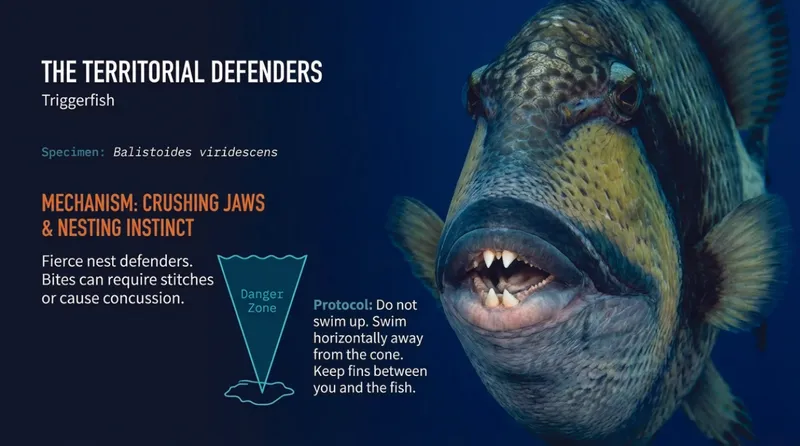
The Territorial Biters: Triggerfish, Moray Eels, and Barracudas
While sharks get the headlines, the Titan Triggerfish (Balistoides viridescens) and Yellowmargin Triggerfish (Pseudobalistes flavimarginatus) are often more aggressive. These fish fiercely defend their nests and will charge anyone who enters their vertical "cone" of territory. Their powerful teeth are capable of inflicting severe trauma; in one instance, a triggerfish strike to a dive master’s head nearly caused a loss of consciousness. Another victim required exactly 30 stitches to close wounds on their cheek following an encounter.
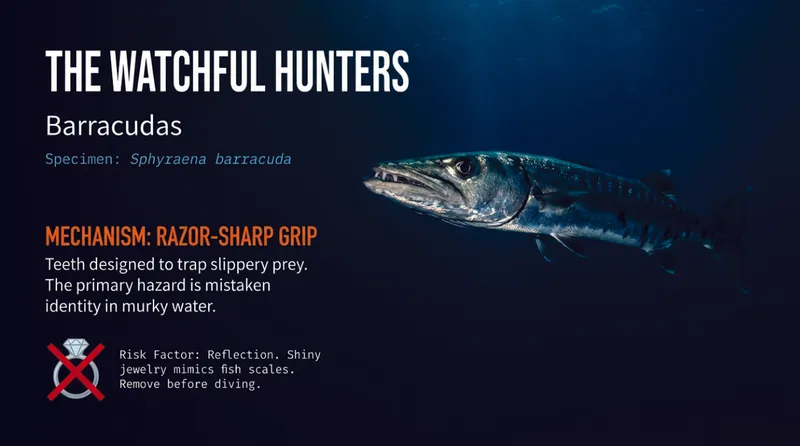
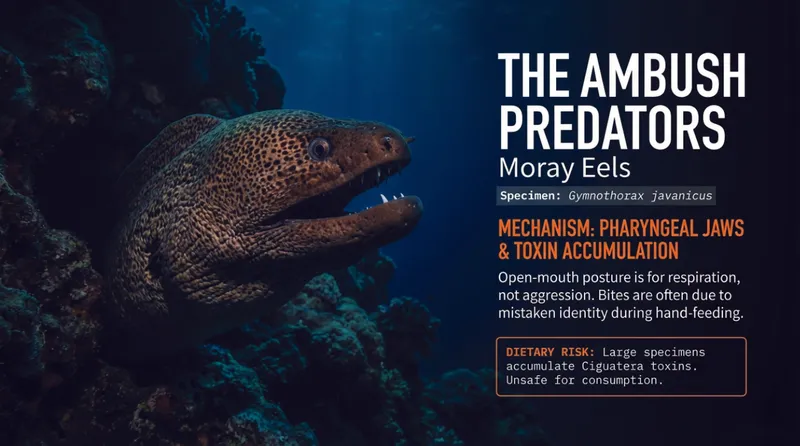
Barracudas, such as the Great Barracuda (Sphyraena barracuda), possess formidable teeth, but attacks are typically cases of "mistaken identity," usually occurring in murky water where a flash of jewelry or a hand might look like a silver fish. Similarly, Moray Eels, like the Giant Moray (Gymnothorax javanicus), are generally passive. Most bites are the direct result of human error - either inserting hands into crevices where eels hide or the dangerous practice of hand-feeding.
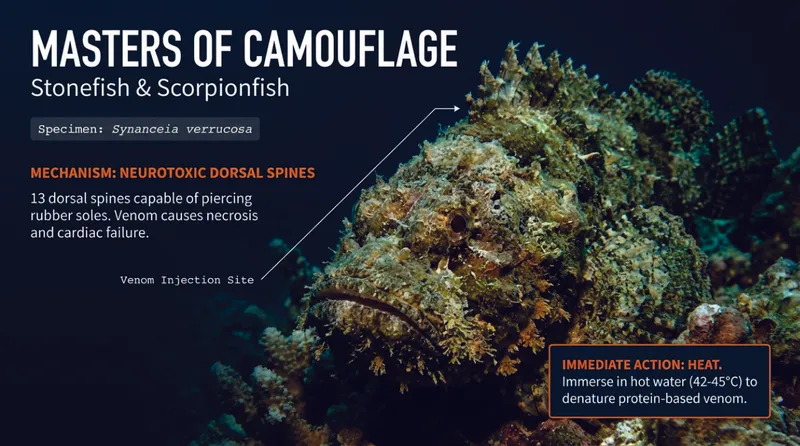
The Venomous Masters of Camouflage: Stonefish, Scorpionfish, and Lionfish
The most significant risks are often the ones you cannot see. The Reef Stonefish or Wartfish (Synanceia verrucosa) is the undisputed master of disguise, mimicking coral rubble so effectively that it is nearly invisible. Its sturdy dorsal spines are strong enough to penetrate the soles of light footwear, such as tennis shoes.
A sting from the Wartfish causes excruciating pain and, without proper treatment, can be fatal.
In contrast, the Common Lionfish (Pterois miles) is bold and makes no effort to hide, relying on its venomous spines for protection. While their stings are rarely deadly to healthy adults, the pain is intense and debilitating. Other representatives include the Devil Scorpionfish (Inimicus filamentosus), the False Stonefish (Scorpaenopsis diabolus), and the Shortfin Dwarf Lionfish (Dendrochirus brachypterus).
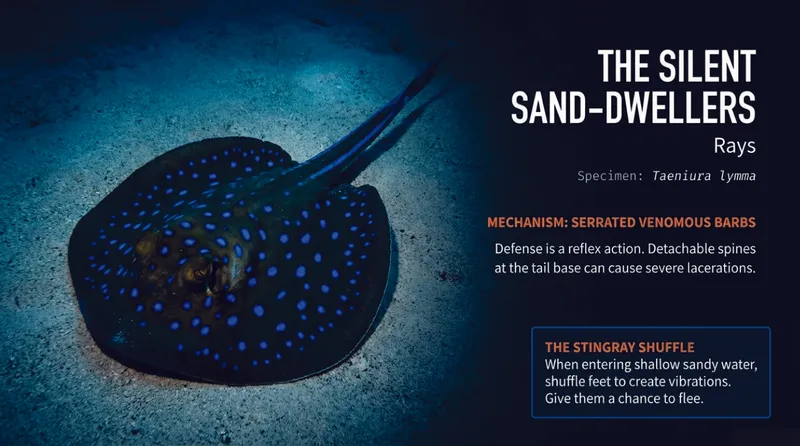
The Silent Sand-Dwellers: Rays
For beachgoers and snorkelers, the danger is often buried. Stingrays, such as the Bluespotted Ribbontail Ray (Taeniura lymma), possess one or more detachable, venomous spines at the base of their tails. Because they bury themselves in the sand for protection, they are easily stepped on by the unwary.
The Red Sea also hosts unique Electric Rays, including the Gulf Torpedo (Torpedo sinuspersici), Leopard Torpedo Ray (Torpedo panthera), and Marbled Electric Ray (Torpedo marmorata), all of which can deliver a powerful electric shock if disturbed. Other notable species include the Mangrove Whipray (Urogymnus granulatus), Pink Whipray (Pateobatis fai), and the Spotted Eagle Ray (Aetobatus narinari).
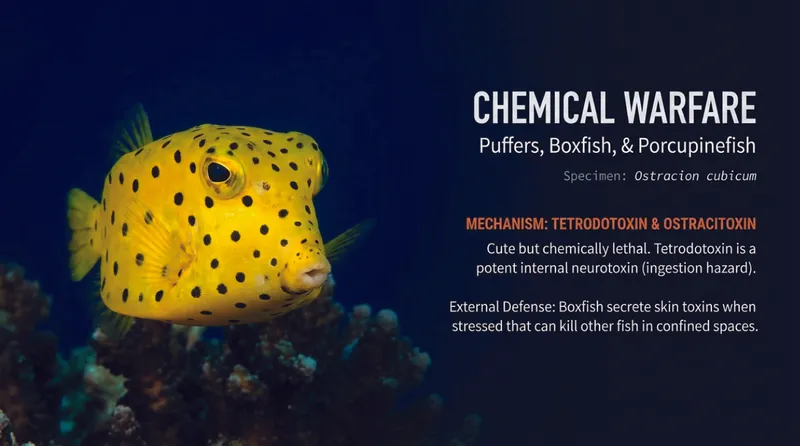
Chemical Warfare: Puffers, Boxfish, and Porcupinefish
Internal defenses are just as potent as external ones. The Back Puffer (Lagocephalus sceleratus), Yellow Boxfish (Ostracion cubicum), and Longhorn Cowfish (Lactoria cornuta) contain Tetrodotoxin. This is one of the strongest known neurotoxins; while these fish are safe to observe, they are lethal if consumed.
The Porcupinefish, such as the Spot-fin Porcupinefish (Diodon hystrix), provides a physical deterrent to supplement any chemical defense, utilizing protruding cheek spines to ensure they are a difficult meal for any predator.
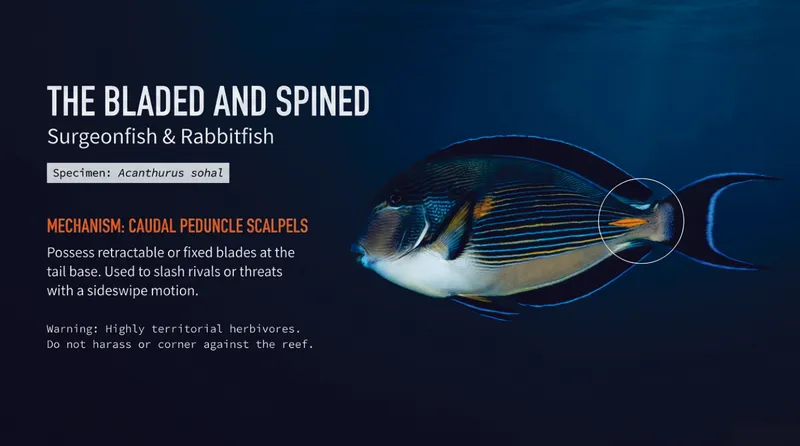
The Bladed and Spined: Surgeonfish and Rabbitfish
The Sohal Surgeonfish (Acanthurus sohal) carries its own "surgical" kit. These fish possess sharp, movable blades or pairs of immovable shields at the base of their tails. If the fish thrashes against a human, these blades can cause deep, clean lacerations that are difficult to close.
Rabbitfish, including the Forktail (Siganus argenteus), Rivulated (Siganus rivulatus), and Stellate (Siganus stellatus laqueus), possess venomous spines. These are primarily a stinging hazard for those who attempt to handle or spear them.
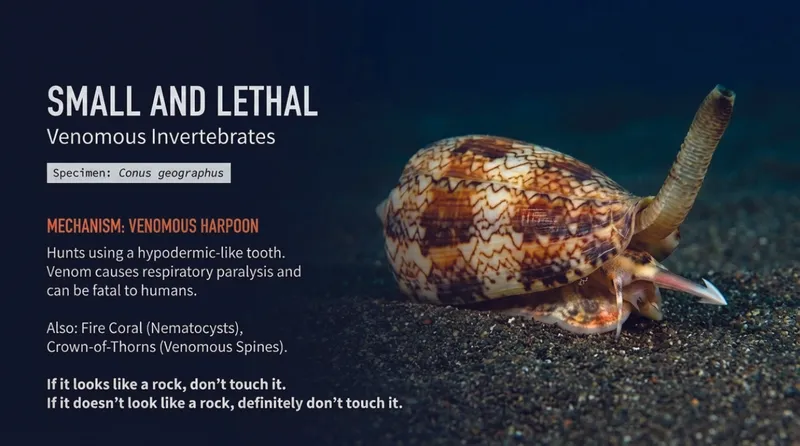
The Small and Lethal: Venomous Invertebrates
Size is never an indicator of safety on the reef:
- Cone Shells (Conus spp.): Predatory mollusks like C. geographus use a venomous harpoon to hunt. Their neurotoxin causes rapid paralysis and can be fatal to humans.
- Jellyfish and Hydroids: The Portuguese Man o' War (Physalia physalis) and Fire Corals (Millepora spp.) use nematocysts to sting. While local Box Jellyfish (Cubomedusae) cause intense pain, they lack the extreme lethality of Australian species.
- Sea Urchins and Starfish: The Diadem Sea Urchin and the Crown-of-Thorns Starfish (Acanthaster planci) have venomous, brittle spines that easily break off inside the skin. The Crown-of-Thorns venom is particularly potent and can cause paralysis.
- Sponges and Anemones: The Toxic Finger Sponge (Negombata magnifica) can cause painful dermatitis, while the anemone Alicia pretiosa causes significant inflammation and rashes.
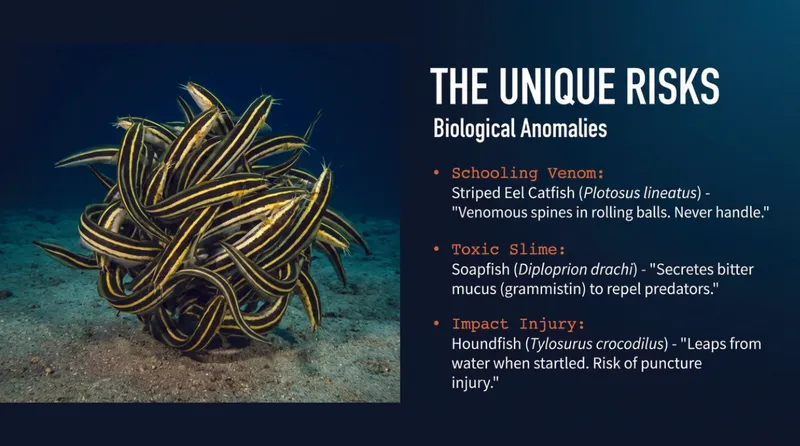
The "Other" Hazards: A Deep Dive into Specific Species
Beyond the usual suspects, several other species present unique risks that every diver should note:
- Bohar Snapper (Lutjanus bohar) & Giant Moray (Gymnothorax javanicus): These are significant "food safety" risks rather than in-water threats. They accumulate Ciguatera toxins - produced by dinoflagellates - in their liver and muscles. Consuming these large predators can lead to severe cardiac and respiratory distress.
- Soapfishes (Red Sea Soapfish Diploprion drachi and Gold-Ribbon Soapfish Aulacocephalus temminckii): These fish possess "toxic skin," secreting a bitter mucus that repels predators and can irritate human skin.
- Flatheads (Bartail Platycephalus indicus and Tentacled Papilloculiceps longiceps): Their hazard is physical; they possess sharp spines and are easily stepped on or touched because their camouflage makes them appear like the seafloor.
- Houndfish (Tylosurus crocodilus): These long, needle-like fish have a dangerous habit of leaping from the water, which can result in serious puncture injuries to people in their path.
- Striped Eel Catfish (Plotosus lineatus): Highly dangerous due to venomous spines on the dorsal and pectoral fins; never attempt to handle these schooling fish.
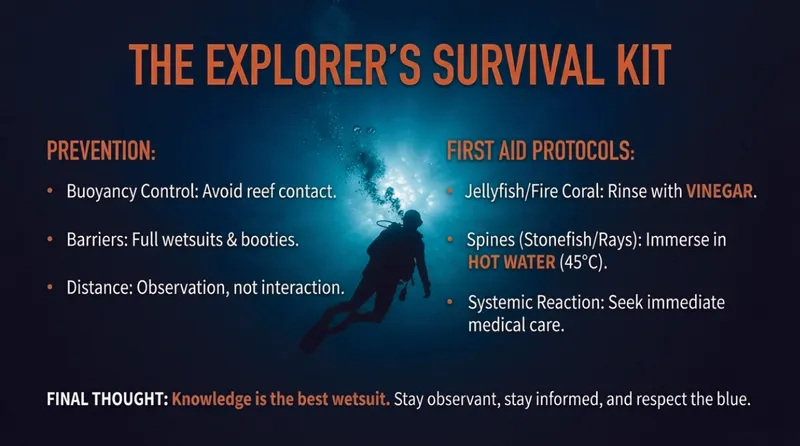
The Explorer’s Survival Kit: Safety and First Aid
As an instructor, I emphasize that prevention is the only 100% effective treatment.
- Buoyancy is Life: Mastery of buoyancy prevents accidental contact with fire coral or camouflaged stonefish.
- The "Stingray Shuffle": When walking in sandy shallows, shuffle your feet to alert buried rays.
- The Barrier Rule: Wear a full wetsuit, booties, and gloves to provide a physical layer against stings and cuts.
Quick Recovery Guide
- Jellyfish and Fire Corals: Rinse immediately with vinegar. This is critical as it prevents unfired stinging cells (nematocysts) from discharging more venom into the skin.
- Stonefish, Lionfish, and Sea Urchins: Immerse the injury in hot water (42-45°C) for 30-90 minutes to break down the heat-sensitive toxins.
- Crown-of-Thorns Starfish: The venom of this starfish is more resilient; the water must be very hot (>50°C) to effectively neutralize the toxin.
Critical Emergency Contacts
- Hurghada Hyperbaric Medical Center: +20 65 354 9150
- El Gouna Deco International (In El Gouna Hospital): +20 65 358 0011 or +20 122 219 0383
- Safaga Deco International: +20 122 219 0383
- Sharm El-Sheikh Hyperbaric Medical Center: +20 69 366 0922
- Marsa Alam Hyperbaric Medical Center: +20 65 375 0100
- DAN Emergency Hotline (Europe): +39 06 4211 8685
Conclusion: Respecting the Reef
The "dangerous" animals of the Red Sea are not monsters; they are highly evolved survivors that have inhabited these waters for millennia. Their defenses are a testament to the complexity and competitiveness of marine life. As explorers, it is our responsibility to maintain proper buoyancy and distance, protecting both ourselves and this fragile ecosystem. By moving through their world with humility and knowledge, we ensure the Red Sea remains a paradise for generations to grow.
Final Takeaway: Knowledge is the best wetsuit. Stay observant, stay informed, and respect the blue.
PADI Divemaster and underwater storyteller with over 7 years of hands-on Red Sea diving experience, documenting marine life, mapping dive sites, and promoting responsible ocean conservation.