Beyond the Bite: The Surprising Science of the Moray Eel’s Secret Jaws

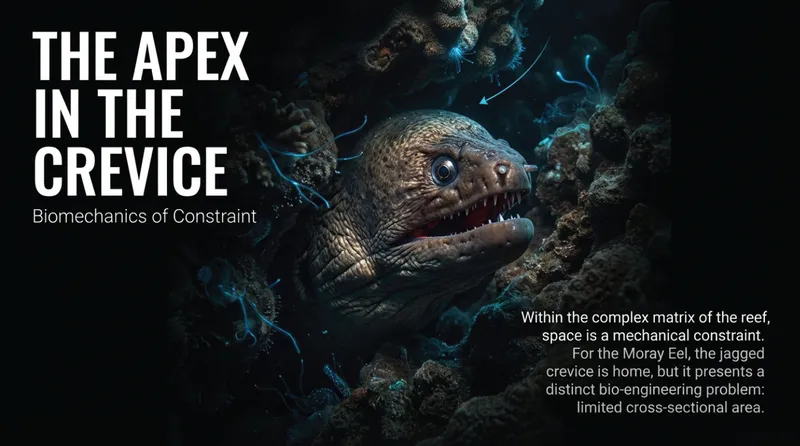
Within the complex matrix of coral reefs, space is a mechanical constraint. For the majority of teleost fishes, feeding is a high-volume affair. Survival depends on the "suction engine" - a process involving the rapid rotation and abduction of cranial elements to expand the mouth cavity, creating the negative pressure required to draw in water and prey. But for the moray eel, a resident of narrow, jagged crevices, this hydraulic status quo is a physical impossibility. There is simply no room for such explosive expansion.
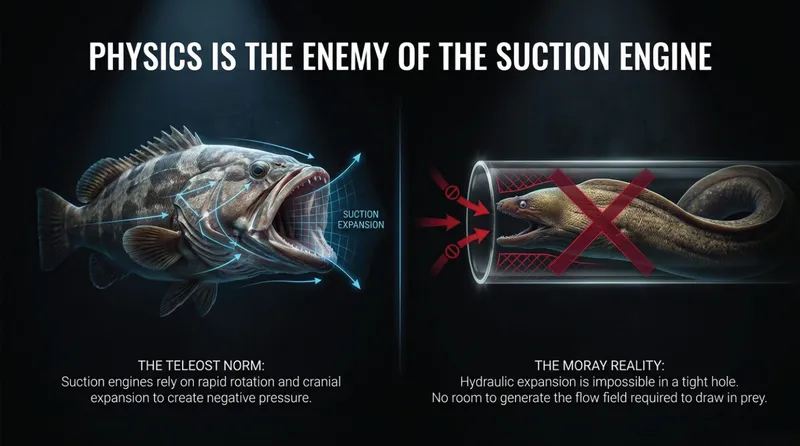
How, then, does an apex predator with an extremely narrow cross-sectional area consume large, struggling prey in the confines of a rocky hole? Research by Rita S. Mehta and Peter C. Wainwright has revealed a biological innovation that redefines our understanding of vertebrate feeding: a second set of raptorial jaws that launches from the throat into the mouth to finish the hunt.
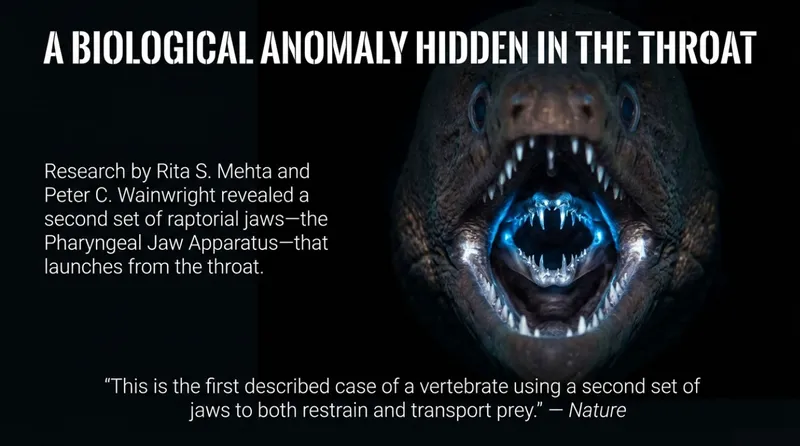
The "Alien" Reality of a Second Set of Jaws
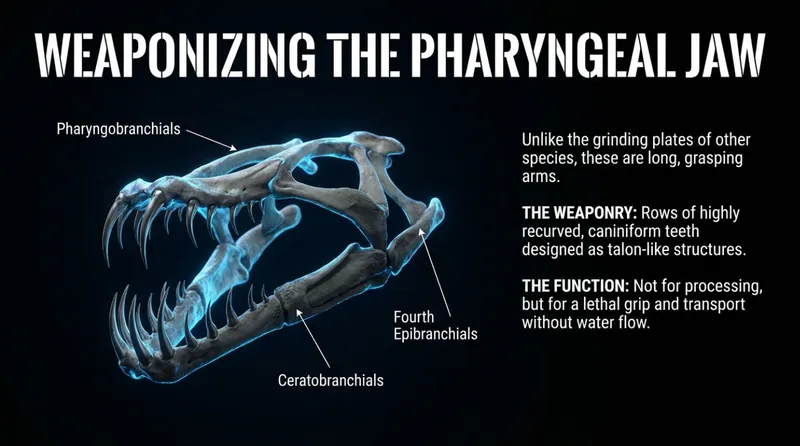
While many fish possess pharyngeal jaws - supplementary structures in the throat used for grinding or processing food - the moray eel has weaponized them into a high-speed transport system. This Pharyngeal Jaw Apparatus represents a radical departure from the teleost norm. In morays, these jaws are not broad processing plates but rather long, thin, grasping arms capable of extreme protraction into the oral cavity.
These jaws are comprised of specialized skeletal elements: the fourth epibranchials and ceratobranchials, with the upper jaws being the pharyngobranchials. Unlike the blunt grinding surfaces found in other species, these are armed with rows of highly recurved, caniniform teeth. These "talon-like" structures allow the eel to maintain a lethal grip, mechanically dragging food into the esophagus without the need for water flow.
"This is the first described case of a vertebrate using a second set of jaws to both restrain and transport prey, and is the only alternative to the hydraulic prey transport reported in teleost fishes." - Mehta and Wainwright, Nature.
Why Moray Eels Refuse to "Suck"
The biomechanical trade-offs made by the moray eel are a direct response to its environment. In the "complex matrix" of the reef, the standard suction engine is a liability. To accommodate their specialized biting strategy, morays have significantly reduced the hyoid skeleton and the sternohyoideus muscle - the primary drivers of hydraulic suction in other fish.
The loss of these structures "frees" the eel from the necessity of cranial expansion. While suction limits a predator to the size of the flow field it can generate, the moray's biting and launching strategy overcomes gape constraints. By abandoning the high-volume suction model, the moray has adapted to a lifestyle where precision and mechanical force are prioritized over hydraulic volume.
The Surprising "Snake" Connection
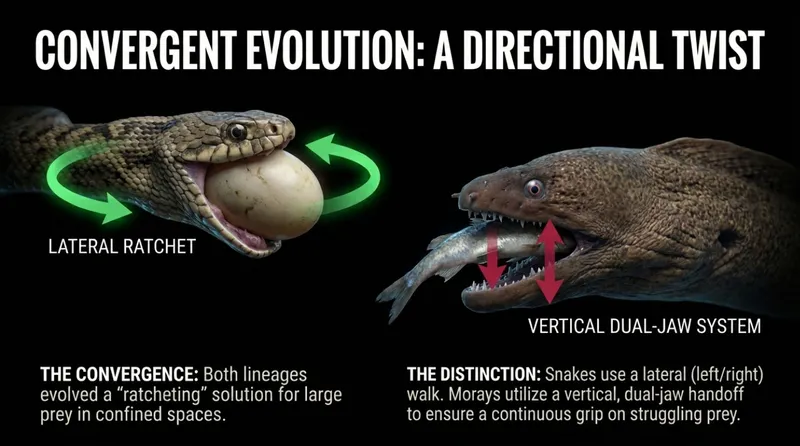
The moray eel’s feeding mechanism provides a stunning example of evolutionary convergence with terrestrial snakes. Despite their disparate lineages, both have arrived at a "ratcheting" solution for consuming large prey in confined spaces.
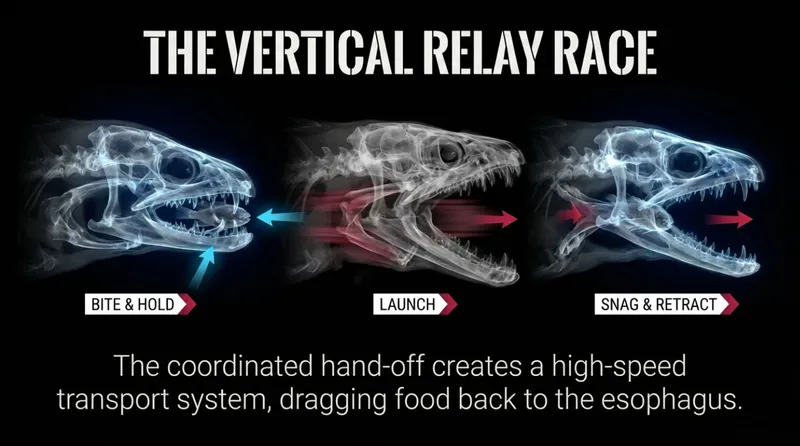
However, the high-signal distinction lies in the directionality of the movement. While snakes use a lateral ratcheting mechanism - alternating the left and right sides of their upper jaws to advance their heads over prey - the moray utilizes a vertical, dual-jaw system. This involves a coordinated hand-off: the oral jaws bite and hold, the pharyngeal jaws launch and snag, and then the oral jaws release as the pharyngeal jaws retract. This alternating oral-pharyngeal movement ensures a continuous grip on struggling prey at all times.
Extreme Anatomy: The Missing Pectoral Girdle
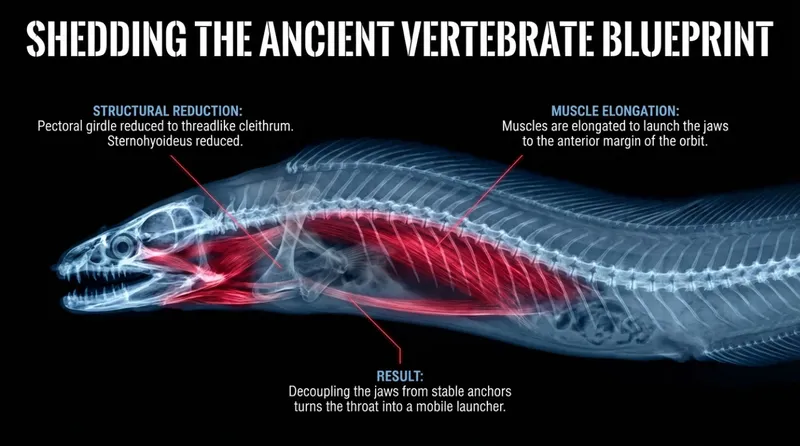
To permit the pharyngeal jaws to travel the distance required for such a "second bite," the moray underwent a radical anatomical restructuring, shedding the constraints of the ancient vertebrate blueprint. In most teleosts, pharyngeal mobility is limited by the pectoral girdle and stable gill-arch anchors. The moray has systematically dismantled these barriers:
- Structural Reduction: The pectoral girdle has been reduced to a "threadlike" cleithrum, and the anterior branchial elements have been minimized to allow the fourth gill arch unprecedented mobility.
- Muscle Elongation: The eel possesses extremely elongated protractor and retractor muscles. Specifically, the levator externi and interni (dorsal protractors) and the rectus communis (ventral protractor) have been modified to launch the jaws as far forward as the anterior margin of the orbit.
By decoupling the jaws from the skeletal anchors of the pectoral girdle, the moray’s throat has become a mobile extension of its predatory reach.
Consistency Over a Lifetime: Isometric Growth
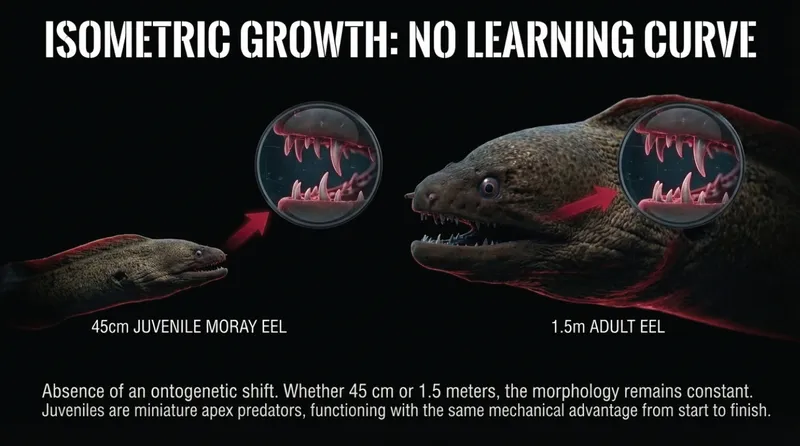
The predatory efficiency of the moray is established early and maintained with clinical precision. Studies on the California moray (G. mordax) demonstrate that their tooth morphology - including the elongated vomerine teeth - scales isometrically as they grow. Whether an individual is 45 cm or 1.5 meters long, the relative shape and size of the teeth remain constant.
The significance of this isometric growth is the absence of an "ontogenetic shift." While many fish must transition between diets as their mouthparts evolve, the juvenile moray is essentially a scaled-down version of the adult apex predator. This allows them to function as generalist hunters of fish and cephalopods throughout their entire lives, utilizing their "talons" with the same mechanical advantage from start to finish.
A Masterpiece of Evolutionary Engineering
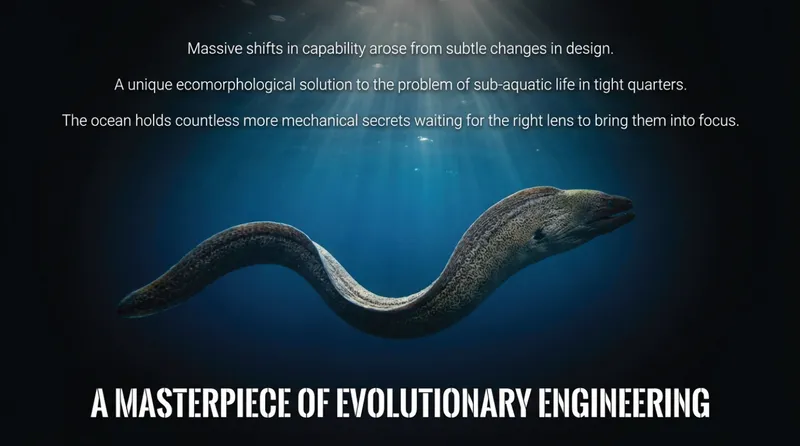
The moray eel is a masterpiece of functional innovation, proving that massive shifts in capability can arise from subtle changes in design. By elongating specific muscles like the pharyngocleitheralis and reducing skeletal anchors like the cleithrum, evolution has produced a unique ecomorphological solution to the problem of sub-aquatic life in tight quarters.
This discovery serves as a compelling reminder of the ocean's untapped complexity. With over 20,000 species of teleost fish currently known, one must wonder what other morphological secrets and mechanical surprises are still hiding within the world’s reefs, waiting for the right lens to bring them into focus.
PADI Divemaster and underwater storyteller with over 7 years of hands-on Red Sea diving experience, documenting marine life, mapping dive sites, and promoting responsible ocean conservation.