Hidden in Plain Sight: The Deadly New Resident of Singapore’s Waters

The Secrets of an Urban Coastline
Singapore is a marvel of urban planning, a hyper-modern city-state where skyscrapers glass the horizon and the ports never sleep. Yet, just beneath the surface of this highly managed coastline, a lethal mystery has been hiding. The recent discovery of a new species of box jellyfish in these waters is a brilliant scientific triumph, but it is also a sobering reminder that the ocean's most dangerous secrets can thrive right in our own backyard.
A Name Rooted in a Dark History
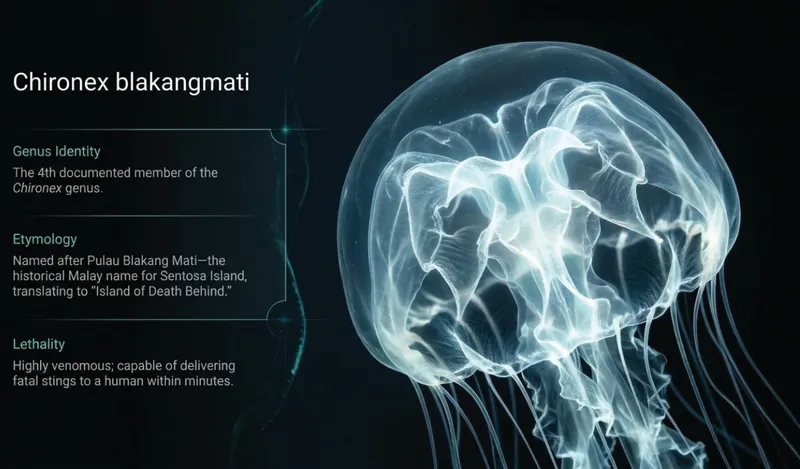
The new resident has been named Chironex blakangmati. This scientific name is a nod to its home near Sentosa Island, which was historically known in Malay as Pulau Blakang Mati - translated as the "Island of Death Behind."
The name is chillingly appropriate. This discovery adds a fourth member to the Chironex genus, a elite group of "sea wasps" known for possessing some of the most potent venom on the planet. These jellyfish are capable of delivering stings that can prove fatal to humans within mere minutes, making the historical name for Sentosa a fitting tribute to this predator's lethal biology.
The Case of Mistaken Identity
For years, C. blakangmati was hidden in plain sight. Due to its appearance, it was frequently mistaken for Chironex yamaguchii, a species originally found in Okinawa. It took a collaborative effort between the National University of Singapore (NUS) and Tohoku University to solve this case of mistaken identity. Lead researcher Cheryl Ames performed a modern biological "cold case" investigation to prove the two were unique.
C. blakangmati looks remarkably like Chironex yamaguchii - a jellyfish species I first discovered in Okinawa while doing my master's degree there... But we realised they were completely distinct. I actually went back to dust off an old sample of C. yamaguchii I still had in storage in Okinawa to help with the comparisons.
This research highlights a vital reality in marine biology: even in well-studied, high-traffic regions, biodiversity can remain invisible without rigorous genetic and morphological analysis.
The "Smoking Gun" in the Anatomy
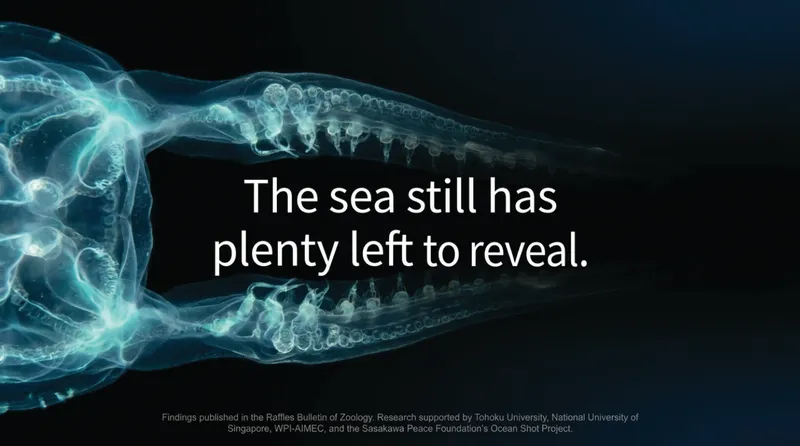
Identifying a new Chironex species requires looking past the standard cube-shaped bell. While these jellyfish are relatively small - with a bell height of approximately 5cm as shown in recent specimens - their most defining features are found in the perradial lappets. These are muscular flaps at the base of the bell that reinforce the jellyfish's ability to propel itself through the water.
In the other three known Chironex species, pointed canals extend from these lappets. In C. blakangmati, these canals are entirely absent. This minute structural difference is the only morphological way to distinguish the species from its relatives without the use of DNA sequencing. It is a "smoking gun" that proves how small structural details can redefine our understanding of a genus.
Hunters, Not Drifters
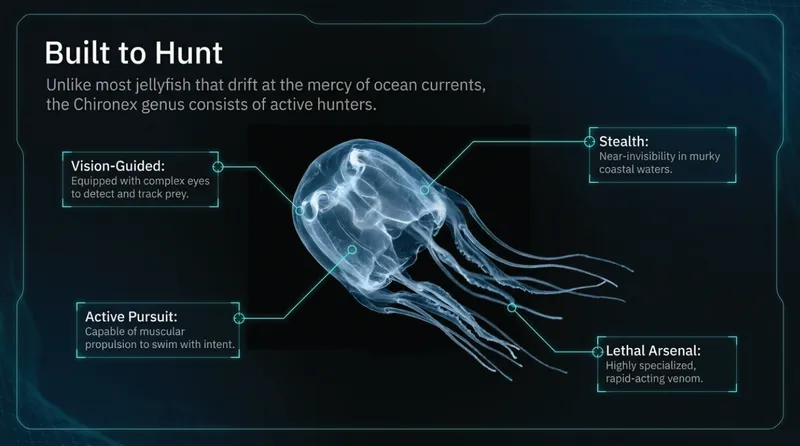
As a marine biologist, I find it essential to correct a common myth: not all jellyfish are passive drifters. Members of the Chironex genus are active, sophisticated hunters. They possess rhopalia - complex, image-forming eyes that allow them to navigate their environment with intent.
Combined with powerful muscular propulsion and near-invisibility in the water, these jellyfish are formidable predators. This mobility makes understanding their ecology a matter of genuine public safety, as they do not simply float with the tide but move with purpose through waters used by the public.
The Thai Connection: A Surprising Range Expansion
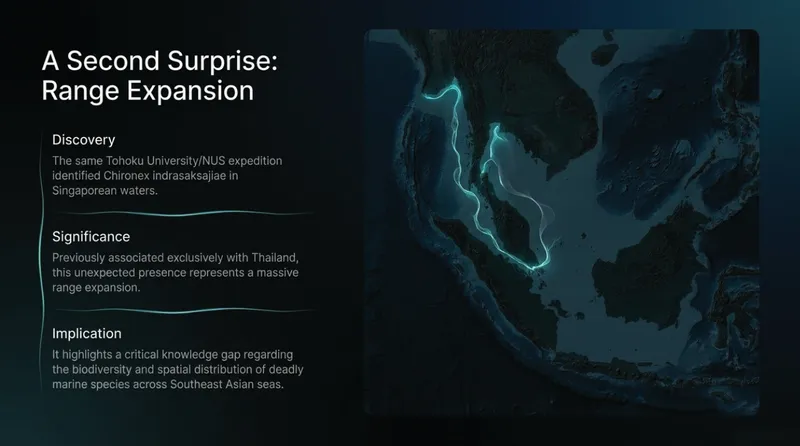
The research expedition yielded an additional surprise for the team: the first recording of Chironex indrasaksajiae, or the Thai sea wasp, in Singaporean waters. Previously, this species was thought to be restricted to the Gulf of Thailand.
"We were surprised to find C. indrasaksajiae so far away from Thailand. Recording range expansions like these is really important, as we currently know so little about the biodiversity and spatial distribution of box jellyfish."
Finding this species so far from its known habitat suggests that box jellyfish distributions across Southeast Asian seas are much broader than we realized, necessitating a regional approach to monitoring these venomous animals.
The Puzzle of the Deep
The discovery of C. blakangmati, recently published in the Raffles Bulletin of Zoology, was made possible through the support of WPI-AIMEC and the Sasakawa Peace Foundation’s Ocean Shot Project. It provides a vital new framework for identifying species within this deadly genus and underscores the importance of continued taxonomic research.
As we continue to develop our coastlines, we must ask: what other lethal mysteries are swimming alongside the world's busiest ports? This find proves that even in a city of millions, the "Island of Death Behind" still holds its breath, waiting for the next discovery to emerge from the shadows of the urban sea.
PADI Divemaster and underwater storyteller with over 7 years of hands-on Red Sea diving experience, documenting marine life, mapping dive sites, and promoting responsible ocean conservation.