The Depths of Expertise: 5 Surprising Truths Behind the Maldives Diving Tragedy

The Maldives is globally revered as a turquoise sanctuary, a "scuba hotspot" where the risks of the abyss often feel secondary to the vibrant kaleidoscope of reef life. Yet, the events of May 2026 shattered this serene reputation, replacing leisure with a jarring, clinical reality. In what has emerged as a baffling tragedy, five Italian nationals - including a world-renowned marine ecologist - vanished during a deep-sea cave exploration in the Vaavu Atoll. For a sophisticated diving community, the accident raises a haunting question: how does a team of seasoned professionals, equipped with decades of collective experience, succumb to an environment designed for recreation?
Investigators are now scrutinizing the "why" behind the loss, looking past the surface-level beauty of the Alimathaa reefs to uncover the technical and psychological factors that led to this disaster.
1. Expertise is No Shield Against Environmental Complexity
Even the most seasoned professionals are vulnerable to "high-risk" underwater environments.
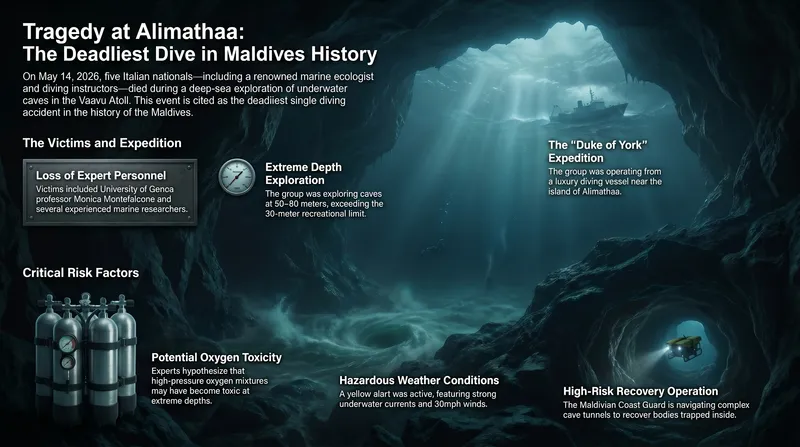
The victims were not holidaymakers in over their heads; they were titans of their field. The group included Professor Monica Montefalcone, 51, a leading light in marine ecology at the University of Genoa and scientific director of the "Mare Caldo" project; her 20-year-old daughter Giorgia Sommacal; research fellow Muriel Oddenino; and expert diving instructors Gianluca Benedetti and Federico Gualtieri.
The University of Genoa, grappling with the loss, stated:
"The University expresses its deepest condolences for the tragic death of Professor Monica Montefalcone... an internationally recognized marine ecology expert involved in multiple environmental projects."
Despite their stature, investigators emphasize that this exploratory cave dive was not an official university research project. This distinction points toward the "paradox of experience." High-level training can occasionally create a "mission focus" bias, where professional curiosity leads experts to push boundaries that exceed the margin of safety. Deep familiarity with the sea does not grant immunity; rather, it often places one in a position where a single technical or environmental shift becomes insurmountable.
2. The "30-Meter Rule" and the Danger of the Deep
The critical gap between recreational limits and the 60-meter abyss.
In the Maldives, recreational diving is strictly capped at 30 meters (approximately 100 feet). This limit is a safety buffer against the physiological strains of pressure. However, the Italian group was exploring a cave system at depths of 50 to 60 meters (165-200 feet).
At these depths, the physics of diving changes radically. While some early reports speculated on the use of Nitrox (oxygen-enriched air) to "mitigate risks," a technical analysis suggests the opposite. Standard Nitrox blends are dangerous at 60 meters because the high partial pressure of oxygen becomes lethal. Technical divers at these depths typically require Trimix - a specialized blend of helium, oxygen, and nitrogen - to manage both narcosis and toxicity. The group was operating in a "gray zone" of exploration where the equipment and gas management protocols leave zero room for human error.
3. The Physiological "Invisible Killer" - Oxygen Toxicity
The hypotheses floated by experts: When gas mixtures become neurotoxins.
The central mystery revolves around how five divers died simultaneously or in rapid succession. The primary hypothesis remains Central Nervous System (CNS) Oxygen Toxicity. When oxygen is breathed at high pressure - as is the case at the 60-meter mark - it can trigger sudden seizures, disorientation, or immediate loss of consciousness.
The group operated from the Duke of York, a luxury liveaboard known to provide Nitrox. If a gas mixture problem occurred - either through an incorrect blend or a diver descending too deep for their specific oxygen fraction - the result would be a "silent" physiological collapse.
"Experts cited by local media pointed to possible problems involving oxygen mixtures in the tanks, strong underwater currents, sudden thermal changes or disorientation inside the cave network."
In the pressurized environment of a deep cave, a "sudden thermal change" or a spike in exertion can accelerate the onset of toxicity, turning a life-giving gas into an invisible killer.
4. The Anatomy of a Coral "Trap"
The deceptive architecture of the Vaavu Atoll cave system.
The site near Alimathaa is not a network of inland karst tunnels, but a complex series of coral reef overhangs, swim-throughs, and tunnels. While these structures are a draw for their biodiversity, they function as a hydraulic trap. Vaavu Atoll is famous for "channel diving," where powerful tidal currents are funneled through narrow gaps in the reef.
These nutrient-rich waters create a "washing machine" effect. Evidence suggests that strong underwater currents may have pinned the divers or caused profound disorientation within the intricate architecture of the coral. The complexity of this "trap" was confirmed by the Maldivian National Defense Force (MNDF), which characterized the recovery of the bodies - discovered at approximately 60 meters - as a "high-risk" mission due to the deceptive nature of the cave’s interior.
5. When Nature Overrules the Mission
The role of external weather conditions in diving safety.
Safety data points to a critical external factor: the "yellow weather alert" in effect at the time of the dive. With 30mph winds and rough seas, the surface conditions were unfavorable even before the divers submerged. These conditions hampered search and rescue efforts, preventing immediate intervention when the group failed to surface by midday.
The decision to proceed under a weather alert is a subject of intense scrutiny. It highlights the unpredictable nature of sudden thermal changes or current shifts common in the Vaavu Atoll. For an expert team, the drive to explore can sometimes mask the warning signs of a deteriorating environment. When nature overrules the mission, technical advancements and years of expertise are often rendered irrelevant by the sheer force of the sea.
The Limits of Human Exploration
The loss of these five individuals marks the deadliest single diving accident in the history of the Maldives. It is a profound tragedy that Professor Monica Montefalcone, a woman who dedicated her life to the 'Mare Caldo' project to monitor and protect our warming oceans, was ultimately claimed by the very ecosystem she sought to save.
Her death serves as a somber reminder: in the quest to map the deep and understand our marine ecosystems, the environment remains an indomitable force. We are left to wonder - can our technical advancements ever truly mitigate the inherent risks of the deep, or will the ocean always reserve the right to remain unexplored?
PADI Divemaster and underwater storyteller with over 7 years of hands-on Red Sea diving experience, documenting marine life, mapping dive sites, and promoting responsible ocean conservation.