Deep Dive: A Journey Through the Five Zones of the Ocean

From the colorful coral reefs we know to the pitch-black trenches we can only imagine, join us as we explore the incredible vertical layers of our ocean.
Here at Red Sea Creatures, we're all about those vibrant shallows bursting with color - think zippy parrotfish nibbling on coral, elegant rays gliding by, and corals waving like underwater fireworks. But have you ever peered into that endless deep blue and thought, what's really down there?
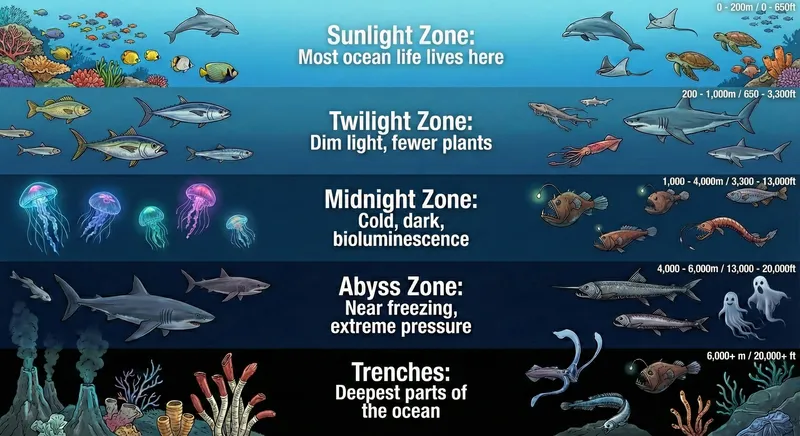
The ocean's no flat puddle; it's a stacked adventure, like plunging through the floors of a colossal underwater skyscraper. Light dims, pressure cranks up, temps plummet - and bam, you've got five distinct zones, each packed with its own wild crew of residents. Grab your imaginary submersible, because thanks to this awesome infographic, we're diving in from sun-kissed surface to crushing depths.
1. The Sunlight Zone (Epipelagic)
Depth: Surface to 200m (0 - 650ft)
This is our happy place - the top slice where sunlight streams in like a spotlight, fueling photosynthesis for all that floating phytoplankton goodness. It's the base of the ocean's food chain, teeming with 90% of marine life. Snorkeling in the Red Sea? You're swimming with dolphins flipping tricks, wise old sea turtles munching seagrass, and a rainbow explosion of reef fish darting everywhere. Warm waters, bright vibes, and non-stop action. Short and sweet: if it's colorful and lively, it's here.[1][4]
2. The Twilight Zone (Mesopelagic)
Depth: 200m to 1,000m (650 - 3,300ft)
Dive a bit deeper, and poof - the sun's glow fades to a spooky twilight. No more plants photosynthesizing; it's all shadows and stealth now. These guys are pros at vertical commuting: hordes of fish, squid, and sharks rocket up to the sunlight zone at night for a feast, then hide out here by day to dodge predators. Picture swordfish slicing through the dim, or cuttlefish flashing camouflage. It's cooler, dimmer, and full of migrants chasing dinner. Kinda like the ocean's night shift.[1][3][4]
3. The Midnight Zone (Bathypelagic)
Depth: 1,000m to 4,000m (3,300 - 13,000ft)
Pitch black. Forever. Sunlight? Ancient history. It's freezing cold with pressure that'd squash us flat, but life? Oh, it parties here with its own disco lights - bioluminescence! Jellyfish pulsing neon, deep-sea shrimp popping flashes, and that nightmare-fuel anglerfish dangling a glowing bait like a fisherman's worst dream. Giant squid lurk, vampire squid drift like gothic balloons, and everything's got oversized eyes or massive jaws for snagging rare meals. Terrifying? Maybe. Totally cool? Absolutely.[1][2][3]
4. The Abyss Zone (Abyssopelagic)
Depth: 4,000m to 6,000m (13,000 - 20,000ft)
"Abyss" means bottomless for a reason - this vast, muddy expanse blankets most of the seafloor, with temps near freezing and pressure so intense it'd turn your Styrofoam dive souvenir into a thimble. Food's a rare treat, mostly "marine snow" - flakes of dead stuff drifting down like sad confetti. Creatures here are energy-savers: ghostly transparent fish, tripod fish propped like alien tripods, slow-moving sea cucumbers, and deep-sea sharks cruising the plains. It's 83% of the ocean, yet feels like a barren frontier. Slow, sparse, surreal.[1][2][5]
5. The Trenches (Hadalpelagic)
Depth: 6,000m+ (20,000ft+)
The grand finale: Earth's deepest scars, like the Mariana Trench, where pressure hits eight tons per square inch and it's hadal-hell cold. Scientists once bet nothing lived here. Wrong! Around hydrothermal vents - underwater volcanoes spewing mineral-rich heat - chemosynthesis rules. No sun needed; bacteria munch chemicals, feeding giant tube worms (up to 2.4m long!), eyeless shrimp, and snailfish. It's alien life on our own planet, thriving in the underworld.[1][3][5]
A Note on the Red Sea
Our Red Sea's no slouch - it plunges to about 3,040m (9,970ft) in the Suakin Trough, hitting sunlight, twilight, and most of the midnight zones. But here's the kicker: it's one of the hottest seas around. Even down in the midnight depths, it's a balmy 21°C (70°F) thanks to geothermal heat from below - no icy shock like the open ocean.
Next time you're bobbing on the surface, gazing into that blue abyss, tip your mask to the mysteries lurking just beneath. The Red Sea's got layers we can only dream of exploring. What's your favorite deep-sea weirdo? Drop a comment - we'd love to hear!
References
PADI Divemaster and underwater storyteller with over 7 years of hands-on Red Sea diving experience, documenting marine life, mapping dive sites, and promoting responsible ocean conservation.