The Architects of the Reef: Understanding Coral Structure


Hey, have you ever plunged into the crystal-clear waters of the Red Sea and felt like you've stumbled into an alien world? Those vibrant reefs look like colorful underwater gardens or bizarre rock formations, right? But here's the cool twist: corals aren't plants or rocks at all. They're actually sessile animals - marine invertebrates that root themselves to the ocean floor. To really get why these "sea flowers" are so mesmerizing, let's zoom in on the tiny heroes building these massive structures: the coral polyps.
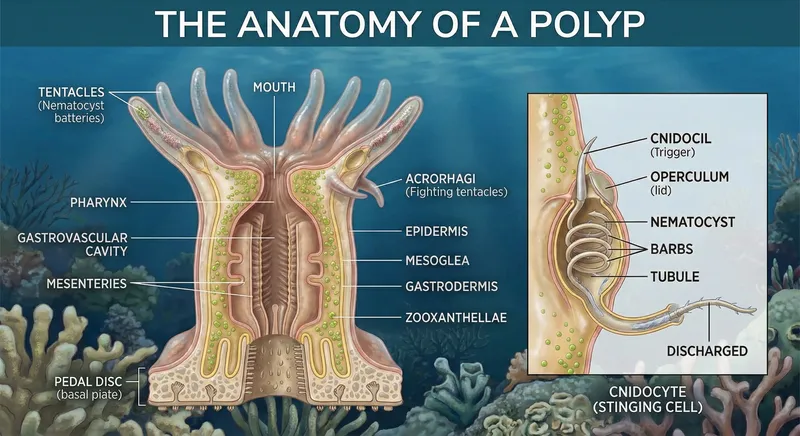
The Anatomy of a Polyp
Picture a coral "head" or colony - it's basically a bustling apartment block made of hundreds, even thousands, of genetically identical polyps. Each one's a small, soft-bodied, sac-like critter with a super simple yet genius body plan. Let's break it down.
- The Mouth: Right in the center of the polyp's upper surface, called the oral disc, sits the mouth. It's the only opening to the body cavity, doubling as both food entrance and waste exit. Talk about efficiency!
- Tentacles and Nematocysts: A ring of flexible tentacles surrounds the mouth, loaded with nematocysts - stinging cells that fire like tiny harpoons. They paralyze plankton or small fish for dinner and keep predators at bay. No mercy in the reef world.
- Body Layers: The polyp has two main layers: the outer epidermis (like skin) and inner gastrodermis (stomach lining), sandwiching a jelly-like mesoglea in between for structure.
- The Gastrovascular Cavity: Inside, this space (aka the coelenteron) works as a basic stomach. Digestive enzymes break down meals, and nutrients zip around the body. Simple, but it gets the job done.
These little guys are the foundation of the Red Sea's reefs, which stretch over 2,000 km along the coast and host more than 265-346 species of hard corals alone, with some unique to this spot.[1][3][4] Pretty impressive for such tiny builders.
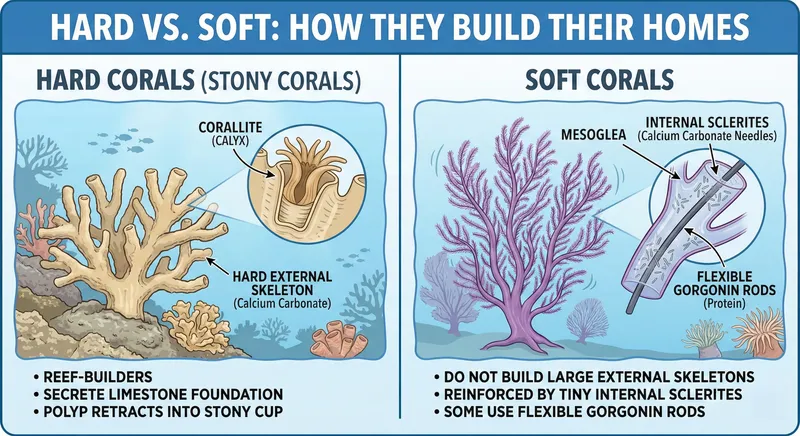
Hard vs. Soft: How They Build Their Homes
The Red Sea teems with both hard and soft corals, and their skeleton-building styles set them worlds apart. It's like comparing a fortress to a flexible tent.
Hard Corals (Stony Corals)
These are the real reef-builders, the architects of those massive fringing reefs. Hard coral polyps pull calcium carbonate straight from seawater to secrete a hard external skeleton. Each polyp chills in its own cup-shaped pit called a corallite or calyx - think cozy limestone condo. When danger looms, it retracts fully inside for safety. No wonder the Red Sea's reefs are some of the healthiest and most diverse on the planet, thriving in warm, clear waters with minimal storms.[1][4]
Soft Corals
Softies skip the big external skeletons. They rely on that jelly-like mesoglea, beefed up with tiny internal needles of calcium carbonate called sclerites or spicules. Sea fans (gorgonians) even add flexible protein rods made of gorgonin for extra sway in the currents. They're bendy, beautiful, and perfectly adapted to the Red Sea's dynamic flows.
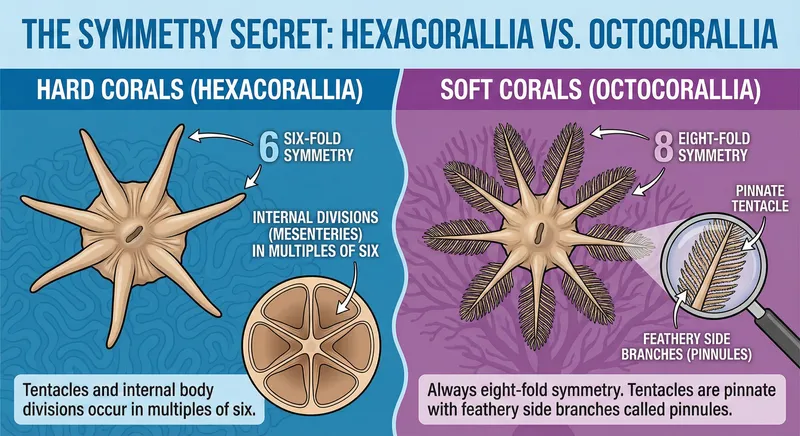
The Symmetry Secret: Hexacorallia vs. Octocorallia
Next time you're diving, play coral detective by counting tentacles. It's the easiest way to tell friends from family.
- Hard Corals (Hexacorallia): Six-fold symmetry rules here - tentacles and internal dividers (mesenteries) come in multiples of six. Spot that pattern, and you've nailed a stony coral.
- Soft Corals (Octocorallia): Eight-fold symmetry every time. Their tentacles are pinnate - feathery with side branches called pinnules. Like mini feather dusters waving in the water.
This neat division helps explain the Red Sea's hyperdiverse reefs, isolated for millions of years and packed with endemic species.[2]
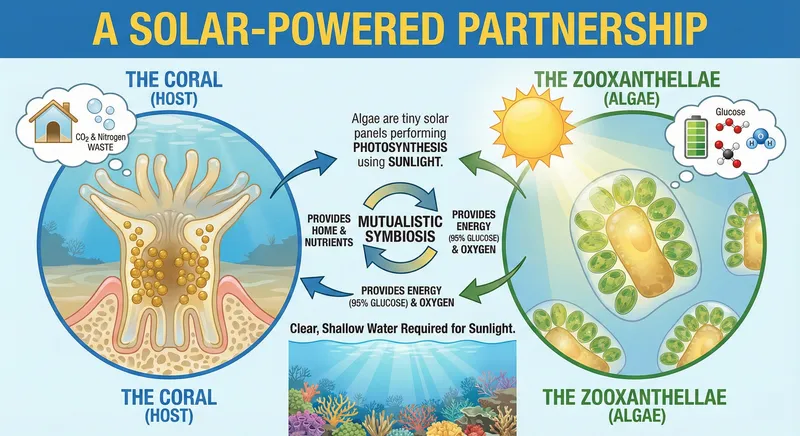
A Solar-Powered Partnership
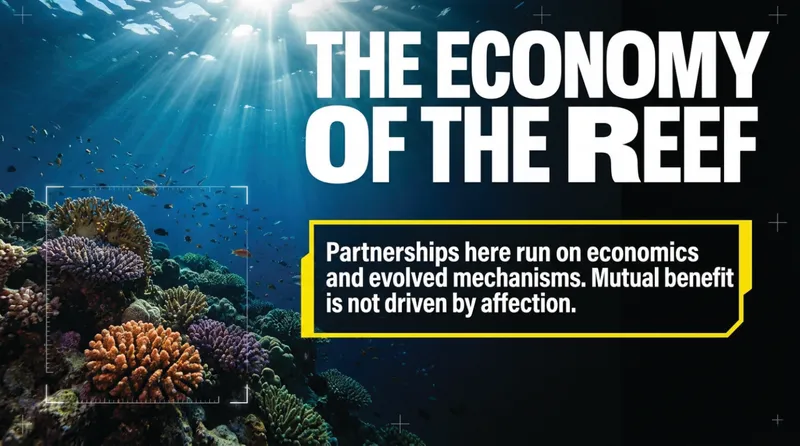
Most Red Sea corals in shallow spots host microscopic algae called zooxanthellae tucked inside their tissues. These are like "tiny solar panels," cranking out glucose and oxygen via photosynthesis - up to 95% of the coral's energy! In exchange, the coral shares its waste (CO2 and nitrogen) and a safe home. It's a match made in reef heaven, demanding clear, sunlit shallows for that internal power plant to hum.
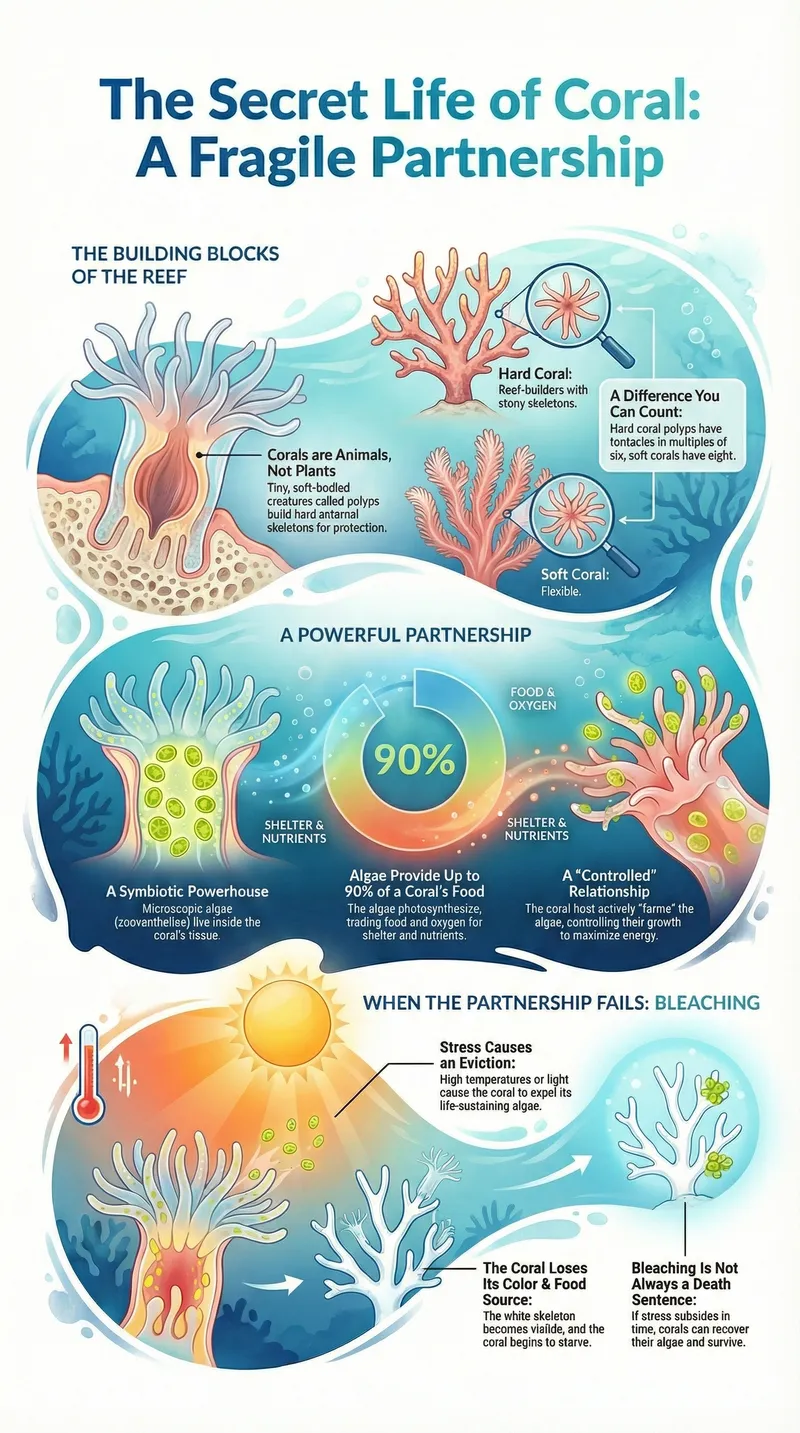
That's why the Red Sea's corals are extra special: many are heat-tolerant "super corals," resisting bleaching better than anywhere else, thanks to evolutionary quirks from their hot history.[2][3][6] They're like nature's lab for climate resilience.
Analogy time: Imagine a hard coral colony as a high-rise apartment complex. Each polyp has its protective limestone "room" (calyx), but they're linked by shared living tissue (coenosarc) for swapping nutrients and gossip, just like neighbors chatting in the hallway. Next dive, you'll see the reef in a whole new light!
References
PADI Divemaster and underwater storyteller with over 7 years of hands-on Red Sea diving experience, documenting marine life, mapping dive sites, and promoting responsible ocean conservation.