What’s the Difference Between a Sea and an Ocean?


Ever catch yourself saying “I love the sea” when you’re staring out at what’s actually the open ocean? You’re not alone. Most people use the words sea and ocean like they mean the same thing. In everyday conversation, that’s fine. But in geography and marine science, they’re not quite the same - and the differences are pretty fascinating.
So… is it one ocean or many?
Let’s start with a fun twist: from a scientific point of view, there is really one big, interconnected ocean. All the water around our planet is linked, flowing between what we call the Pacific, Atlantic, Indian, Southern and Arctic “oceans.” Those five are more like regions or neighborhoods within one global ocean than separate bodies all cut off from each other.
That single ocean also includes all the seas you’ve heard of - the Red Sea, Mediterranean Sea, Caribbean Sea, Sargasso Sea, and so on. So every sea is part of the ocean, but not every part of the ocean is a sea.
Ocean vs sea: the quick definition
If you want the simple, textbook-style distinction:
- Ocean = a large, deep, continuous body of saltwater that covers most of Earth.
- Sea = a smaller area of saltwater, usually on the margins of an ocean, and often partially enclosed by land.
So when you’re looking at a map:
- The Atlantic Ocean is one huge, open, deep basin.
- The Caribbean Sea, Red Sea, or Mediterranean Sea are “arms” or “pockets” of that bigger ocean, tucked closer to land.
But it gets more interesting when you look beneath the surface.
Size and depth: who’s bigger?
The most obvious difference is scale.
- Oceans cover about 71% of Earth’s surface and are on average nearly 4 km deep. That’s a lot of water.
- Seas are smaller and usually shallower, often a kind of “edge zone” where ocean meets land.
Even the largest seas are dwarfed by the smaller oceans. For example, the Arabian Sea is huge by sea standards, but the smallest ocean (the Arctic) is still several times larger.
Depth-wise, oceans typically win too. Their central basins plunge to thousands of meters. Seas, especially those lying over continental shelves, tend to be shallower - think a few hundred meters rather than several thousand. There are some dramatic exceptions (like the deep trenches of the Mediterranean or Coral Sea), but overall the pattern holds: oceans are bigger and deeper; seas are smaller and often shallower.
Surrounded by land: where seas usually sit
When you imagine a “sea,” you might picture water cradled by land - and that’s a good instinct. Most seas are:
- On the edges of oceans
- Partially enclosed by land - continents, peninsulas, or island chains
Classic examples:
- The Mediterranean Sea is almost wrapped in land: Europe to the north, Africa to the south, Asia to the east.
- The Red Sea is tucked between Africa and the Arabian Peninsula.
- The North Sea sits between the UK, Scandinavia and mainland Europe.
Oceans, on the other hand, are not bounded by land in the middle. There’s no point in the open Pacific where land suddenly draws a neat border line; it just keeps going until you eventually hit a continent or a chain of islands.
What’s under them: the crust story
Two kinds of crust
Here’s where we get a bit geological (but stay with me - it’s actually pretty cool).
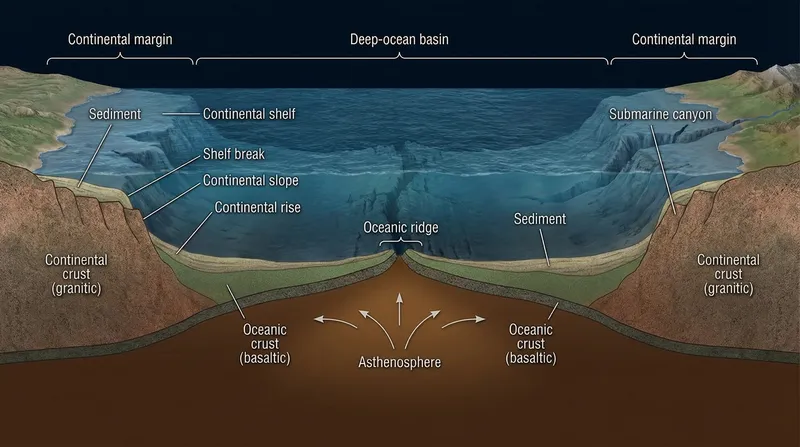
Earth’s outer solid layer, the crust, comes in two main flavors:
- Oceanic crust - thinner, denser, made mostly of dark volcanic rock like basalt.
- Continental crust - thicker, lighter, made mostly of rocks like granite.
Usually:
- The deep open ocean lies over oceanic crust.
- The shallower areas near continents - the continental shelves - lie over continental crust.
So what’s under a “sea”?
Here’s the neat part: most seas sit on top of continental crust, not oceanic.
Picture the shape of the seafloor near a continent. First there’s the shallow, gently sloping continental shelf starting from the coastline. That shelf is where many seas live. So in many cases, when you say “sea,” you’re really talking about a flooded edge of a continent - not the deep, central ocean basins.
This is why seas are often:
- Shallower than the open ocean
- Rich in marine life, because sunlight can reach the bottom in more places
- Heavily influenced by rivers, coastal habitats, and human activity
The rule-breakers: seas over oceanic crust
Of course, the ocean loves exceptions.

The Sargasso Sea: a sea with no shores
The Sargasso Sea is the ultimate oddball. It:
- Sits entirely in the middle of the Atlantic Ocean
- Lies over oceanic crust, not continental
- Has no land boundaries at all
Instead of being edged by coasts, it’s defined by ocean currents that form a giant, slow-spinning gyre. Inside that gyre, you find clear blue water thick with floating brown seaweed called Sargassum - a drifting habitat for fish, turtles, and countless invertebrates. It’s the only sea on Earth defined entirely by currents.
The Caribbean Sea: a mixed foundation
The Caribbean Sea is another interesting case. It’s ringed by land - Central and South America plus the Caribbean islands - so visually it looks like a “typical” sea. But geologically, much of it lies over oceanic crust, with some patches of continental crust around the margins.
So while the general rule is “seas over continental shelves,” places like the Caribbean and Sargasso Sea remind us that nature doesn’t always follow our tidy definitions.
Salty, living, and connected: one oceanic ecosystem
Even though we separate “sea” and “ocean” on maps and in textbooks, marine life doesn’t care about those labels. Water, nutrients, larvae, fish, and even drifting seaweeds move between seas and the open ocean all the time.
Currents link coastal seas to deep basins. Migratory animals - from tiny plankton to giant whales - travel between them. A fish might spend its early life in a shallow sea on a continental shelf and its adult life in the open ocean thousands of kilometers away.
So from an ecological perspective, our planet has one huge, interconnected ocean ecosystem, with seas woven into it like bays and coves in a single, vast shoreline.
Why we mix up “sea” and “ocean” in everyday speech
Part of the confusion comes from language itself. The word “sea” can be used in two ways:
- To mean a specific sea, like the Red Sea or Black Sea.
- To mean “the sea” in general, as a poetic or casual synonym for “the ocean.”
So if you say, “I love swimming in the sea,” you’re not wrong - you’re using the broader, everyday meaning. It’s only when we’re talking geography or geology that the distinction really matters.
Sea vs ocean: key differences at a glance
- Size: Oceans are vast; seas are smaller portions of them.
- Depth: Oceans are generally deeper; seas are often shallower (especially shelf seas).
- Location: Oceans form the major open basins; seas usually sit where ocean meets land.
- Enclosure: Seas are often partly enclosed by land; oceans are not enclosed in their central areas.
- Crust beneath: Oceans typically over oceanic crust; most seas lie over continental crust, with some exceptions like the Sargasso and parts of the Caribbean.
- Usage of the word: “Ocean” is more strictly defined; “sea” is used both technically and casually.
So what should you say: sea or ocean?
If you’re chatting with a friend on the beach, say whichever feels right - the sea, the ocean, the big blue, it all works. But if you’re looking at a map or talking marine science:
- Use “ocean” for the big, deep, continuous basins (Pacific, Atlantic, etc.).
- Use “sea” for the smaller regions, often near land, like the Red Sea, Arabian Sea, or Mediterranean Sea.
Just remember: whether you’re standing on the shore of a named “sea” or gazing out over the open “ocean,” you’re really looking at different faces of the same, incredible global ocean - one vast, living system that wraps our planet in blue.
References
PADI Divemaster and underwater storyteller with over 7 years of hands-on Red Sea diving experience, documenting marine life, mapping dive sites, and promoting responsible ocean conservation.