The Ocean’s Secret: How Phytoplankton Outshines Trees in Oxygen Production

When we think of the Earth’s lungs, lush rainforests and towering trees often come to mind. But beneath the waves, in the vast blue expanse of our oceans, lies a hidden powerhouse that quietly produces more oxygen than all the forests combined: phytoplankton. These microscopic organisms are the unsung heroes of our planet’s oxygen supply, and their story is one every scuba diver, marine biologist, and ocean enthusiast should know [2].
The Invisible Oxygen Factories
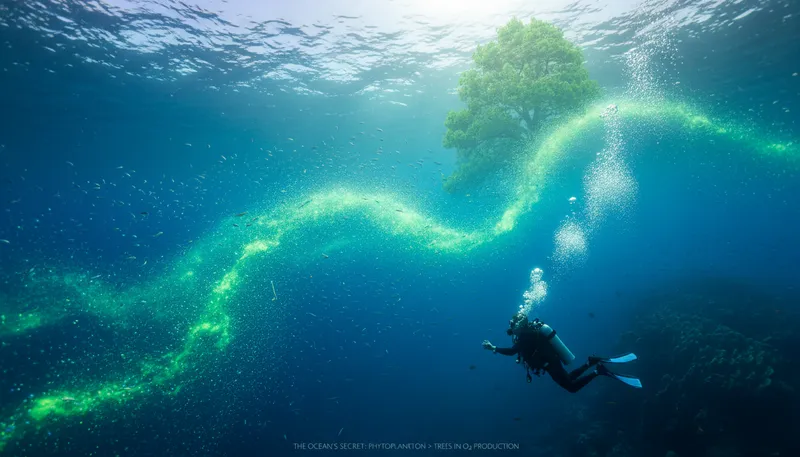
Phytoplankton are tiny, plant-like organisms that drift in the sunlit upper layers of the ocean. Through photosynthesis, they absorb carbon dioxide and release oxygen, much like trees on land. However, their global reach and sheer numbers make them the dominant oxygen producers on Earth. Scientists estimate that phytoplankton generate roughly 50% to 80% of the world’s oxygen, far surpassing the contribution of terrestrial plants and forests [1][2][3][4].
Why Phytoplankton Matter More Than Trees
While trees and forests are vital to our ecosystem, their net oxygen production is surprisingly low. Most of the oxygen produced by forests is consumed by the animals and microbes living within them, leaving little surplus for the atmosphere. In contrast, the oxygen released by phytoplankton enters the ocean water and then diffuses into the atmosphere, directly contributing to the air we breathe [5]. In fact, oceanic plankton are responsible for about half of the planet’s oxygen production, with phytoplankton being the primary contributors [11].
For Scuba Divers: The Breath Beneath the Waves
Every time you take a breath underwater, you’re experiencing the legacy of phytoplankton. The oxygen in your tank or regulator is a product of these microscopic marvels. As divers, we witness the vibrant marine life that depends on phytoplankton, from the smallest fish to the largest whales. Protecting the health of our oceans ensures that phytoplankton can continue their vital work, supporting both marine and human life [2][5].
For Marine Biologists: The Foundation of the Food Web
Phytoplankton form the base of the marine food chain, supporting everything from zooplankton to apex predators. Their seasonal blooms, fueled by sunlight and nutrients, drive primary production in the ocean. Understanding phytoplankton dynamics is crucial for studying climate change, carbon sequestration, and the overall health of marine ecosystems [3][4].
For Photographers: Capturing the Unseen
While phytoplankton are invisible to the naked eye, their blooms can transform the ocean into a canvas of swirling greens and blues, visible from space. Photographers can capture these breathtaking patterns from boats or drones, showcasing the beauty and scale of these microscopic organisms. Phytoplankton blooms are not only stunning but also a reminder of the ocean’s vital role in sustaining life on Earth [4].
Protecting Our Ocean’s Secret
The health of phytoplankton populations depends on clean, nutrient-rich waters. Pollution, climate change, and ocean acidification threaten their survival, with potential consequences for global oxygen levels and marine biodiversity. By monitoring water quality and supporting conservation efforts, we can help ensure that phytoplankton continue to outshine trees in oxygen production and keep our planet thriving [5].
- Phytoplankton produce 50% to 80% of the world’s oxygen [1][2][3][4].
- Oceanic plankton are responsible for about half of the planet’s oxygen production [11].
- Phytoplankton form the base of the marine food chain and support diverse marine life [3][4].
- Phytoplankton blooms create stunning visual patterns visible from space [4].
- Protecting ocean health is essential for sustaining phytoplankton populations and global oxygen levels [5].
References
- 10Plankton
PADI Divemaster and underwater storyteller with over 7 years of hands-on Red Sea diving experience, documenting marine life, mapping dive sites, and promoting responsible ocean conservation.