
Butterfly rayGymnuridae
A pregnant butterfly ray is producing milk. There is no placenta and nothing resembling a mammal's gland: the wall of the uterus grows fields of fine filaments, and those filaments secrete a thick fluid heavy with fat and protein straight into the space the embryos are floating in. The pups burn through their yolk early in the pregnancy and spend the rest of it drinking, taking the fluid in through the mouth and the spiracles, and they are born as complete small rays able to feed themselves the same day.
The tail is the family's other oddity, and the name records it: Gymnuridae means naked tail. Almost every other ray trails a whip several times the length of its own body, and this one has a stub with no fin fold on it. Where the related families carry a serious serrated spine, some butterfly rays carry a small one and some carry none at all. This is the ray that put down the weapon and relies entirely on not being found, which is also part of why so little is known about it.
The mouth is different too. Instead of the pavement of fused plates that a shellfish-eating ray uses, the jaws hold bands of many small pointed teeth, because a good share of the diet is fish taken off the bottom, with shrimp and small crabs alongside.
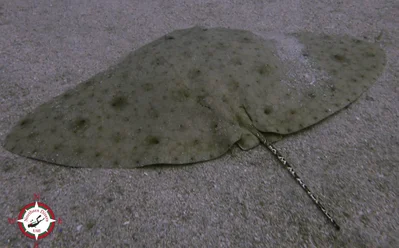
One species is listed for this sea, the longtail butterfly ray, which is the exception that keeps a longer tail than its relatives. It lives on soft open bottom well away from coral, and most of what is known about it in this region comes from trawl catches and stranded animals rather than from anyone watching a live one. The divers who do find one generally find it by accident, as an outline in the sand that turns out to move.
- very wide, flattened disc
- disc width noticeably greater than its length
- blunt head broadly integrated into disc
- very short, slender tail
- often partially or fully buried in sand or mud
1 species in Butterfly ray
Other groups in Rays
Nearby in the catalogue.


Last Update: August 23, 2026