
Mantas and devil raysMobula
A manta has the largest brain of any fish, and it keeps it warm. A dense mesh of blood vessels wraps the braincase and works as a heat exchanger, holding the brain above the temperature of the water around it, which matters because these animals dive. Rays of this genus have been tracked down past a thousand meters into cold black water and back up again, on trips that look deliberate rather than accidental.
The horns are the feeding gear. Those two lobes carried rolled up at the front of the head are the leading edge of the pectoral fins, split off and turned into a separate pair of fins, and a feeding animal unrolls them into a funnel that steers water into a mouth set at the front of the head instead of underneath. What happens next is the part worth knowing. The gill plates inside are not a sieve. Water crossing them meets a series of lobes and rolls into small vortices that throw plankton backward toward the throat while the water itself passes out through the gills, so the food never settles on the filter and the filter cannot block.
It is an expensive way to live and a slow one. A female carries a single pup for about a year and does not breed every year, so animals taken out are not replaced inside a working lifetime. That is what makes the trade in their gill plates so destructive. They are also predictable, which is worse: they queue at cleaning stations on reef pinnacles and hold position there, and that is exactly where a fishery finds them.
Mantas and devil rays now sit in one genus, Mobula, the separate genus Manta having been folded into it. In this sea they are an occasional encounter rather than a reliable one, most often a reef manta working a current line in the south, or devil rays offshore in a group. The two are not the same animal to meet: a manta will often circle a diver, and devil rays generally will not stay.
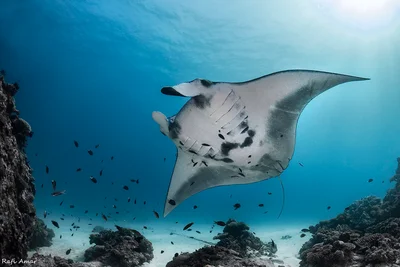
- very large, flat, diamond-shaped body
- extremely long, wing-like pectoral fins
- two horn-shaped lobes extending from head
- dark upper side, white underside with dark markings
- often seen barrel-rolling or somersaulting in open water
5 species in Mantas and devil rays



Other groups in Rays
Nearby in the catalogue.


Last Update: August 23, 2026