
Eagle rayMyliobatidae
An eagle ray eats animals that are built not to be eaten, and its jaws are a mill. Instead of rows of points, the teeth are fused into wide flat bars laid across the jaw like paving, one interlocking set above and one below, pushed forward and replaced from behind as the working edge wears down. A clam that has spent its whole life inside a shell arrives intact and comes apart in one closing of the mouth.
Finding it is the harder half of the job. The ray works nose-down over sand, digging with the shovel-shaped snout and blowing jets of water from its mouth to blast a pit clear, then takes whatever the hole gives up: bivalves, snails, crabs, worms. Shell and meat go in together and are sorted inside the mouth, and the shell is spat back out. An eagle ray that has been feeding leaves a line of craters and a slick of crushed shell on the bottom behind it.
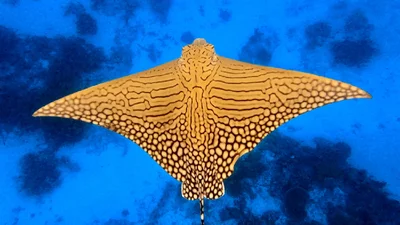
The rest of the animal is built for a different job entirely. The disc is long and pointed like a wing rather than round, the head stands clear of it with a blunt snout and eyes set on the sides, and the ray beats its way through open water in slow deep strokes, crossing ground between reefs rather than living on one. They will jump clear of the surface and land flat, hard enough to hear. Behind them trails a thin whip of a tail, several times the length of the disc, carrying one or more spines near its base.
Two species are listed here. The ocellated eagle ray is the one seen, dark with a scatter of white spots, usually cruising a wall or crossing sand alone or in loose company. The ornate eagle ray is among the rarest large rays anywhere in the world, patterned in dark bands and rings, and a sighting of one is worth reporting rather than just photographing.
- flattened, kite or diamond-shaped body
- long, whip-like tail
- distinct head with a pointed or shovel-like snout
- dark upper body, white belly
- active swimmers, often cruising mid-water
2 species in Eagle ray

Other groups in Rays
Nearby in the catalogue.


Last Update: August 23, 2026