
WedgefishRhinidae
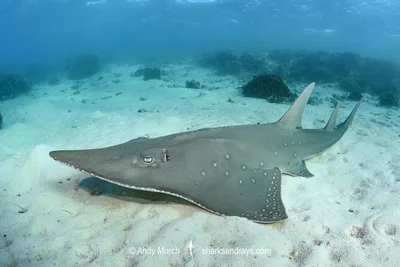
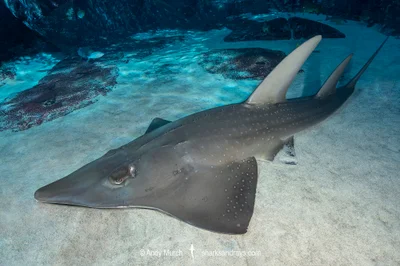
The largest animal living on the open sand in this region is a ray that most people would report as a shark. A wedgefish grows past three meters, and from above and behind that is exactly what it looks like: a heavy body, two tall dorsal fins, a deep forked tail with a strong upper lobe. Only the front end gives it away. The head is flattened into a wedge, the eyes sit on top of it, the mouth is a straight line underneath, and the gill slits are on the belly, which no shark has.
Front and back do different jobs. The flat head is a bottom tool, put down on sand and rubble for crabs, shrimp and buried shellfish that are crushed between ridged pavements of teeth. The tail is a shark's and it is fast, so unlike a stingray this animal can also run down fish in open water instead of waiting for them to arrive. The whole upper surface is armed with rows of large thorns, over the eyes, across the shoulders and down the midline, and the arrangement of those thorns and of the white spots on the back is how the species are told apart.
They carry no sting. What a big wedgefish does when a diver arrives is lift off the sand and go, without any hurry, at a speed that ends the encounter.
That encounter has become very unlikely. Wedgefish live in shallow coastal water, use bays and flats as nurseries and grow slowly, which puts them in front of inshore fisheries for their entire lives, and the family is now listed as Critically Endangered across its range. Two species are on the list for this sea, and records from this coast are now few enough that a photograph of the spot pattern is worth more than a sighting on its own. This is one of the animals the catalogue documents partly because it may not be here much longer.
- flattened head and broad pectoral disc
- robust, shark-like body posterior to disc
- two large, distinct dorsal fins
- strong, crescent-shaped tail fin
- grey to olive-brown body, often with pale spots or bars
2 species in Wedgefish
Other groups in Rays
Nearby in the catalogue.


Last Update: August 23, 2026