Butterflyfishes
Bony fishes

ButterflyfishesChaetodontidae

Family15 species

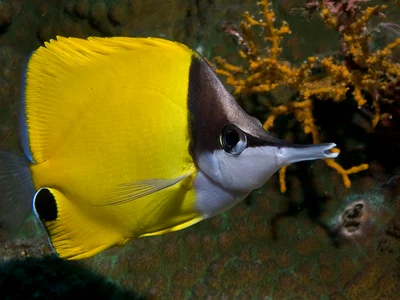
Much of this family eats coral, and eats it one polyp at a time. The snout ends in a brush of fine teeth, which is what the family name means, and the fish picks individual polyps out of the surface of a living colony or clips the crowns off tube worms, taking a fraction of a meal from a hundred colonies in a morning and killing none of them. It is the opposite of how anything else on the reef feeds.

Some species can switch to other food. Several cannot, and that turns them into an instrument. An obligate coral feeder has no fallback, so when the coral dies the fish goes even though the reef still looks like a reef: the skeleton stands, the shape is unchanged, and the butterflyfish are simply not there anymore. Survey teams count them for exactly that reason. The number drops before the structure does, and after a bleaching event the coral eaters thin out first while the generalists stay put.

They go in twos. A butterflyfish pair is not a courtship that ends; it can hold for years, and the two feed within a body length of each other, work the same ground day after day and search when they are separated. For an animal whose food is scattered in small fixed amounts across a territory, two fish that know every colony on it and can drive off an intruder together are worth more than either alone.

The family they get confused with is the angelfishes, and one mark settles it: an angelfish carries a spine at the lower corner of the cheek and a butterflyfish does not. Fifteen species are listed here and several of them, including the two you will see most, live here and nowhere else. Their young are worth a footnote: the larva swims in a case of bony plates over the head and shoulders, armor that no adult has and that it sheds when it settles onto a reef.

How to recognise butterflyfishes
DiscRound and flat as a plate, seen from the side - butterflyfishes, angelfishes.
  • deep, laterally compressed body
  • small, brush-like mouth
  • distinctive contrasting colour patterns

15 species in Butterflyfishes

Chaetodon

12

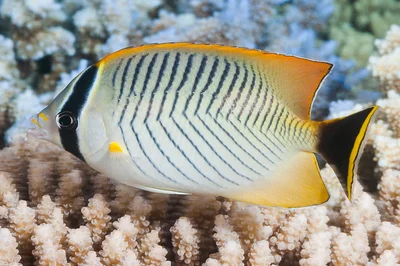
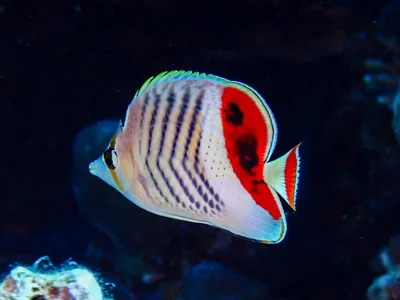
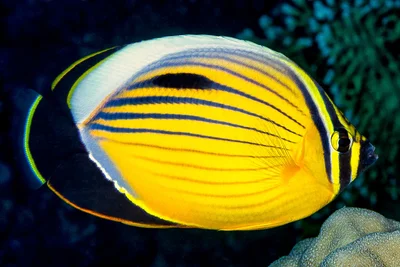
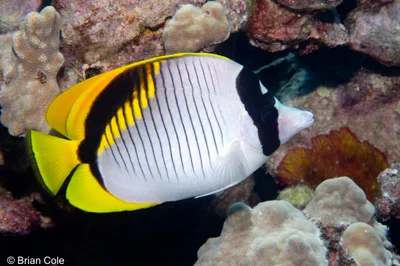
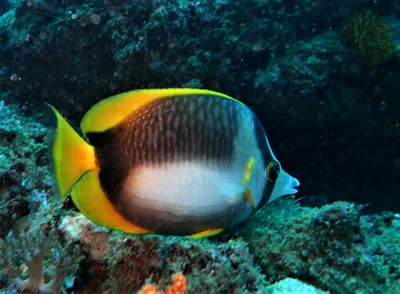
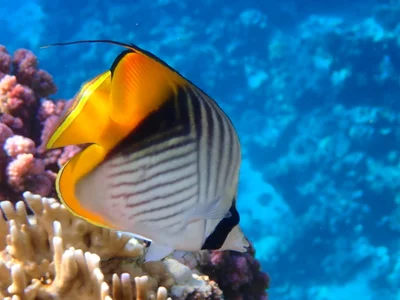
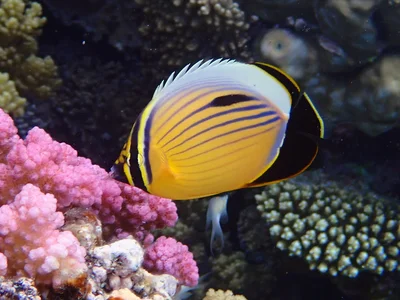
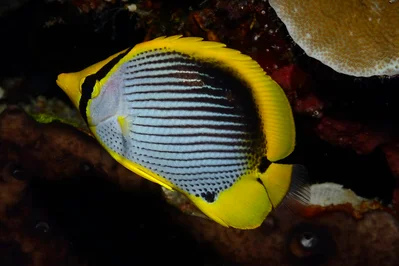
Twelve of the fifteen species here, and the pattern is the whole identification - not the colors, which repeat across the genus, but the geometry: whether the lines run vertically, diagonally or as chevrons, and where the black sits. Almost every one of them wears a dark bar dropping through the eye, which is the point of it: the eye is buried in the band, and several species carry a false target at the other end of the body, so a strike goes to the wrong end of a fish that is about to leave in the opposite direction.
Heniochus

2

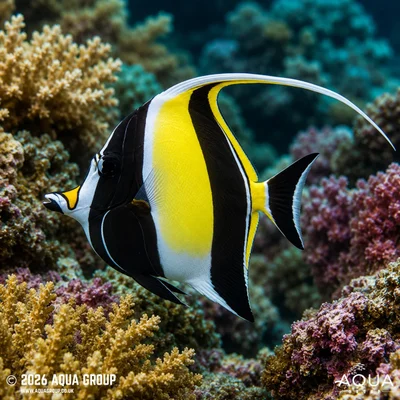
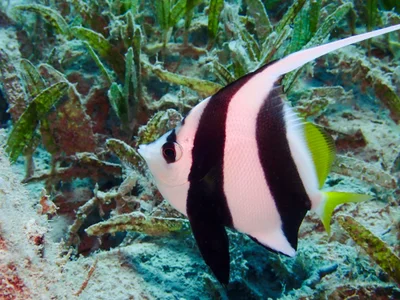
The bannerfishes, named for one feature: the fourth dorsal spine is drawn out into a long white pennant that trails over the back. The two here look almost identical and behave nothing alike - one moves in shoals, the other in the pairs the rest of the family keeps to. Both are regularly called Moorish idols, which are a different family altogether.

Other genera

1
Other disc-shaped groups

Similar silhouette underwater - worth a look if this was not your animal.

Buy me a coffee
Affiliate partner

Last Update: August 23, 2026