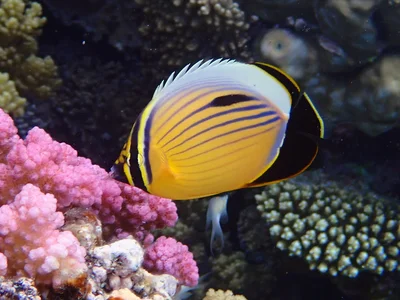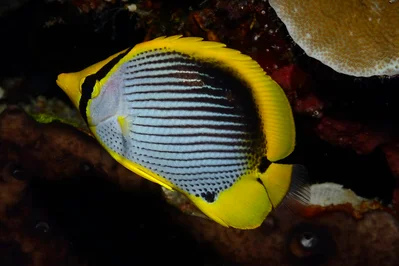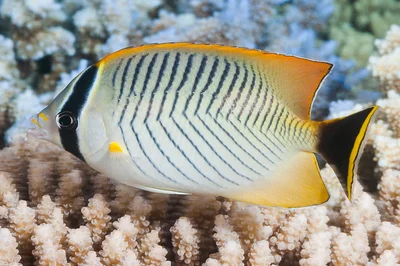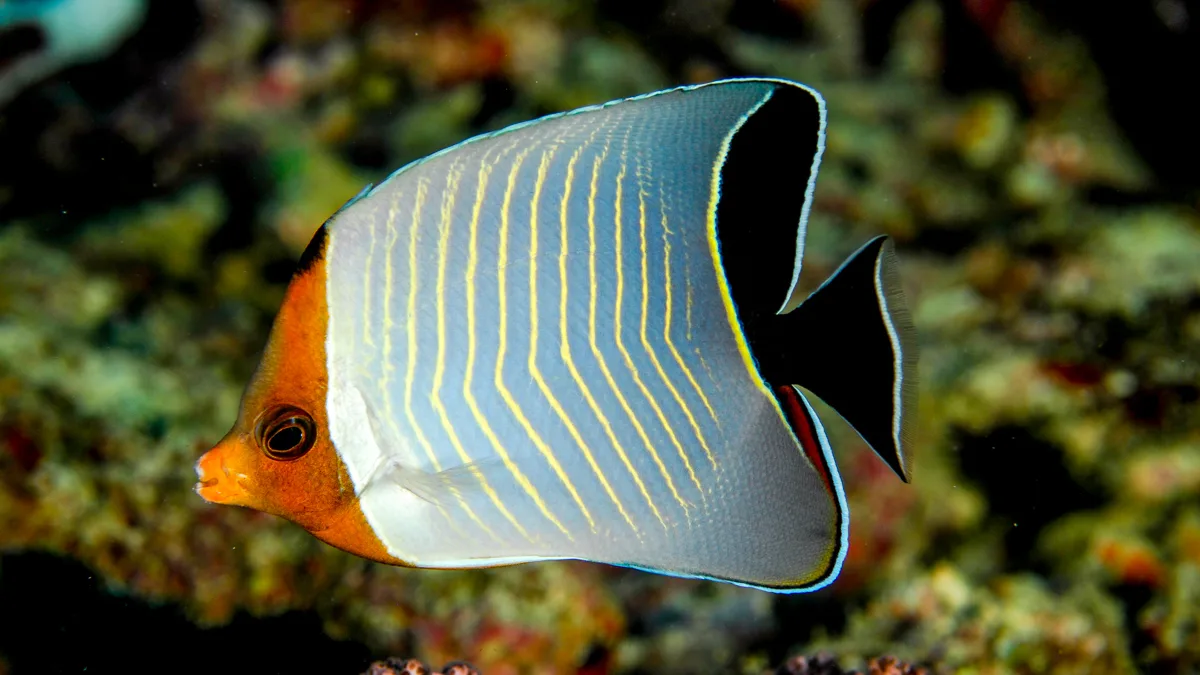
The Orangeface Butterflyfish, Chaetodon larvatus, is a deep-bodied, compressed butterflyfish. It reaches a maximum total length of 12 cm (4.7 in). The body is primarily powder blue, marked with narrow, white chevron-shaped bars that run across the flanks. The head and the front part of the body display an intense red-orange coloration, a feature from which its common name derives. The scientific name larvatus is Latin for "masked," referring to this distinctive facial pattern. The back of the dorsal fin and the entire caudal fin are black. This species shares a morphological resemblance with the Triangle Butterflyfish (Chaetodon triangulum), its sister species from the 🌊 Indian Ocean, particularly in its deep, angular body shape.
This species inhabits seaward and lagoon coral reefs, typically at depths ranging from 3 to 20 meters (10 to 66 ft). Orangeface Butterflyfish are commonly observed in stable pairs, which maintain a territorial presence on the reef. As a diurnal species, it is active during daylight hours. Its diet consists exclusively of the polyps from tubular Acropora corals, making it a specialist corallivore. The primary distribution of Chaetodon larvatus covers the 🌊 Red Sea and 🌊 Gulf of Aden, though it has been recorded twice recently in the eastern Mediterranean Sea off Palestine and Syria.
The genus. Chaetodon Linnaeus 1758 - chaeto- (bristle) + odon (tooth). ETYFish
The species. Chaetodon larvatus Cuvier 1831 - masked. ETYFish
Why it's threatened
Threat classification from the IUCN Red List.