The Crush of the Abyss: Three Scuba Records That Redefined Human Limits

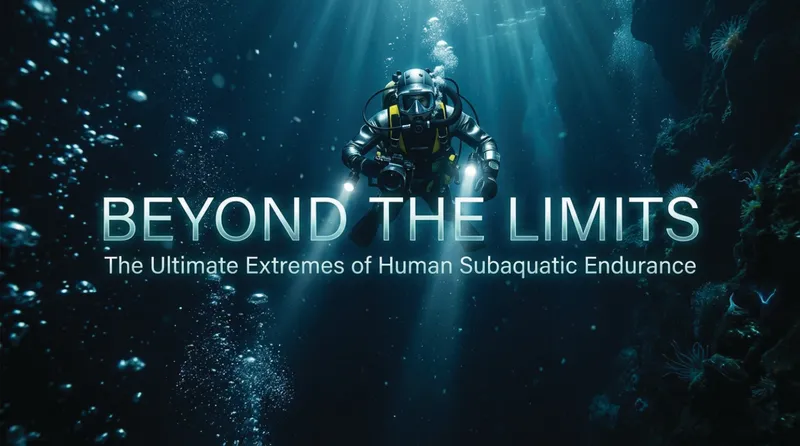
For the recreational diver, the underwater world is a temporary sanctuary experienced in 40- to 60-minute windows. We are bound by "bottom time" - a delicate calculation of air consumption and no-decompression limits. For most, the surface is always a shallow breath away. However, a elite group of explorers and technicians has looked at these biological boundaries and systematically dismantled them.
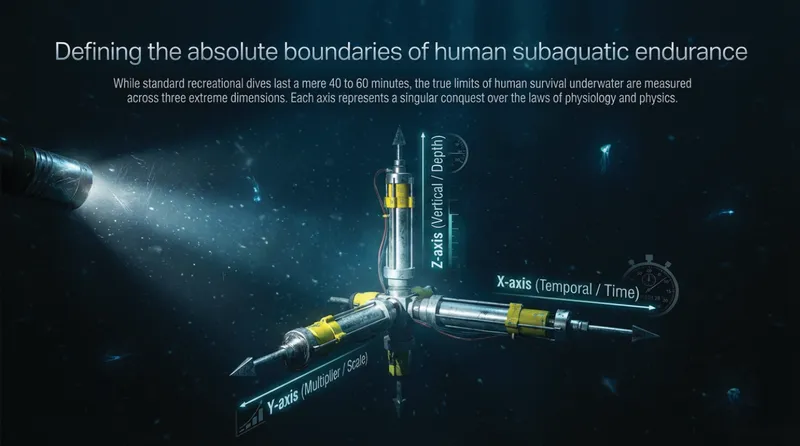
By manipulating gas partial pressures, enduring psychological isolation, and mastering complex logistical chains, these record-breakers have pushed into a realm where the water column becomes a physical weight and time is the ultimate enemy.
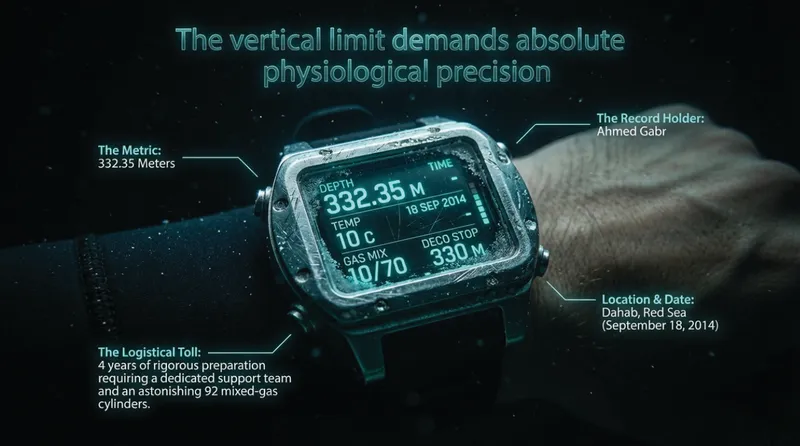
The 14-Hour Journey Home: A 332-Meter Descent
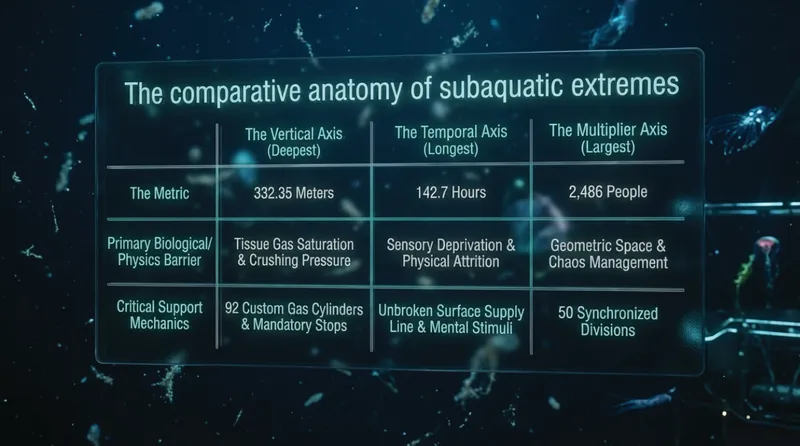
On September 18, 2014, Egyptian diving specialist Ahmed Gabr achieved the unthinkable in the Red Sea off Dahab. He plummeted to a staggering depth of 332.35 meters, effectively entering a world of crushing hydrostatic pressure and absolute darkness. While his descent was a rapid, 15-minute freefall, his return to the surface was a grueling 14-hour marathon of physiological survival.
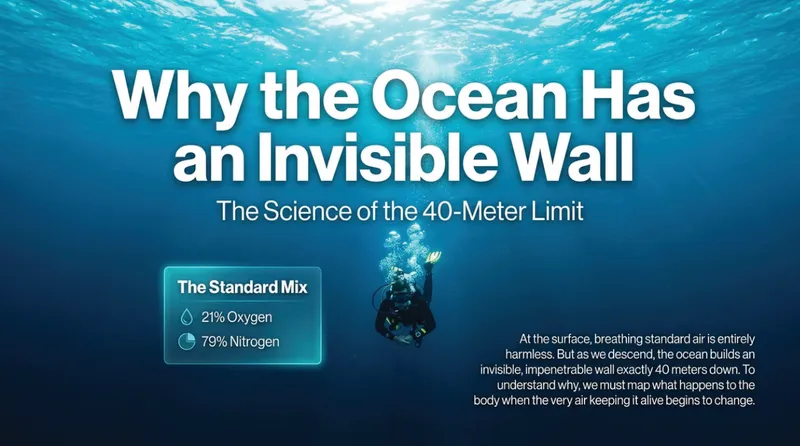
This extreme asymmetry is dictated by the physics of gas solubility. As a diver descends, the high ambient pressure forces gases - specifically nitrogen - to dissolve into the body's tissues at an accelerated rate. While the body "saturates" quickly, it desaturates with agonizing slowness. Surfacing too fast would cause that dissolved nitrogen to erupt into bubbles within the bloodstream, causing catastrophic decompression sickness.
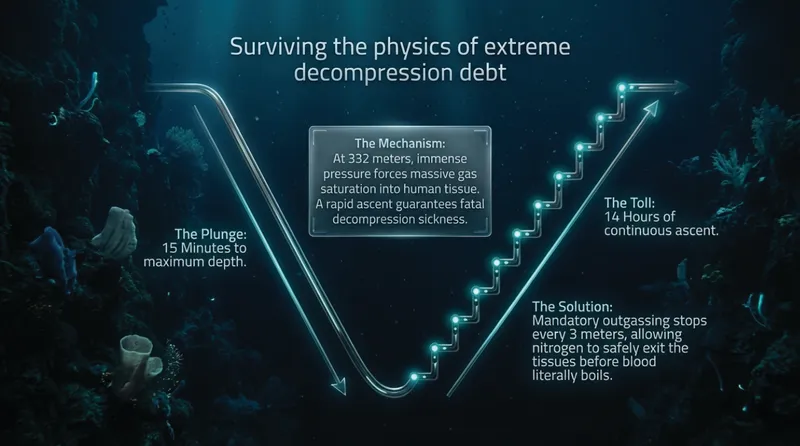
To manage this risk, Gabr’s team developed a rigorous decompression schedule involving specific trimix blends and 92 gas cylinders. He was forced to pause and off-gas at precise 3-meter intervals, hovering in the blue for hours as his body slowly equalized.
"At these extreme depths, the margin for error is non-existent. Surfacing is not a choice; it is a clinical process of pressure management. If you violate those 3-meter interval stops, you are inviting certain death from decompression."
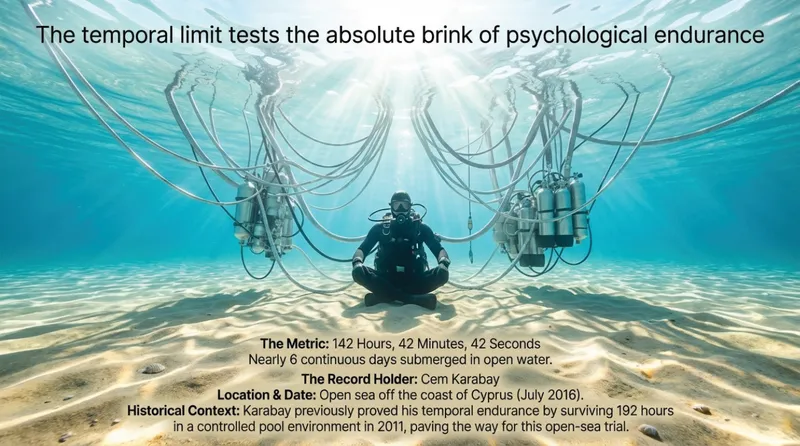
Living Underwater: Six Days in the Open Sea
While Gabr challenged the vertical limit, Turkish diver Cem Karabay sought the horizon of human endurance. In July 2016, submerged off the coast of Cyprus, Karabay set a breathtaking record by remaining in the open sea for 142 hours, 42 minutes, and 42 seconds. For nearly six days, he did not see the sun or breathe atmospheric air.
Surviving for a week underwater is a logistical and psychological nightmare. Karabay’s support team functioned as a deep-sea lifeline, delivering food, water, and fresh cylinders to his seafloor camp. Beyond the physical toll of thermoregulation and skin maceration, the mental strain of the "silent world" is profound. To maintain cognitive function and ward off the sensory deprivation of the Mediterranean, Karabay engaged in underwater chess and football. Far from a simple game, playing football while submerged is an exertion nightmare, requiring precise buoyancy control and stamina in a high-resistance environment.
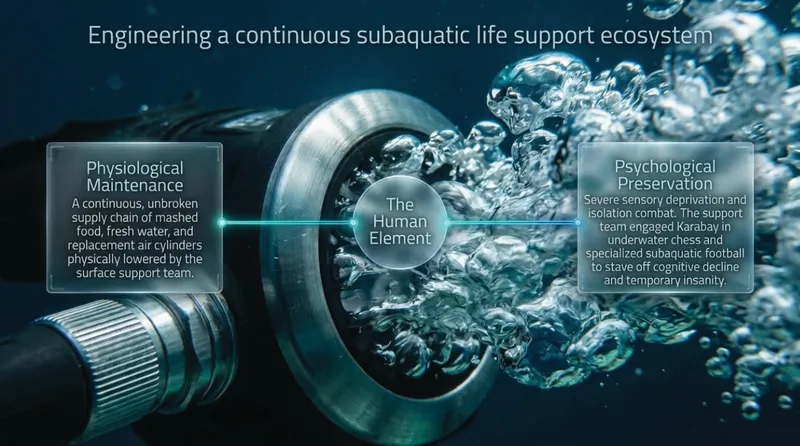
This open-sea feat far surpassed his 2011 pool record of 192 hours. While the pool offered a controlled environment, the Cyprus record forced Karabay to contend with shifting currents, fluctuating temperatures, and the psychological weight of knowing he was an alien inhabitant of a vast, unpredictable ecosystem.
The Underwater Army: 2,486 Divers in Unison
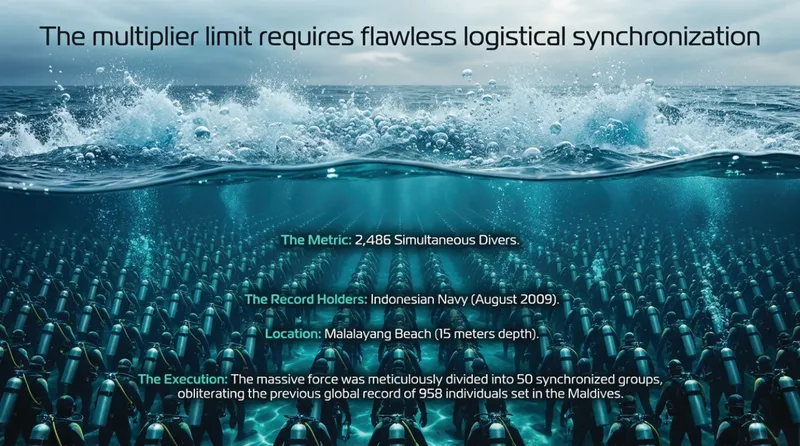
If individual records test the soul, the Indonesian Navy’s 2009 achievement tested the limits of collective discipline. At Malalayang Beach, the Navy orchestrated a massive "underwater army," submerging 2,486 divers simultaneously.
This was not a chaotic assembly. The divers were organized into 50 distinct tactical groups, each descending to a depth of 15 meters in a synchronized display of coordination. This feat more than doubled the previous record held by the Maldives (958 divers), representing an exponential leap in risk. In a mass dive of this scale, the logistical complexity is staggering; a single panicked diver or a regulator failure can trigger a chain reaction.
The achievement was less about individual physical prowess and more about the technical precision of the Indonesian Navy’s command structure. Coordinating the air supply, buoyancy, and safety of nearly 2,500 people in a medium that is fundamentally hostile to human life is a testament to the power of maritime discipline and high-level logistical planning.
Conclusion: The Receding Horizon
These records - measured in atmospheres of pressure, days of isolation, and thousands of participants - reveal a fundamental truth: the "limit" is a moving target. We are terrestrial creatures, yet our technical ingenuity and restless curiosity drive us to colonize the deep, if only for a few days or a few hundred meters.
As we continue to refine hyperbaric medicine and life-support technology, we must ask: Are we nearing the final biological wall, or is the horizon of human endurance still receding further into the deep blue?
PADI Divemaster and underwater storyteller with over 7 years of hands-on Red Sea diving experience, documenting marine life, mapping dive sites, and promoting responsible ocean conservation.