Sharks: Nature's Engineering Masterpiece - Why They're More Advanced Than You Think

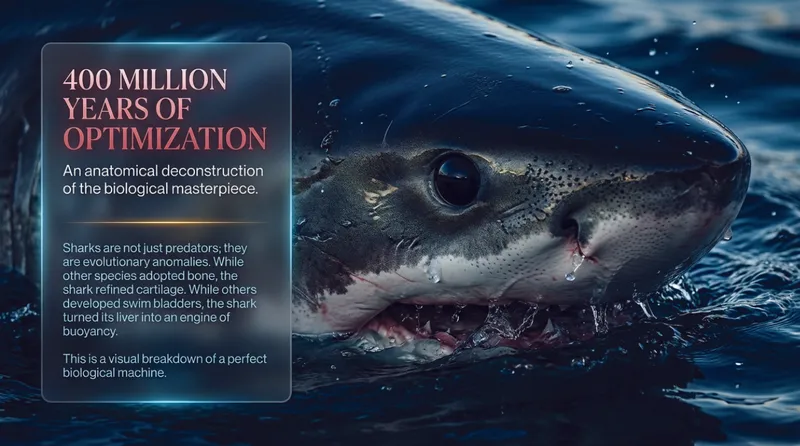
It is a common misconception that sharks are "living fossils" - primitive relics that have remained frozen in time for hundreds of millions of years. In reality, sharks were perfecting their biological blueprints long before the first trees appeared on Earth, and they are older than many ancient lineages, including insects, mammals, and birds. Far from being evolutionary leftovers, these apex predators are some of the most sophisticated machines on the planet.
Their anatomy is a masterclass in efficiency, featuring counter-intuitive biological "hacks" that allow them to thrive in environments ranging from vibrant coral reefs to the crushing, pitch-black silence of the deep sea. By deconstructing their physiology through a modern lens, we discover that sharks have not just survived; they have engineered their way to the top of the food chain.
The "Boneless" Evolutionary Reversion
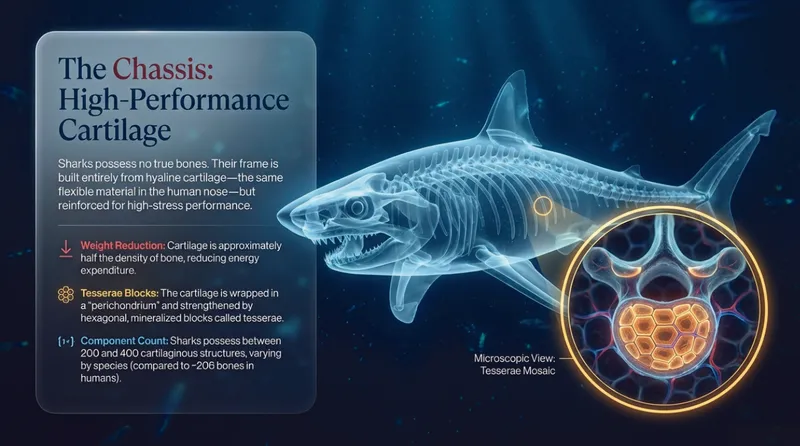
While most vertebrates rely on a heavy, bony skeleton, sharks utilize a framework made of cartilage - the same resilient material found in your ears. Though often viewed as a "simpler" trait, evidence suggests this is a deliberate evolutionary reversion. Early shark ancestors likely possessed bony skeletons, but the lineage transitioned back to cartilage to prioritize a high-performance, high-speed lifestyle.
This cartilaginous endoskeleton is about half as dense as bone, providing a massive reduction in weight without sacrificing structural integrity. To solve the problem of strength, the skeleton is reinforced by tesserae: a layer of hexagonal, mineralized blocks that provide a protective "armor" over the hyaline cartilage. This unique engineering allows for incredible flexibility and tighter turns while pursuing prey.
"We think early sharks developed a cartilaginous skeleton because it better suited their lifestyle. Being light and more flexible than bone, cartilage means sharks can typically swim faster than bony fish." - Emma Bernard, Fossil Fish Curator.
The 25% Rule: A High-Octane Buoyancy Strategy
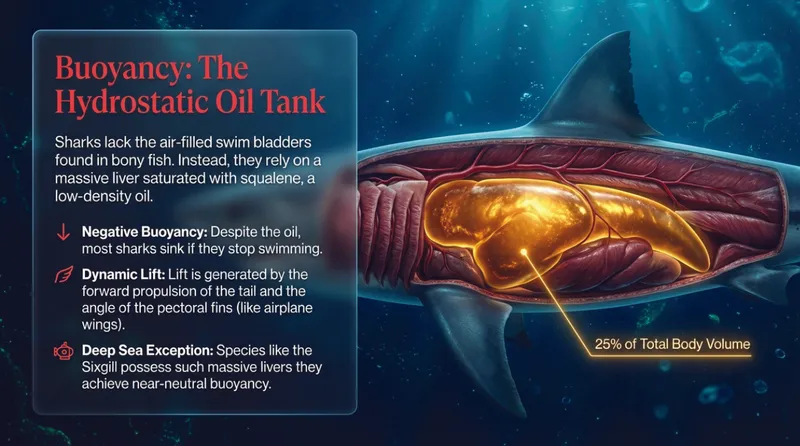
Unlike bony fish, which utilize a gas-filled swim bladder to maintain their position in the water column, sharks have opted for a massive, hydrocarbon-based buoyancy system. The cornerstone of this strategy is the liver - a hydrostatic organ that can account for up to 25% of a shark's total body weight.
This oversized organ is saturated with squalene, a low-density oil. Because squalene is significantly less dense than seawater, it provides the "lift" necessary to prevent the shark from sinking. Beyond buoyancy, these oily reserves act as a high-density energy store. This dual-purpose engineering allows sharks to navigate resource-scarce environments for weeks between meals, essentially carrying their own fuel tank and ballast system in a single organ.
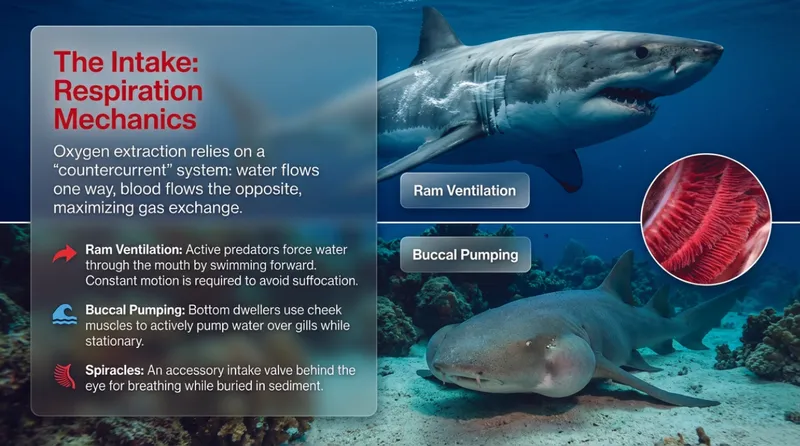
How Sharks Breathe: Engineering Oxygen Extraction
Sharks extract oxygen from water through gills employing a highly efficient countercurrent exchange system, where water flows over the gill filaments in the opposite direction to blood flow, maximizing oxygen diffusion gradients for up to 80-90% extraction efficiency - far superior to the parallel flow in human lungs.
Fast-swimming species like great whites and makos rely on ram ventilation, forward propulsion forcing water through their gaping mouths and over the gills; this demands constant motion, as stillness risks suffocation, aligning perfectly with their high-speed predatory lifestyle. In contrast, bottom-dwelling sharks such as nurse or wobbegong sharks use buccal pumping, rhythmically contracting buccal cavity muscles to draw water over gills without swimming, enabling ambush predation from stationary positions.
Enhancing versatility, many sharks feature spiracles - small openings behind the eyes that pump water directly to the gills, crucial for respiration when mouth-closed or buried in sediment, ensuring survival in diverse habitats from reefs to abyssal plains.

Nature’s Tesla Valve: Passive Intestinal Plumbing
One of the most profound technological parallels found in nature is the shark’s spiral intestine. Recent 3D reconstructions created from CT scans have revealed that this organ functions essentially as a biological "Tesla Valve." Much like the fixed-geometry valve patented by Nikola Tesla, the spiral intestine facilitates unidirectional flow without the need for mechanical parts or "flappers."
This design operates passively, without requiring muscular contractions to guide the movement of material. The complex, 3D folds - ranging from columnar to scroll-like structures - create a path of high resistance for backflow while slowing the transit of food. This maximizes the time available for nutrient absorption, ensuring the shark extracts every possible calorie from its diet with surgical efficiency.
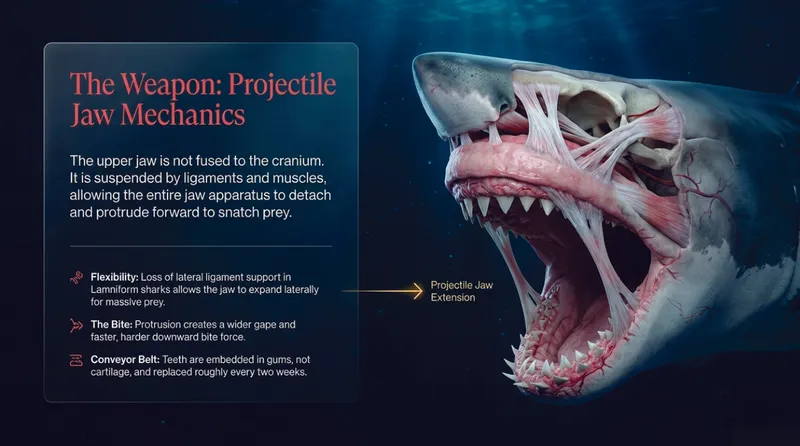
The Slingshot Jaw: Independent Suspensions for Predators
The mechanics of a shark’s strike are fundamentally different from the fused anatomy of a human skull. In sharks, the upper jaw - known as the palatoquadrate - is not fused to the cranium. Instead, it is a "floating" structure held in place by a complex network of ligamentous support.
When a shark strikes, it utilizes the preorbitalis muscle and the palatonasal ligament to thrust the entire jaw forward and away from the head in a "protrusion mechanism." This creates a "slingshot" effect, allowing the shark to deliver a downward bite that is faster and more forceful than a fixed jaw would allow. This independent suspension enables the shark to open its mouth exceptionally wide and maintain lateral support during the high-energy struggle of subduing oversized prey.
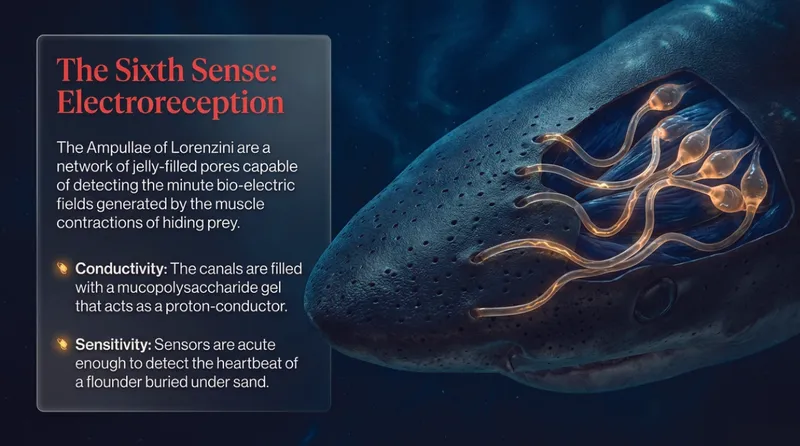
The Sixth Sense: Navigating the Dark via Electroreception
In the light-limited reaches of the deep sea, traditional vision is often a secondary tool. Sharks possess a sophisticated "sixth sense" powered by the Ampullae of Lorenzini - a network of jelly-filled pores that act as biological semiconductors. These receptors detect the minute electromagnetic fields generated by the muscle contractions of other living organisms.
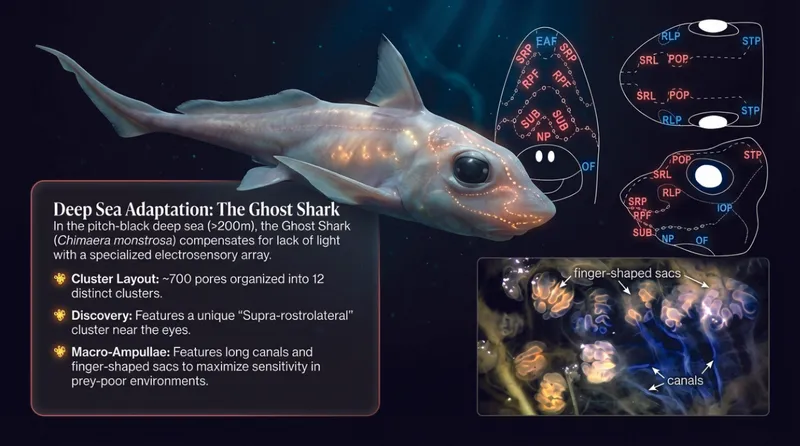
This system is so refined that it allows sharks to locate prey buried beneath the sand or navigate in total darkness. In ancient deep-sea species like the Chimaera monstrosa (Ghost Shark), this system is particularly specialized, featuring approximately 700 pores organized into 12 distinct clusters. This sensory array allows the Ghost Shark to "see" a map of electrical heartbeats, ensuring it remains an effective hunter in the most extreme environmental niches on Earth.
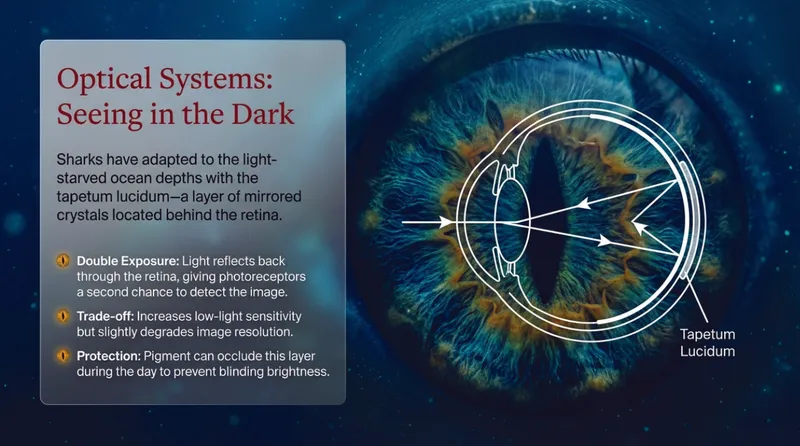
Optical Systems: Seeing in the Dark
Sharks have adapted to the light-starved ocean depths with the tapetum lucidum, a reflective layer of mirrored crystals - guanine-based platelets - positioned behind the retina. This biological mirror functions through a "double exposure" mechanism: incoming light passes through the photoreceptors once, reflects off the tapetum, and passes through them again, dramatically boosting sensitivity in low-light conditions. This engineering marvel allows sharks to detect faint bioluminescence or moonlight scattered through water, essential for hunting in twilight zones or murky coastal waters where photons are scarce.
However, this high-gain optical system comes with calculated trade-offs. The reflective rebound slightly degrades image resolution due to scattered light, prioritizing detection over sharp detail - ideal for spotting movement in the gloom rather than fine print. For daytime protection, specialized pigments in the retinal epithelial cells migrate to occlude the tapetum, preventing overload from bright sunlight and avoiding "blinding" effects, much like an automatic camera shutter. This dynamic control showcases sharks' versatility across diel light cycles, from sunlit reefs to abyssal voids.
Complementing the tapetum, many sharks possess a high ratio of rod cells to cones in their retinas, further tuned for scotopic (low-light) vision, while species like the bull shark exhibit enhanced accommodation via a spherical lens for clearer focus. These optical innovations render sharks far from primitive; their eyes are precision instruments rivaling modern night-vision tech, enabling dominance in environments where light fails other predators.
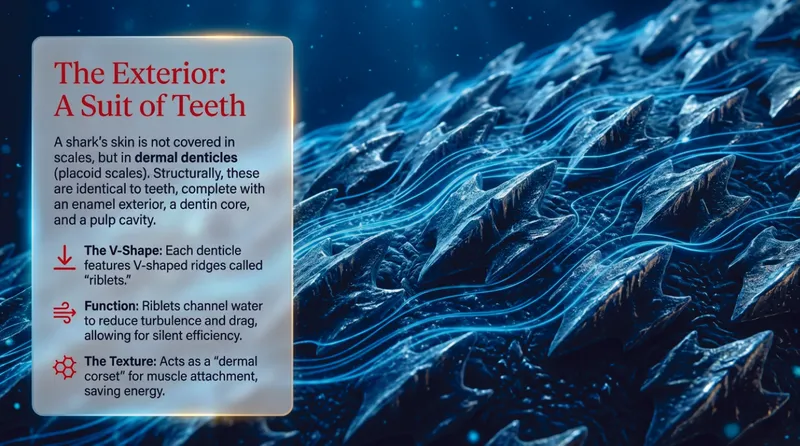
The Exterior: Nature's Hydrodynamic Armor
A shark's skin is not covered in conventional scales, but in specialized structures called dermal denticles (placoid scales) that represent a remarkable convergence of form and function. Structurally identical to teeth, complete with an enamel exterior, a dentin core, and a pulp cavity, these microscopic armor plates demonstrate nature's ability to repurpose proven designs across different biological systems. Each denticle is not merely a static feature but an active participant in the shark's hydrodynamic performance, featuring V-shaped ridges called riblets that channel water flow with precision engineering. This texture acts as nature's answer to the drag-reducing coatings found on modern racing vehicles and aircraft, enabling sharks to move through water with minimal resistance and near-silent efficiency - a critical advantage when hunting prey that rely on detecting vibrations and pressure changes.
Beyond hydrodynamic optimization, the dermal denticle system functions as a "dermal corset" that facilitates muscle attachment and energy conservation. By providing a structured framework for muscular engagement, this textured exterior reduces the metabolic cost of movement, allowing sharks to maintain their predatory lifestyle across vast oceanic distances without expending excess energy on swimming mechanics. The design is so effective that it has inspired biomimetic innovations in human technology, from competitive swimsuit design to industrial applications seeking to reduce fluid drag. This elegant solution demonstrates how evolution has engineered every square centimeter of the shark's exterior as a multi-functional system rather than a passive surface.
What makes this system particularly sophisticated is its universality across shark species despite extraordinary diversity in size, habitat, and hunting strategy. From the massive whale shark gliding through tropical waters to the deep-sea sixgill shark navigating abyssal trenches, the fundamental architecture of dermal denticles remains optimized for the specific environmental pressures each species encounters. This consistency across 450 million years of shark evolution suggests that the riblet-textured skin represents one of nature's most refined solutions to the problem of efficient motion through fluid - a principle that modern engineers continue to study and implement in cutting-edge submarine design and competitive athletics.
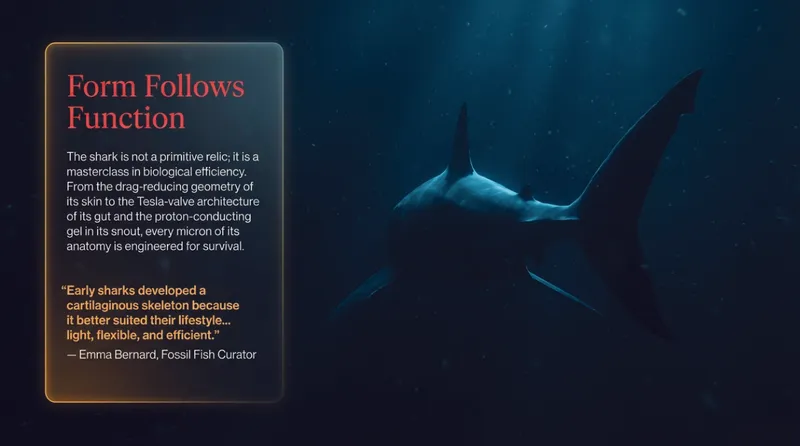
When we deconstruct the anatomy of a shark, we don't find a primitive survivor; we find a masterpiece of refined biological design. From the "Tesla valves" in their guts to the hydrodynamically optimized placoid scales (or dermal denticles) that cover their skin with a texture of "riblets" to reduce drag, every aspect of their body is a lesson in efficiency.
As we look toward the next generation of human technology, we are left with a profound question: what other blueprints for the future are currently swimming in our oceans? Whether it is the design of industrial valves or the development of high-efficiency hydrodynamic coatings, the shark remains our oldest and most sophisticated mentor in the art of engineering.
PADI Divemaster and underwater storyteller with over 7 years of hands-on Red Sea diving experience, documenting marine life, mapping dive sites, and promoting responsible ocean conservation.