Sharks of the Red Sea: The Kings of the Coral Kingdom

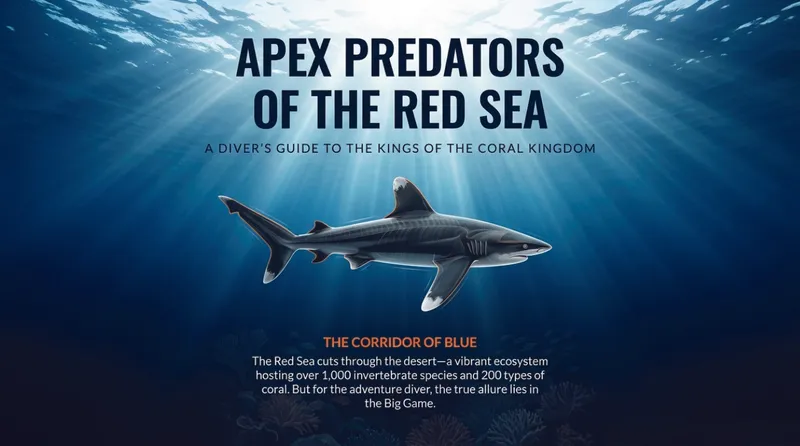
The Red Sea is one of the most vibrant underwater ecosystems on the planet, a corridor of blue cutting through the desert that hosts over 1,000 species of invertebrates and 200 species of soft and hard corals. But for many divers and ocean enthusiasts, the real draw isn’t just the colorful reefs - it’s the big game. It’s the adrenaline spike of seeing a shadow detach itself from the deep blue.
Today, we are diving deep into the world of Red Sea sharks. From the gentle giants to the infamous hunters, here is everything you need to know about these apex predators, the myths surrounding them, and how to encounter them safely.
The "Big Bosses": Key Species You Might Encounter
While there are 44 confirmed species of shark in the Red Sea, divers are most likely to encounter a specific few. Here are the stars of the show:
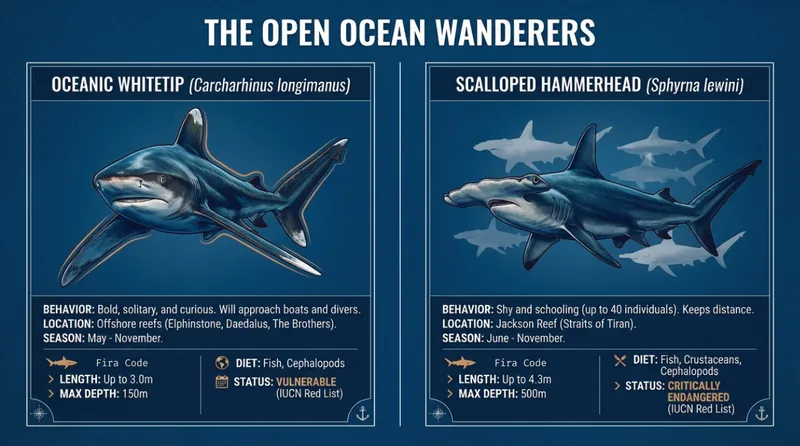
1. The Oceanic Whitetip (Carcharhinus longimanus)
Often called by its scientific name, Longimanus, this shark is perhaps the most iconic - and infamous - of the Red Sea pelagics. They are unmistakable with their huge, paddle-like pectoral fins tipped with white.
- Behavior: Unlike shy reef sharks, Oceanics are bold, solitary, and curious. They often approach divers and boats to investigate.
- Where to find them: They are true open-ocean wanderers but are frequently seen at offshore reefs like Elphinstone, Daedalus, and The Brothers.
- Best Time: Encounters peak from May to November.
2. Scalloped Hammerhead (Sphyrna lewini)
Known for their bizarre, hammer-shaped heads, these are a bucket-list sighting for many.
- Behavior: While they can be solitary, the Red Sea is famous for schools of hammerheads, sometimes numbering up to 40 individuals. They are generally shy and tend to keep their distance from divers.
- Where to find them: The back of Jackson Reef in the Straits of Tiran is a legendary spot for schooling action.
- Best Time: Summer months, particularly June to November, when the water is warmest.
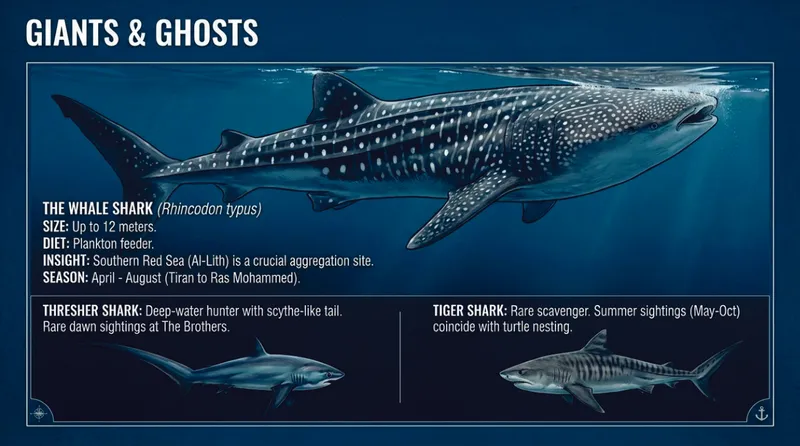
3. The Whale Shark (Rhincodon typus)
The gentle giant of the sea. Despite their size (growing up to 12 meters), they feed only on plankton.
- Scientific Insight: Recent tracking studies have identified the Southern Red Sea (specifically near Al-Lith, Saudi Arabia) as a crucial aggregation site for juvenile whale sharks.
- Where to find them: They are migratory and can pop up anywhere from Tiran to Ras Mohammed, often near the surface.
- Best Time: Spring and early summer, typically April to August.
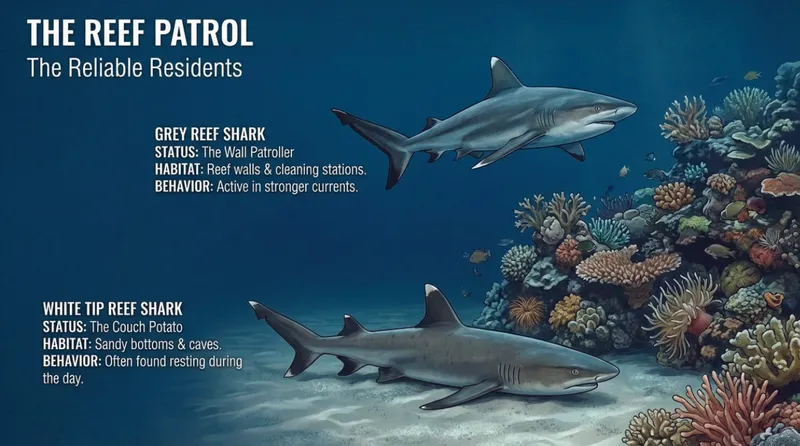
4. Reef Residents: White Tip & Grey Reef Sharks
- White Tip Reef Sharks: The couch potatoes of the shark world. You will often find them resting on sandy bottoms or inside caves during the day.
- Grey Reef Sharks: Classic-looking sharks often found patrolling reef walls or visiting cleaning stations in stronger currents.
5. The Elusive Hunters: Threshers and Tigers
- Thresher Sharks: Easily identified by their massive scythe-like tails, these deep-water sharks are rare treats, occasionally spotted at dawn at places like The Brothers or Daedalus.
- Tiger Sharks: These scavengers are rare but are sometimes seen in the summer (May - October), timing their arrival with the turtle nesting season.
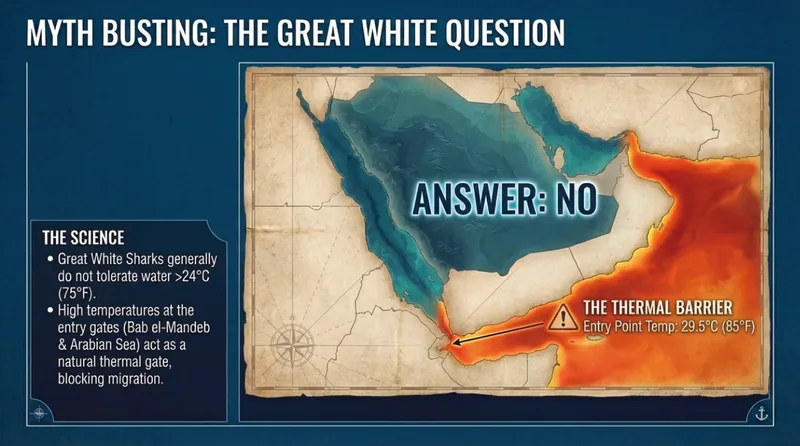
Myth busting: Are there Great Whites in the Red Sea?
A common question we get is whether the legendary Great White Shark patrols these waters. The answer is no. While the Red Sea has deep, cooler waters that Great Whites could technically survive in, they are blocked from entering. To get here, they would have to swim through the Arabian Sea and the Bab el-Mandeb strait, where water temperatures average 29.5°C (85°F). Since Great Whites generally do not tolerate temperatures above 24°C (75°F), this warm water acts as a natural thermal barrier, keeping them out.
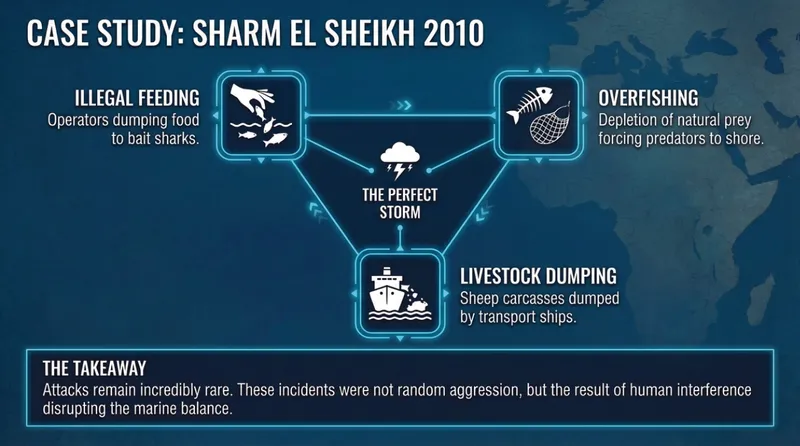
A Note on Safety: The 2010 Sharm El Sheikh Incidents
We cannot talk about Red Sea sharks without addressing the tragic events of December 2010, when a series of attacks in Sharm El Sheikh resulted in injuries to four tourists and the death of another. What happened? Experts described these attacks as "unprecedented". Investigations suggested a "perfect storm" of human-caused factors triggered the aggression:
- Illegal Feeding: Unscrupulous tour operators were dumping food to bait sharks for clients.
- Overfishing: Depletion of natural prey forced predators closer to shore.
- Dumping: Reports indicated a livestock transport ship had dumped sheep carcasses into the sea nearby.
The Takeaway: Shark attacks remain incredibly rare. The 2010 incidents serve as a grim reminder of what happens when humans disrupt the marine balance. When respectful distance is maintained and feeding is banned, diving with these creatures is generally safe.
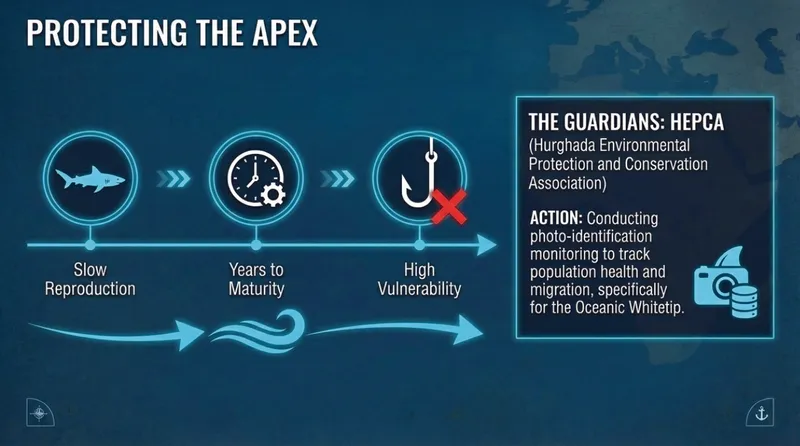
Conservation: Protecting the Apex
Sharks are slow to reproduce; many species take years to reach maturity and have few young. This makes them incredibly vulnerable to overfishing. In the Red Sea, organizations like HEPCA (Hurghada Environmental Protection and Conservation Association) are working to monitor populations through photo-identification projects, particularly for the Oceanic Whitetip.
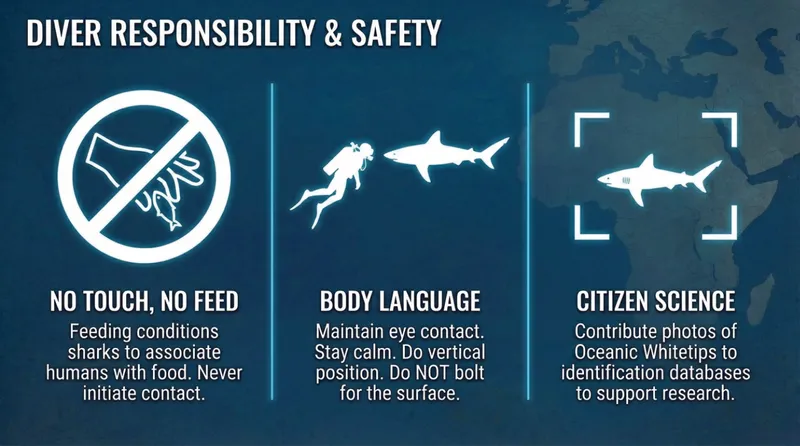
How You Can Help:
- Do Not Touch or Feed: Feeding conditions sharks to associate humans with food, which is dangerous for everyone.
- Dive Responsibly: If you encounter a shark, stay calm, maintain eye contact, and do not bolt for the surface. Enjoy the moment.
- Support Research: If you have photos of Oceanic Whitetips, you can contribute to identification databases that track migration and population health.
Conclusion
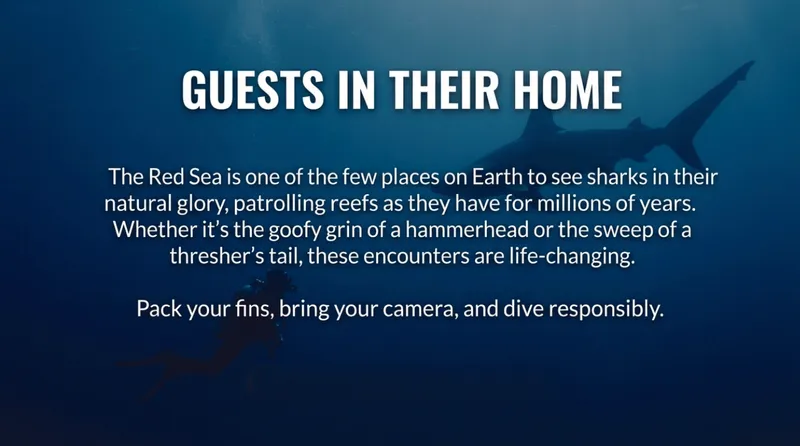
The Red Sea remains one of the few places on Earth where you can still see sharks in their natural glory, patrolling the reefs as they have for millions of years. Whether it's the goofy grin of a hammerhead or the majestic sweep of a thresher's tail, these encounters are life-changing.
Pack your fins, bring your camera, and remember: we are guests in their home.
Ready to book your next dive trip? Check out our list of dive centers on RedSeaCreatures.com.
PADI Divemaster and underwater storyteller with over 7 years of hands-on Red Sea diving experience, documenting marine life, mapping dive sites, and promoting responsible ocean conservation.