
Lefteye flounders
A flounder is an ordinary fish lying on its side. That is the difference between a flatfish and a ray: a ray is pressed flat from above and rests on its belly, while a flounder is squeezed from the sides and has simply tipped over. The mottled surface you are looking at is its left flank, the white underside is its right, and the fin running along the top edge is still the dorsal fin. It has only been laid down.
Which way it tips is not a choice. In the fish collected under this heading the eyes finish on the left side and the animal lies on its right, and that is settled by descent rather than by circumstance: several families that agree on very little else agree on direction. Reversed individuals turn up rarely enough that they get written up as curiosities, and that reliability is why sidedness is one of the first questions an identification key asks about a fish that otherwise offers almost nothing to count.
What the arrangement buys is an ambush. A flounder settles, ripples the continuous fringe of fin that runs around its whole margin, and throws a layer of sand over its own back in a second or two, leaving a pair of eyes showing. In Bothus those eyes sit on short stalks that can be raised clear of the bottom and turned independently, so a buried fish watches two directions at once while moving nothing else. Shrimp, worms and small fish are taken upward, mostly after dark, and the largetooth flounder here carries the canine teeth to hold something that struggles.
Eight are listed here, from thumb-sized Engyprosopon to tonguesoles of 46 cm (18 in), the leaf-shaped ones with no separate tail fin at all. You do not spot the fish. You spot an outline, or the small cloud of sand where one has just left, glided a few body lengths and put itself away again.
- lying still, often partially buried, on substrate
- both eyes on left side of head
- camouflaged colour pattern matching substrate
8 species in Lefteye flounders




Other flattened groups
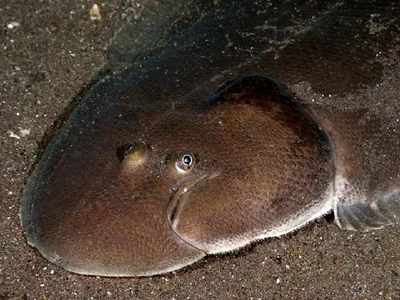
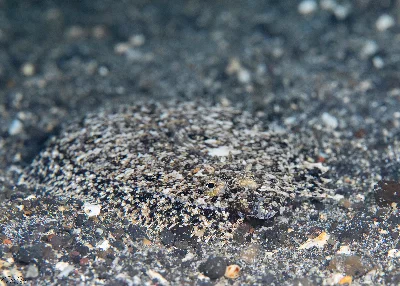
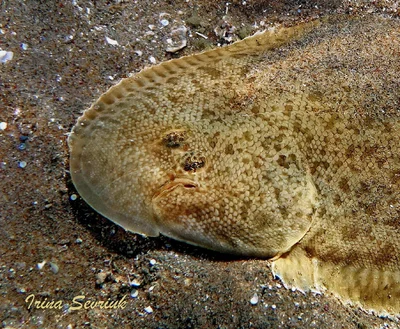
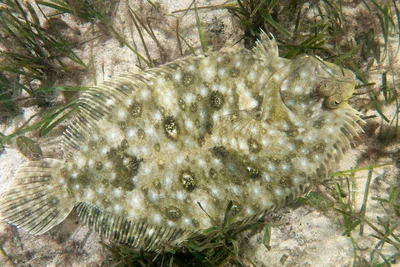
Similar silhouette underwater - worth a look if this was not your animal.


Last Update: August 23, 2026