Marine Symbiosis in the Red Sea: Five Partnerships and How They Work

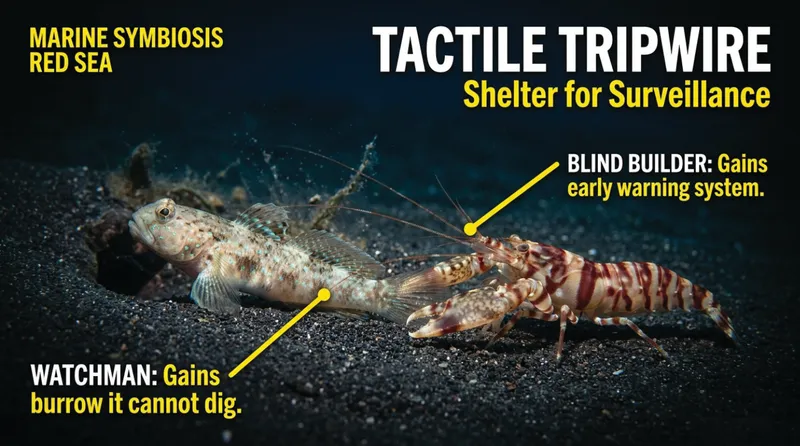
A shrimp that can barely see digs a burrow it cannot guard, and rents it to a fish that cannot dig. The shrimp keeps one antenna resting on the goby's tail the whole time it works. When the goby flicks that tail, the shrimp is underground before the threat has closed the distance.
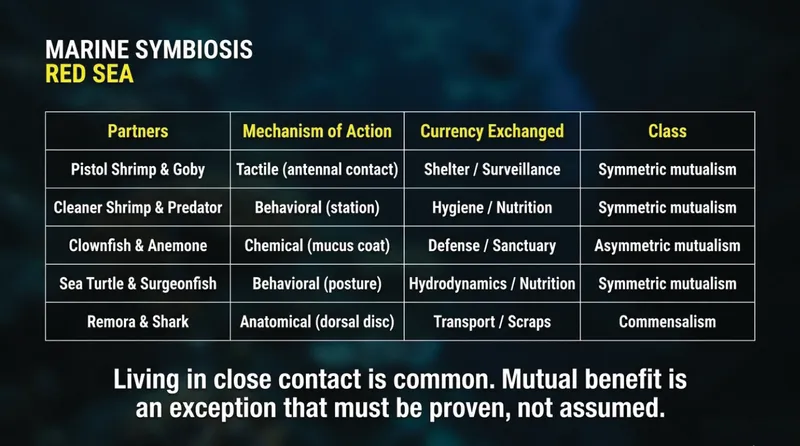
That arrangement is not unusual on a reef. It is one of several in which two species that have no reason to trust each other end up depending on one another anyway, and each of them runs on a specific mechanism rather than on goodwill.
The burrow and the lookout
On open sand there is nowhere to hide, so the shelter has to be dug. Snapping shrimp of the genus Alpheus, including the Tiger Pistol Shrimp (Alpheus bellulus), excavate and constantly repair a burrow, pushing spoil out with the front of the body. Digging leaves them exposed, and their eyesight is poor.
The shrimpgoby supplies what the shrimp lacks. Species such as the Steinitz Shrimpgoby (Amblyeleotris steinitzi) and the Red Sea Shrimpgoby (Cryptocentrus caeruleopunctatus) sit at the burrow entrance and watch. The signal between them is touch, not sight: the shrimp maintains antennal contact with the goby's tail while it works, and a flick of that tail sends both animals into the hole. The goby gets a shelter it could never build; the shrimp gets an early warning system it could never see for itself.
The cleaning stations
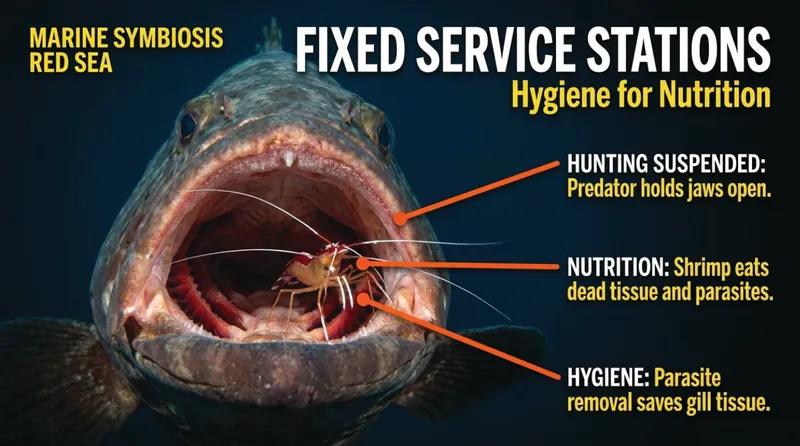
Certain patches of reef work as fixed service points. Cleaner shrimp, including the Banded Cleaner Shrimp (Stenopus hispidus) and the Scarlet Cleaner Shrimp (Lysmata amboinensis), hold a station and advertise it by waving their long white antennae.
What makes the arrangement remarkable is what the client does. Fish large enough to eat the shrimp several times over queue up, hold still, and open their mouths and gill covers so the shrimp can work inside. Parasitic isopods and copepods, dead tissue and damaged scales are removed and eaten. The predator's hunting response is suspended for the duration, and the shrimp works in a mouth that is otherwise lethal.
The economics are straightforward on both sides. The shrimp gets a reliable food supply delivered to a fixed address. The fish gets its parasite load reduced, which is not cosmetic: heavy infestations damage gill tissue and cost the host condition.
The anemone and the fish that ignores its stings
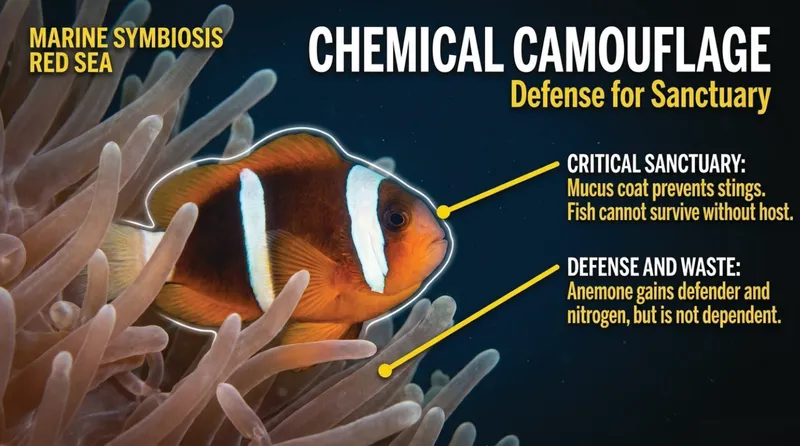
An anemone's tentacles are covered in nematocysts, stinging capsules that fire on chemical and mechanical contact and kill most small fish outright. The Red Sea Clownfish (Amphiprion bicinctus) lives inside them.
The mechanism is a mucus coat on the fish's skin that does not carry the chemical cues a nematocyst reads as prey. Part of that coat appears to be acquired from the anemone itself, which is why a clownfish introduced to an unfamiliar anemone will touch it repeatedly and briefly before settling in, rather than diving straight home.
What each side gets is worth stating precisely, because it is often overstated. The clownfish gets a shelter no predator will enter, and it needs one: it is bound to anemones and does not survive long without one. The anemone gets a defender that drives off butterflyfish, which specialize in biting tentacles, plus water movement from the fish's fanning and nitrogen from its waste. Those are real benefits, but the anemone is not dependent in the way the fish is. The relationship is mutual and it is not symmetrical.
The turtle that queues for a service
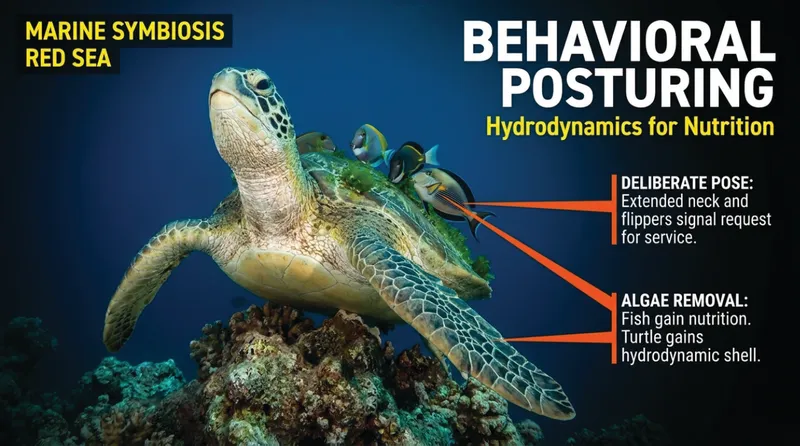
Green Sea Turtles (Chelonia mydas) carry a growing load on their shells: algae, and barnacles such as the Turtle Barnacle (Chelonibia testudinaria), which settle on the carapace and stay. Both add drag to an animal that migrates over long distances, and neither can be reached by a flipper.
So the turtle goes to the reef and waits. At a cleaning station it settles onto a coral head and holds a posture with the neck extended and flippers spread, which is the signal that it is there to be worked on rather than to feed. Surgeonfishes move in and graze the shell.
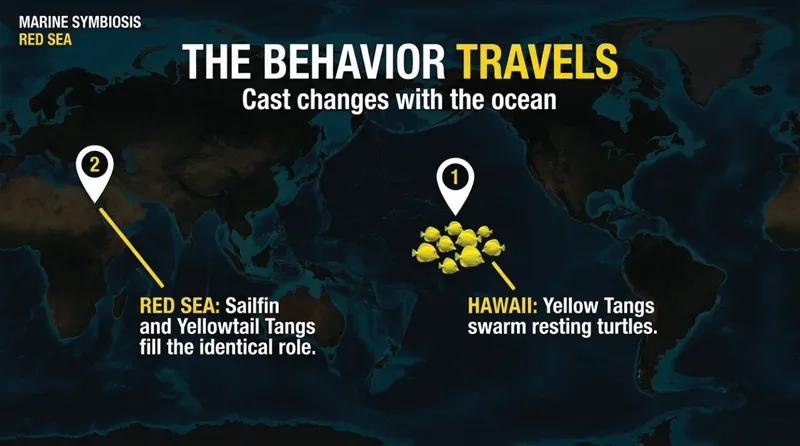
The footage most people have seen of this was shot in Hawaii, where Yellow Tangs (Zebrasoma flavescens) swarm a resting green turtle in dozens, a wall of bright yellow against the dark carapace. That species is Pacific and does not reach the Red Sea. The same work here is done by Desjardin's Sailfin Tang (Zebrasoma desjardinii), the Yellowtail Tang (Zebrasoma xanthurum) and several Acanthurus surgeonfishes. The behavior travels; the cast changes with the ocean.
The fish get a dense mat of algae in one place. The turtle gets a shell that is clean, lighter and more hydrodynamic.
The passenger that gives nothing back
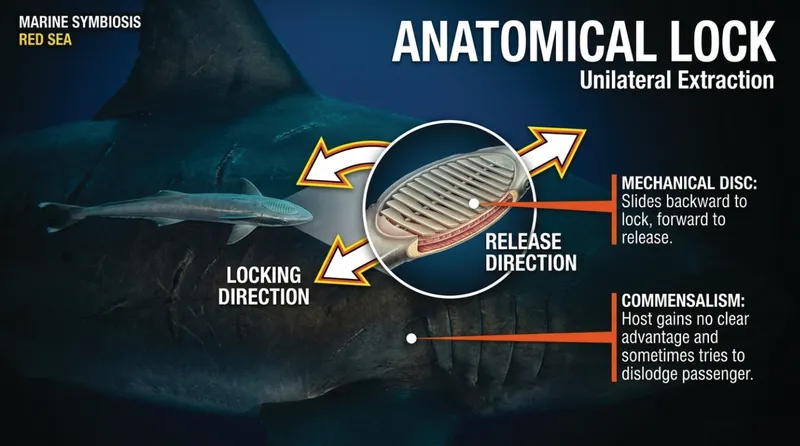
The last of these arrangements is the one usually described wrongly. The Live Sharksucker (Echeneis naucrates) and the Common Remora (Remora remora) travel attached to sharks, rays, turtles and large fish. The attachment is a modified first dorsal fin, flattened into an oval disc of movable slats on top of the head. The remora slides backward to lock the slats and forward to release, so holding on costs it almost nothing while the host swims.
The benefits to the remora are obvious: transport, protection inside a large animal's personal space, and scraps from its kills. What is much less clear is what the host gets. Remoras are often credited with removing parasites, and this is sometimes observed, but the bulk of the diet is scraps, host waste and sloughed skin. Hosts show no obvious advantage and sometimes attempt to dislodge their passengers.
That makes the remora a commensal rather than a mutualist: one side gains, the other is largely unaffected. It belongs in this list precisely because it is the exception. Living in close contact with another species is common on a reef; the arrangement being good for both parties is a separate claim, and it has to be checked case by case rather than assumed.
PADI Divemaster and underwater storyteller with over 7 years of hands-on Red Sea diving experience, documenting marine life, mapping dive sites, and promoting responsible ocean conservation.