Boxing Gloves and a Night Demon: How Sea Creatures Get Their Latin Names

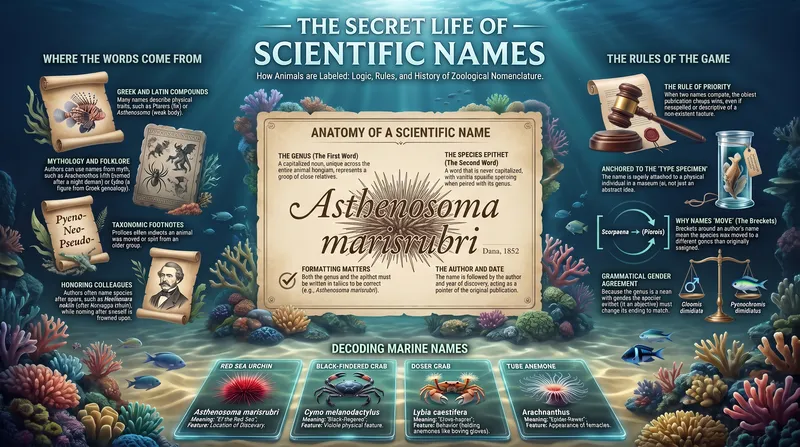
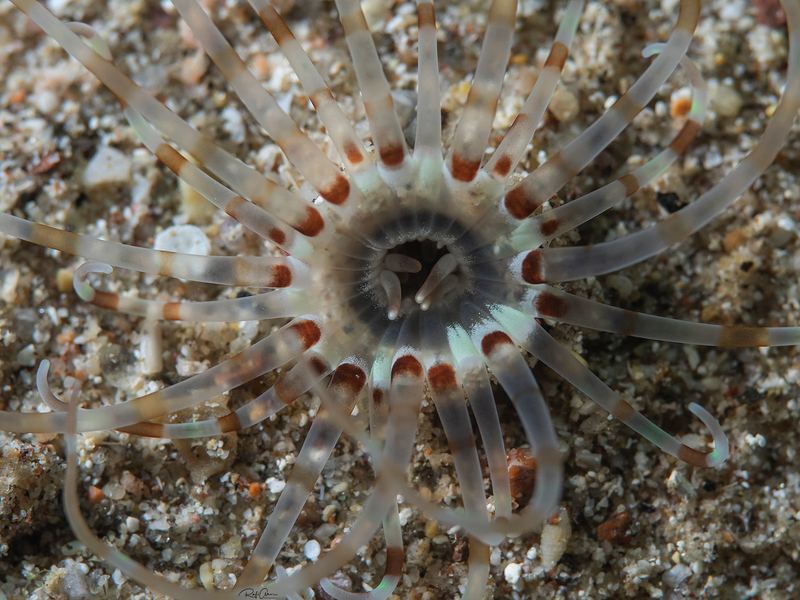
Somewhere in this catalogue sits a small anemone called Arachnanthus lilith, named after a night demon out of Mesopotamian folklore. A crab that walks around holding live anemones in its claws is Lybia caestifera, from caestus, the leather glove a Roman boxer strapped on before a fight. A sea urchin whose spines can end a dive holiday is Asthenosoma marisrubri. Sooner or later everyone asks the same thing: who lets people do this?
Nobody. That is the whole surprise. There is no committee that approves scientific names, no office that stamps them, no authority you appeal to when one is silly. A name works more like a mining claim than a patent: you stake it, you record it properly, and from then on it is yours by date. The rules govern the paperwork, not the taste.
Two Words, and What Each One Does
The first word is the genus, a group of close relatives. The second is the species epithet, and it only has meaning inside that genus. Miles, "soldier", is attached to a whole list of unrelated animals; only the pair Pterois miles points at the lionfish.
We owe the format to Linnaeus, who standardised it in 1758. Before him a species was identified by a descriptive Latin sentence, something along the lines of "sea urchin with long hollow spines and a venom sac at the tip", and every author trimmed that sentence differently. The two-word tag replaced a paragraph with a label, which is why it stuck.
Written form carries information too. The genus is capitalised, the epithet never is, and both go in italics. Asthenosoma marisrubri is correct; Asthenosoma Marisrubri is not.
Where the First Word Comes From
The genus is a noun, and unlike the epithet it has to be unique across the whole animal kingdom. Nobody else may use it, ever, for anything. With roughly two million described animals that shelf is crowded, which is most of the reason genus names read like someone was inventing words. Someone was.
The common route is a Greek or Latin compound describing what the animal looks like:
- Pterois, the lionfish, from pterus, fin, for the high dorsal and long pectoral fins that anyone who has met one will remember.
- Asthenosoma, from asthenes and soma, weak body. These urchins have a flexible shell that gives slightly under a finger, which is unusual for a sea urchin and clearly struck the author.
- Arachnanthus, spider flower, for a tube anemone whose long thin tentacles spread out of the sand like legs.
The second route explains the names that look like typos. When a genus turns out to hold animals that are not close relatives, part of them is moved into a new one, and the new one is very often built out of the old one with a prefix. That is where our catalogue gets Pycnochromis (compact Chromis), Neoliomera (new Liomera) and Pseudamiops (false Amiops). Read that way the name is not gibberish, it is a footnote about the animal's taxonomic history: this one was split off from that one.
Mythology supplies the rest. The boxer crab's genus, Lybia, is a figure out of Greek genealogy, and nothing about the crab is being described at all. That is allowed. A genus name is required to be unique and pronounceable as Latin, not to be meaningful.
One practical consequence: because the genus is a noun with a grammatical gender, it quietly governs the ending of the epithet attached to it. That is worth remembering for what happens further down.
The Name Comes With an Address
Behind most names you will find a person and a year:
- Cymo melanodactylus Dana, 1852
- Pterois miles (Bennett, 1828)
That is not decoration. It is a pointer to the publication where the species was described for the first time, so anyone can go back and check what the author actually had in front of them.
The brackets in the second line are the interesting part. They mean the species has moved house. Bennett described the lionfish in 1828, but he put it in Scorpaena, the scorpionfishes. Later work concluded it belonged with the lionfishes, so the animal became Pterois miles and Bennett's name went into brackets. The convention is strict and useful: brackets always mean the genus changed, and the epithet came along with the animal.
Where the Second Word Comes From
Once you know the sources, most names stop being random noise and start being descriptions:
- The place. Asthenosoma marisrubri: "of the red sea", literally. Described in 1998 by Weinberg and de Ridder.
- A visible feature. Cymo melanodactylus: black-fingered, and the tips of its claws really are dipped in black.
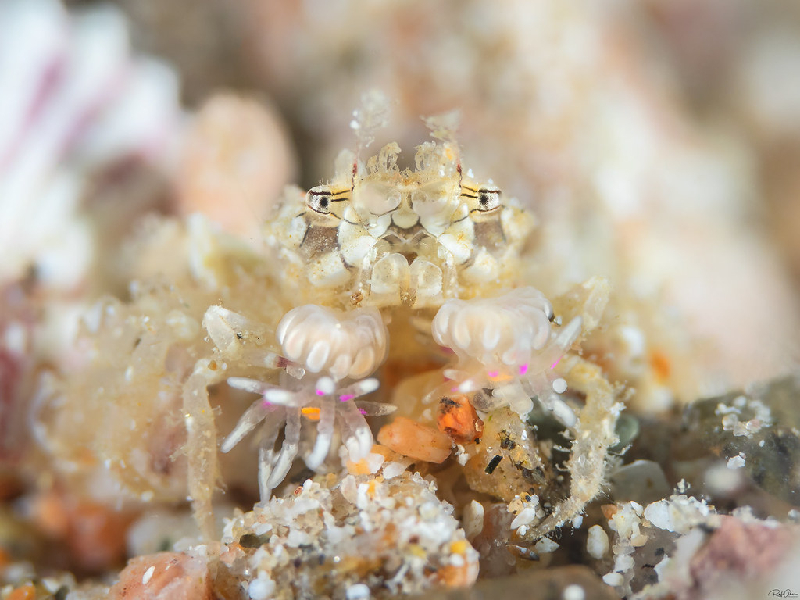
- An object. Lybia caestifera: glove-bearer. The animal holds an anemone in each claw and punches with them.
- A colleague. Neoliomera nobilii, after Giuseppe Nobili, who spent his career on crustaceans.
- Mythology. Arachnanthus lilith, described in 2018, for an anemone that comes out of the sand only after dark.
The author who publishes the description chooses the word. It has to be latinised and it must not already be taken inside that genus, and that is essentially the entire constraint. Naming a species after yourself is not forbidden by the code, it is simply not done, which is why the honour names always point at someone else.
No Approval, But Real Rules
What replaces the missing committee is the International Code of Zoological Nomenclature[1], a rulebook the community agrees to follow. A name counts as valid when a few conditions are met. It has to be published in a form that libraries can hold and cite. It has to come with a description that separates this animal from its neighbours. And it has to be anchored to a type specimen: one physical individual, in a museum, with a catalogue number.
That last requirement does more work than it looks. The name is attached to the jar, not to the idea. If someone later shows that two different animals have been going under one name, the specimen in the jar decides which of them keeps it, and the other needs a new name.
When two names compete, the tie-breaker is priority: the older publication wins. It applies even when the older name is inconvenient, misspelled or plainly wrong about the animal. A shrimp named for a colour it does not have keeps that name, because the alternative would be a system where names could be relitigated forever.
Why the Name You Learned Keeps Changing
Here is a case from this year's catalogue work. The little chromis that hangs over reef tops used to be Chromis dimidiata. It is now Pycnochromis dimidiatus[2].
Nobody renamed the fish. Genetic work showed that Chromis, as it stood, lumped together damselfishes that are not each other's closest relatives, so part of them was moved into Pycnochromis. The species is the same, the epithet is the same word, and Klunzinger, who described it in 1871 while working at Al-Qusayr, a few hours down the coast from Hurghada, still holds the authorship.
Look closely at the ending, though: dimidiata became dimidiatus. The epithet is an adjective, and Latin adjectives agree in gender with the noun they attach to. Chromis is feminine, Pycnochromis is masculine, so the adjective changes its ending on arrival. The boxer crab did the same thing in reverse: it started life as Melia caestifer and became Lybia caestifera.
This is why searching for one spelling is a poor way to look a species up. The same animal can sit in the literature under half a dozen forms, and every one of those is a synonym: not an error, but a name that used to be current.
How to Read a Card on This Site
Every creature page here carries the currently accepted name, the author and year, and the synonyms underneath. Those fields are not typed by hand. We sync them against the World Register of Marine Species[3], the registry that tracks which name is accepted today and which have been retired, so a card reflects the current state of the literature rather than the state of a field guide printed in 1990.
It also changes how we work. When a species from an older book cannot be found, the first assumption is not that it is absent from these waters. The first assumption is that it moved.
You Can Now See This on the Cards
Writing this post is what pushed us to put the answer where the question actually comes up. Every species page in the catalogue now shows what its name means, on two lines: what the genus says, and what the epithet says. Chaetodon auriga is bristle-tooth, then coachman. Pterois miles is fin, then soldier. Acanthurus gahhm is thorn-tail, and then it stops being Latin altogether: gahhm is simply the Arabic name for the fish along this coast.
Two honest limits. It is there where a citable source covers the name, which today means most fishes and very few invertebrates: 260 genera and 521 species out of the catalogue's 1,123. And when the source only tells a story rather than breaking the word down, we show nothing at all rather than a confident guess. So a page with no name line is not an oversight; it is us declining to invent one.
Staked, Not Granted
So the honest answer to "who allowed this" is: a person did, once, in a publication, and after that the system's whole job was to make the decision permanent. A name is not a description that must stay accurate, and it is not an award that can be withdrawn. It is a claim with a date on it.
Which is how a small anemone off a sandy slope ends up carrying the name of a demon, and keeps it.
References
PADI Divemaster and underwater storyteller with over 7 years of hands-on Red Sea diving experience, documenting marine life, mapping dive sites, and promoting responsible ocean conservation.