Why “Blue” Doesn't Actually Exist in the Deep Blue Sea

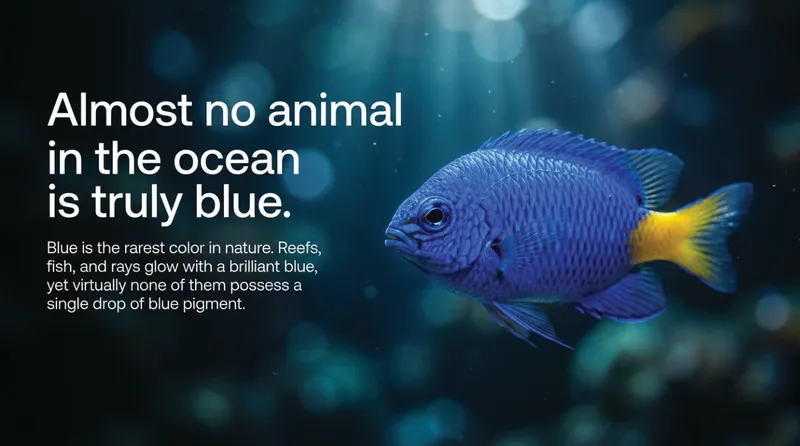
Imagine dipping a glass into the sapphire sea only to find it filled with clear, colorless liquid. The ocean is the bluest thing on Earth, yet it is made of a substance that possesses no color at all. This is the Great Cerulean Deception - a world-scale illusion built on physics rather than paint.
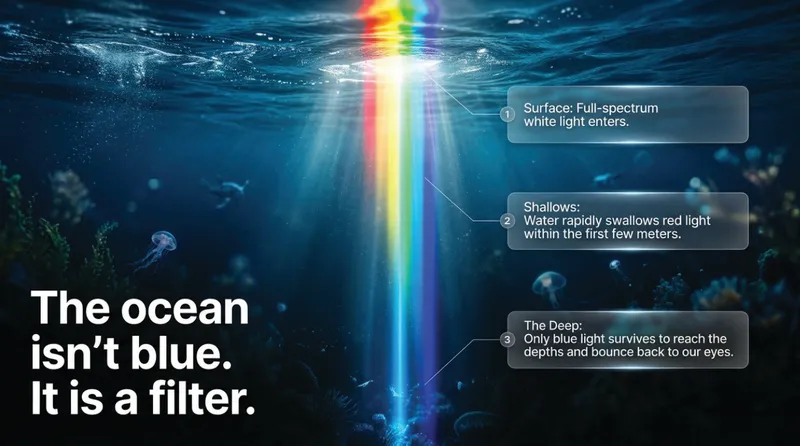
The water itself is not a blue liquid; it is a master of light absorption. As sunlight hits the surface, the water begins to "swallow" the spectrum, starting with the long wavelengths of red light. Within just a few meters, those warm tones are extinguished, leaving only the most persistent rays to carry on.
Blue light is the ultimate survivor of this process. It is the only part of the spectrum that travels deep enough to be scattered and reflected back to our eyes. When we look at the sea, we aren't seeing a pigment; we are seeing the last remnant of light that the water couldn't consume.
In the natural world, blue is a ghost. While green leaves rely on chlorophyll and red feathers on carotenoids, blue is almost never the result of biological chemistry. Instead, it is a triumph of physics over the limitations of pigment.
"The color is in the light, not in the animal."
This distinction is fascinating because it means that what we perceive as a blue animal is actually a structural trick. If you were to remove the light, the blue would effectively cease to exist because there is no "paint" on the skin. The animal is, in a sense, a mirror that only reflects one specific secret.
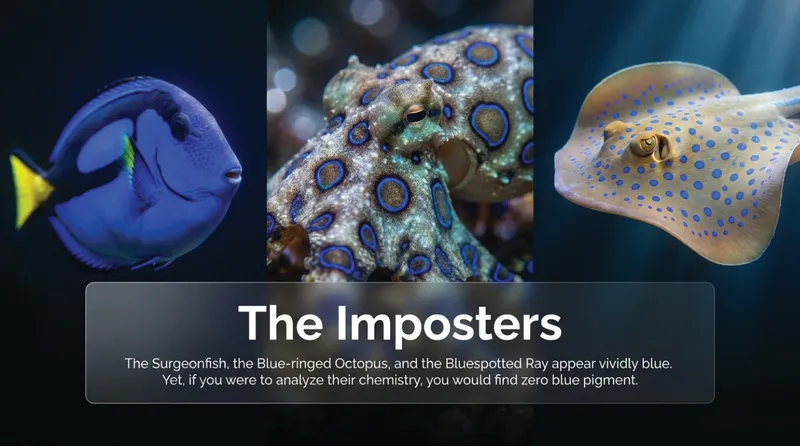
Many of the most vibrant creatures in the reef, such as the Surgeonfish and the Blue-ringed Octopus, are actually colorless. They wield a clever trick of physics known as "structural color." Within their skin, they house tiny layers of crystals arranged with mathematical precision.
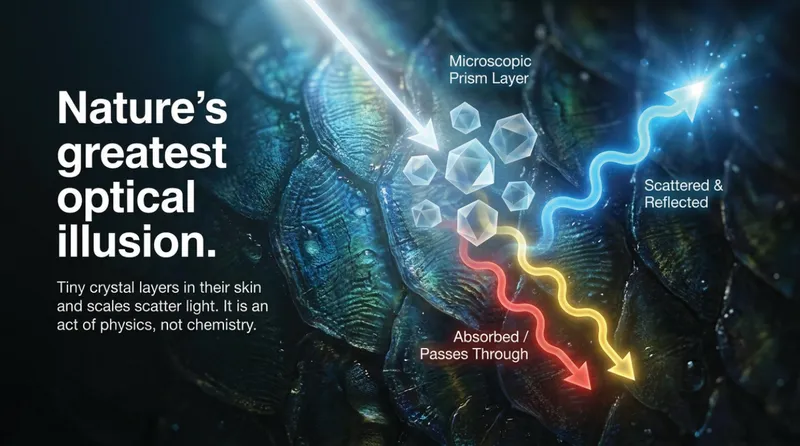
These crystal layers are designed to scatter incoming light so that only the blue wavelengths are thrown back at the observer. The Blue-spotted Stingray uses this to a stunning effect, making its markings appear to "glow" against its skin. This isn't a chemical trait; it is a magical feat of evolution.
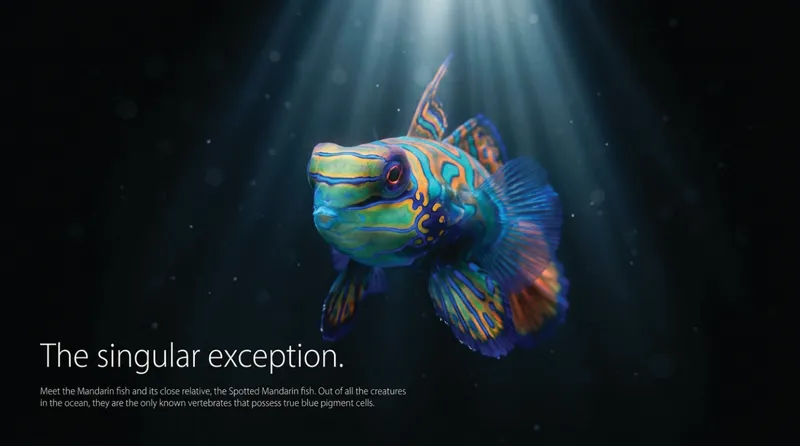
Amidst this sea of illusions, two biological rebels have managed to invent a way to cheat the system. The Mandarin fish and its close relative, the Spotted Mandarin fish, are the only known vertebrates to possess "true" blue pigment cells.
These tiny, vibrant fish didn't settle for structural tricks; they developed a unique biological chemistry that the rest of evolution seemingly forgot. They are the ultimate outliers, possessing a true blue that remains even when the angle of light shifts.
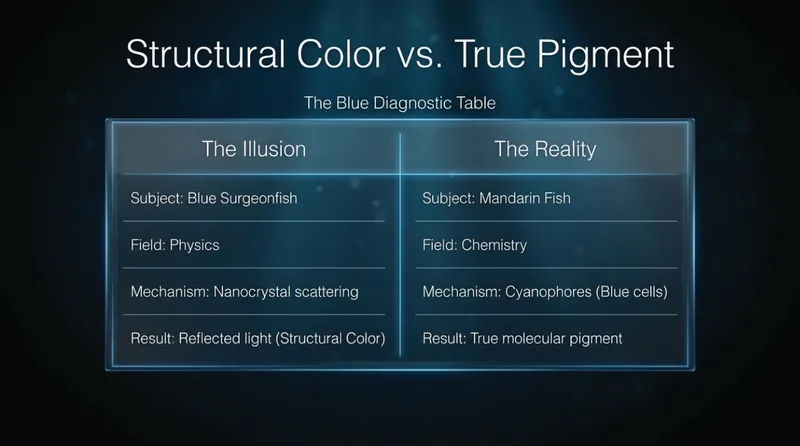
The beauty of the horizon is not found in a static bucket of blue paint, but in a shifting interplay of light and structure. That sapphire horizon is a ghost - a reflection of the light that the water simply couldn't swallow.
This knowledge transforms the ocean from a simple body of water into a complex masterpiece of physics. It reminds us that nature doesn't always provide what it promises at first glance.
How does it change your perspective to know that the sea’s most famous color is actually its greatest secret? The next time you look at a bright blue fish, ask yourself: are you seeing a color, or are you witnessing a brilliant trick of the light?
PADI Divemaster and underwater storyteller with over 7 years of hands-on Red Sea diving experience, documenting marine life, mapping dive sites, and promoting responsible ocean conservation.