
AnnelidAnnelida
A segmented worm is built the way a train is built, out of one working unit repeated as many times as needed.
Each segment carries its own muscle blocks, its own knot of nerve, its own pair of bristle bundles, and its own share of the plumbing. Copy a unit that already works and stack it, and an animal can get longer, faster and stronger without inventing anything new. It is one of the most reused ideas in evolution: arrived at separately, it also produced the body of an insect and the vertebrae running down your back. Annelida means little rings, and on a live worm you can count them.
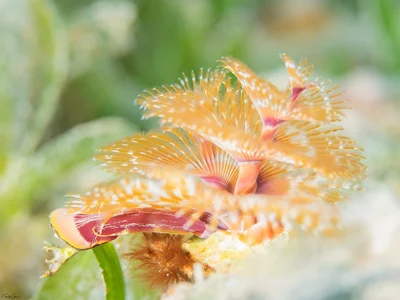
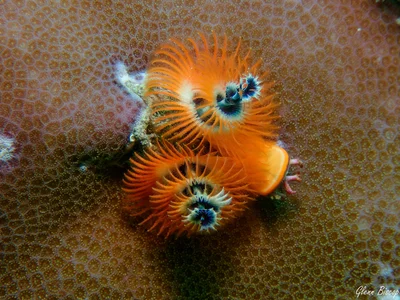
The showpieces on a reef are the ones that gave up walking. A Christmas tree worm is a tube sunk into living coral with almost nothing outside it but two spirals of feathered tentacles, which work as gills and plankton net in the same structure. The coral grows around the tube rather than over it, so worm and colony age together. Those spirals carry light-sensitive spots, and a shadow crossing them, a diver, a fish, is enough: the crown is gone into the tube before you register the movement, with a hard lid pulled shut behind it. Hang still and it comes back a little at a time.
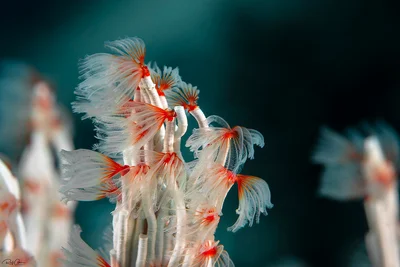
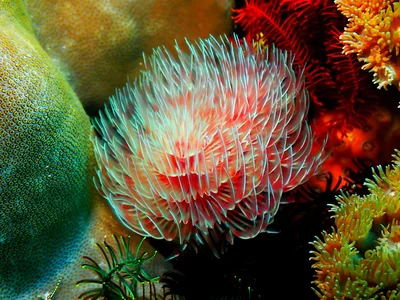
The tubes themselves are masonry. A fan worm catches sand grains in its crown, sorts them by size in a pouch below the mouth, and cements them into the rim of its tube in courses, which is why a bare tube in the rubble looks manufactured.
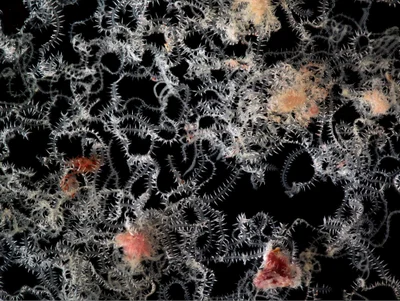
One member of the group breaks the shape entirely. There is a small worm that lives inside a sponge, keeping a single head buried at the base while its body branches, and branches again, threading the sponge's canals until one animal ends in hundreds of separate tails. Almost nothing else in the animal kingdom is built that way.
- elongated body, distinctly segmented
- body often housed in a fixed tube
- feathery crown of colourful feeding tentacles
- rapid retraction of crown when disturbed
9 species in Annelid



Other groups in Worms
Nearby in the catalogue.


Last Update: August 23, 2026