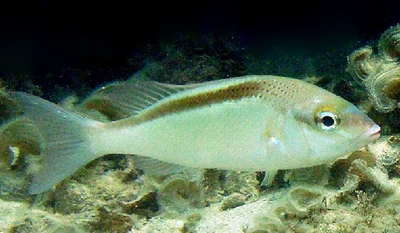
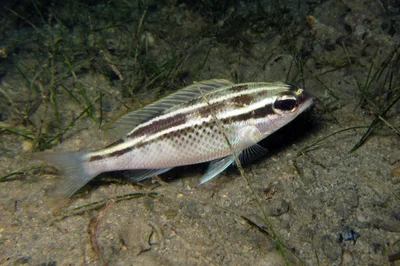
A pink-silver fish to 34 cm (13 in) with yellow stripes along the flank and the upper lobe of the tail drawn out into a long filament - the thread that names the family. It lives over sand and mud away from the reef, which is why divers rarely see it and trawlers constantly do.
It hunts the bottom in daylight, taking small crustaceans, worms and fish off the sediment, and gathers in loose aggregations over feeding ground rather than schooling tightly.
This is one of the most heavily landed fish in the 🌊 Indian Ocean. Threadfin breams are the backbone of the region's demersal trawl fishery and a large share of the world's surimi, and stocks in several areas show the classic signs of overfishing: fish maturing smaller and younger than they did a few decades ago, which is an evolutionary response to nets that take the big ones.
Spawning runs for much of the year in warm water, with peaks that vary by region, and the larvae are planktonic - the reason a heavily fished stock can still rebound quickly when pressure eases.
The genus. Nemipterus Swainson 1839 - nem[atos] (thread) + pterus (fin). ETYFish
- pink-silver body with a yellow stripe along the flank and a red-edged eye
- upper lobe of the tail drawn out into a long trailing filament
- over open sand and mud rather than on the reef
- length up to 34 cm