
Threadfin breamsNemipteridae
Most of the fish in this family are caught by boats that never see them until they land on deck.
Threadfin breams live over open sand and mud away from the reef, in the depth band a trawl works, in numbers, and that combination has made the genus Nemipterus one of the most heavily fished groups in tropical Asia. A large part of the catch never appears as a fish at all: it goes into surimi, the washed white paste behind imitation crab sticks and fish balls. One of the four listed here, the Japanese threadfin bream, is a mainstay of exactly that trade. It is a strange thing to know about an animal almost no diver has looked at.
The same habits explain why divers do not. Bare sand at depth is empty-looking ground that nobody plans a dive around, and the fish that live there are small, pale and quick to keep a distance. They are also short-lived and fast-growing, maturing early and turning over quickly, which is the profile of an animal that can absorb heavy fishing pressure for a while and then fail suddenly.
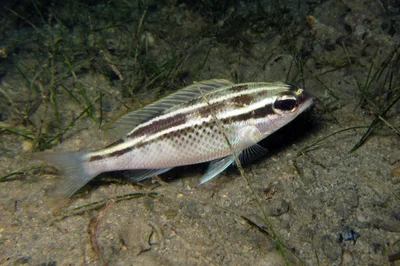
The ones you do meet are the monocle breams, Scolopsis, and they behave differently: single fish hovering a hand's width above rubble and sand at the foot of the reef, holding still, moving off in a short dash and settling again. The family's other name is spinecheeks, and the reason is a small backward-pointing spine on the bone below the eye. The thread that names the group, a filament drawn out of the upper lobe of the tail, is on the Nemipterus species and is dealt with on its page; most of the fish here do not have one.
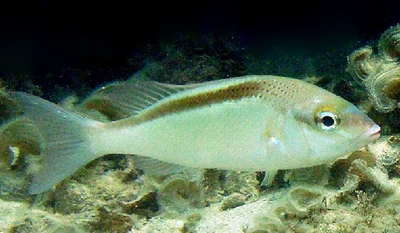
Four are listed here, and they are the sort of fish that gets logged as a small emperor or a young bream and forgotten. The shape is right for that mistake: a plain silver-pink oval with stripes or a dark streak, a single unbroken dorsal fin, and nothing dramatic about it at all. This is a small heading in this catalogue and a large one in the world's fish markets.
- elongate body, moderately compressed
- silvery, pinkish, or reddish body colours
- often with stripes or spots
- over sandy or rubbly bottoms adjacent to reefs
4 species in Threadfin breams


Other elongated groups
Similar silhouette underwater - worth a look if this was not your animal.


Last Update: August 23, 2026