For most of the year a snapper is spread thin along a coast. Then, in a particular week of a particular moon, it goes to a meeting. Fish arrive from far up and down the reef and collect at one promontory or one channel mouth in the thousands, spawn over a few nights, and scatter. The site is the one the species used last year, and the year before that. That reliability is the whole problem: an aggregation is a fixed address holding a region's entire breeding stock, and where a fleet has learned the address, the aggregation has usually stopped forming.
The rest of the year they are the most conspicuously idle fish on the reef, standing in the shade of a coral head in a packed school that faces the current and does nothing at all. That is the resting state. The work is done after dark and alone, out over sand and rubble, and the school is back at the same coral head by morning.
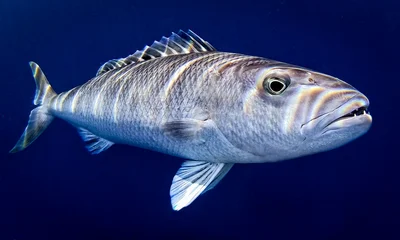
Nothing about the equipment is specialized. A heavy head, a mouth that opens straight forward, a pair of canines at the front of each jaw you can see from a meter away, and a diet of whatever fits: fish, crabs, octopus. It is a design that scales, which is why the family runs from slim species hunting open water off the wall to the mangrove snapper at a meter and a half.
Common, predictable and edible is a bad combination to be. Snappers are the backbone of most tropical reef fisheries, and they are also where the ciguatera problem sits, concentrated in the largest and oldest fish at the end of the longest food chains.
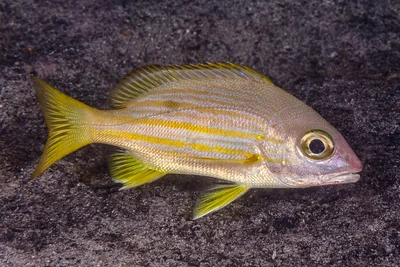
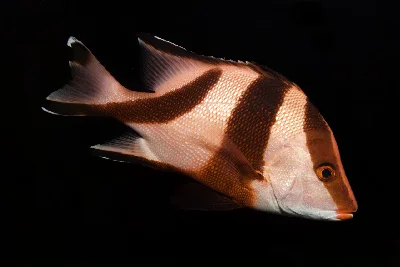
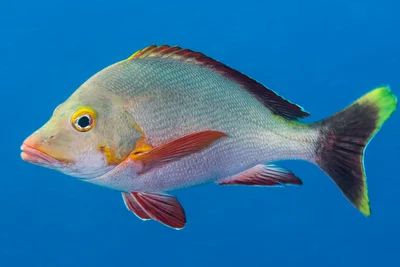
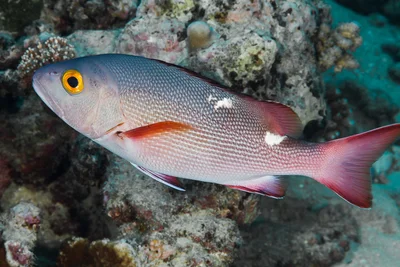
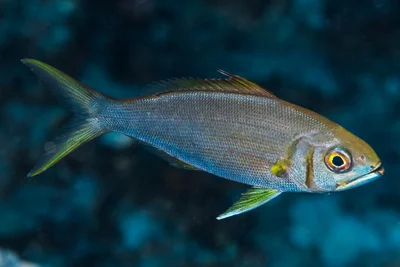
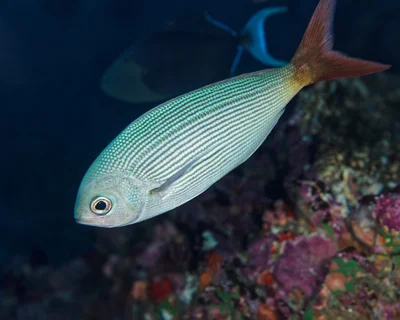
Fifteen species are listed here. Most divers meet the schooling ones first, blue-striped and humpback snappers stacked over a coral head in the middle of the day, and the big solitary reds later, under a ledge, watching.
How to recognise snappers
OvalEgg-shaped body, deeper than it is thick - damselfishes, surgeonfishes.
- stout, oval body shape, deeper than thick
- large mouth
- overall coloration often silvery, reddish, or yellowish
- some species with distinct blue stripes on head or body
- found solitary, in small groups, or large schools