syn. Diacope macolor, Macolor macolor, Macolor typus, Sciaena nigra
up to 75 cm2-90 mLeast Concern
1540
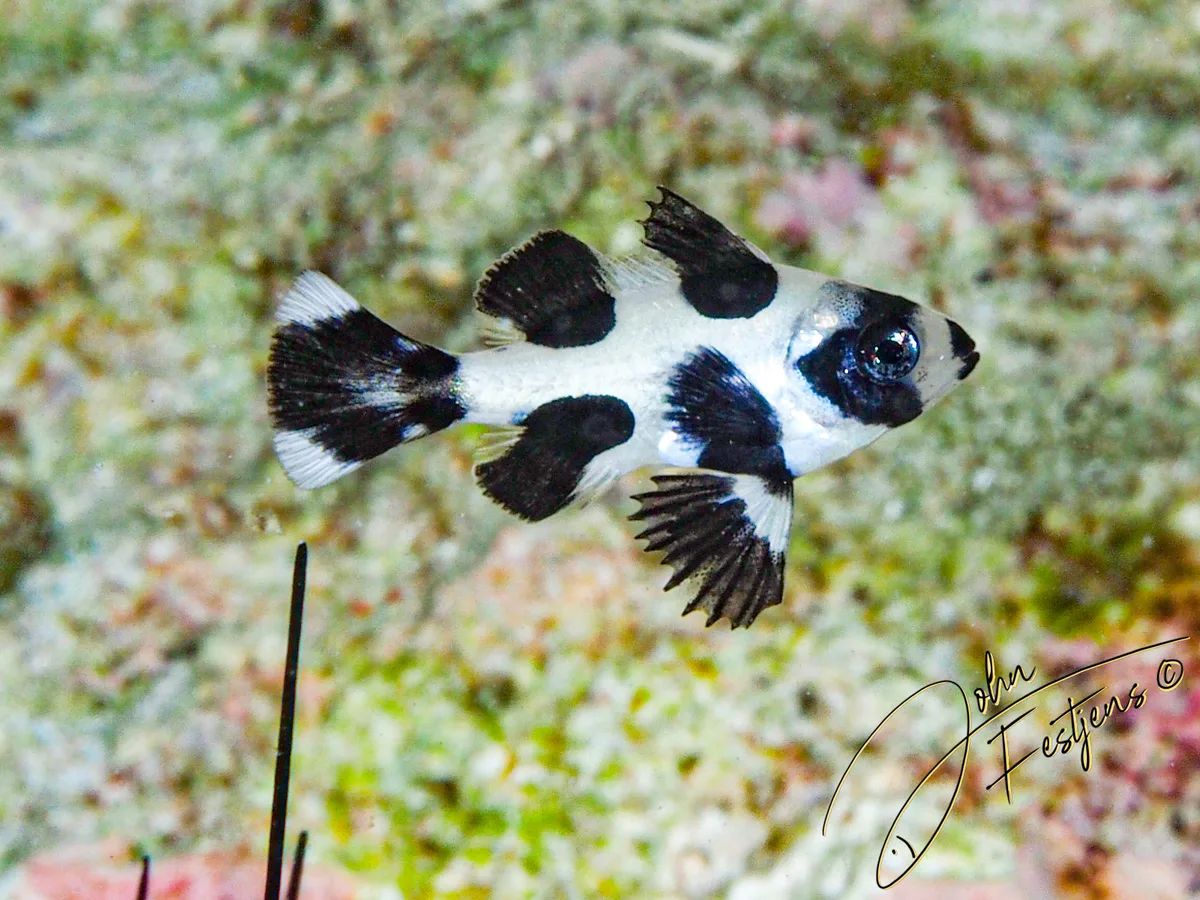
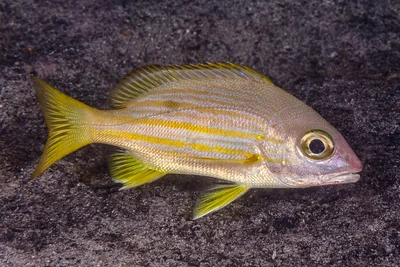
Two fish in one card. The adult is a sooty gray-black slab hanging off a wall in a slow group of a dozen, unremarkable except for how dark it is against the blue. The juvenile is a black and white harlequin with pelvic fins so long they trail behind it like streamers, drifting alone over coral, and nothing about the two suggests a relationship.
That difference does work. A young fish standing out in bold black and white, with fins that break its outline into pieces, is not trying to hide - it is advertising that it is not worth chasing, and it moves slowly enough to make the point. As it grows the pattern is dropped and the fish joins a group, which is a different defense with the same purpose.
Adults feed at night on the plankton and small fish that the current brings up a wall, which is why they hold on the outer reef where water moves. By day they idle, facing into the flow, and let divers approach closer than most snappers will.
They are long-lived and slow to mature, and where spearfishing is heavy the big groups are the first thing to go.
The species.Macolor niger (Forsskål 1775) - black. ETYFish
How to recognise it
adults uniform sooty gray-black, deep-bodied, in slow groups off the wall
juveniles black and white in bold blotches, with enormous trailing pelvic fins
This species is caught with handlines, gill nets, traps, and are also speared by divers. It is frequently encountered in fish markets (Anderson and Allen 2001). There have been no confirmed population declines for M. niger due to exploitation; however, because of its affinity with coral reefs, we infer that M. niger may be experiencing population declines due to habitat loss in parts of its range.
As of 2008, fifteen percent of the world’s coral reefs were considered under imminent threat of being “Effectively Lost” (with 90% of the corals lost and unlikely to recover soon), with regions in East Africa, South and South-east Asia, and the wider Caribbean being the most highly threatened (Wilkinson2008). Of 704 zooxanthellate reef-building coral species which were assessed by using the International Union for Conservation of Nature Red List Criteria, 32.8% are in categories with elevated risk of extinction (Carpenter et al. 2008).
Threat classification from the IUCN Red List.
Comments
Please, sign in to leave a comment
Continue with a social account - yours will be created automatically.