
Snake eelsOphichthidae
Every so often somebody opens a large predatory fish and finds an eel inside it, and not in the stomach where a swallowed fish belongs but out in the body cavity, coiled against the liver and dried to a mummy. It has happened often enough to have a scientific literature behind it, and the explanation is the tail. A snake eel that gets swallowed does what a snake eel does whenever anything goes wrong: it starts digging backward. The tail of one of these animals ends in a hard bare point with no fin on it, and it will work through sand, through mud and through the wall of a stomach. On the far side there is nowhere left to go. The eel cannot get out through the body wall, it dies in the cavity, and the host walls it off. More than one has been found in a single fish.
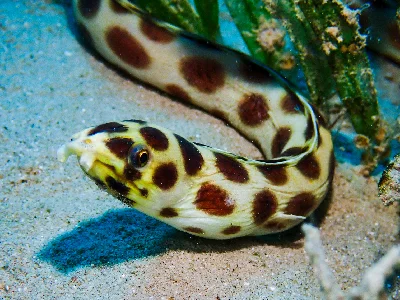
In its own habitat that tail is a door. A snake eel goes into open sand backward and is gone in seconds, which is the wrong direction for a fish and the reason so few divers have watched it happen. The rest of the body follows the same logic: no scales, a stiff cylinder, the dorsal and anal fins stopping well short of the tail so that nothing catches on the way in, and in several species no pectoral fins at all.
What shows above the sand is usually a head. Nostrils drawn out into short tubes, eyes set well forward, a mouth opening and closing, and no clue as to how much animal is underneath, which in some species is well over a meter of it. They hunt at night over sand and rubble, taking small fish and crabs, and a few move openly in daylight.
This is the largest family of eels there is, with more described species than any other, and much of what is known about them comes from animals dredged or dug up rather than watched. Eleven are listed here. Most people who have seen one have seen a head.
- elongated, cylindrical body
- pectoral fins often small or absent
- dorsal and anal fins not reaching the tail tip
- pointed, hardened tail tip
- often partially buried in sand or mud
11 species in Snake eels




Other eel-like groups
Similar silhouette underwater - worth a look if this was not your animal.



Last Update: August 23, 2026