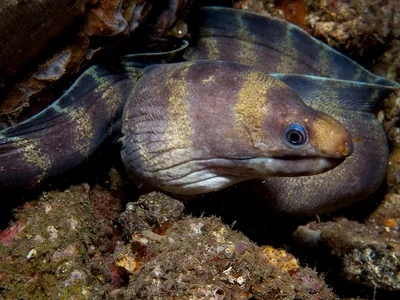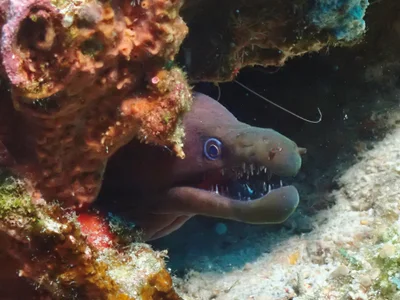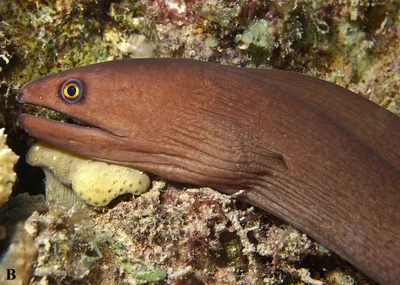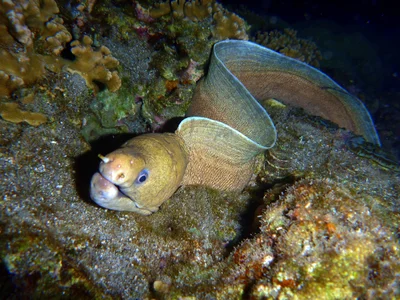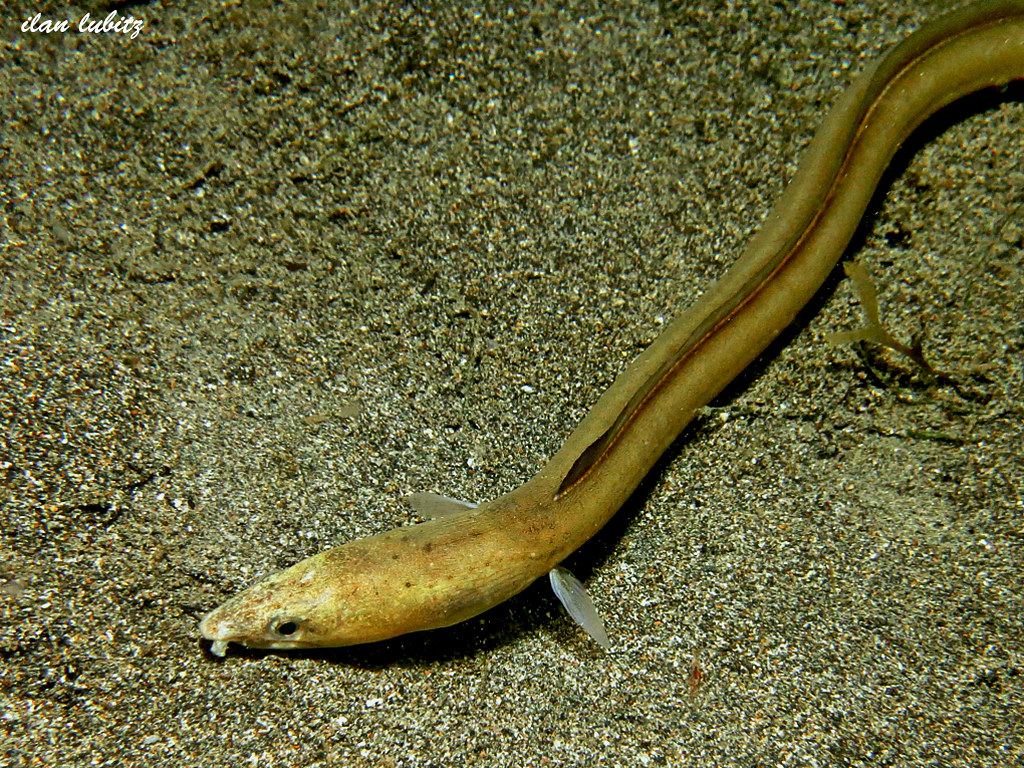
A moray has no scales at all. Where any ordinary reef fish is armored in overlapping plates, an eel of this family is bare skin, and it is coated instead in a thick layer of mucus that it produces continuously.
That coating is doing several jobs at once. It is armor of a sort, because it is slippery enough that the animal can force itself through a gap in coral with a diameter smaller than its own body and come out the other side unmarked, where a scaled fish would be shredded. It is a chemical barrier, loaded with antibacterial compounds, which matters for something that spends its life pressed against rock in warm water. In several species it is outright toxic. And it is the reason a moray hauled out of the water is almost impossible to hold.
It also has a cost: mucus is expensive to make, and it is one reason morays are ambush hunters that spend most of their lives motionless.
This one is a small plain brown moray of reef and rubble, under half a meter, with nothing much to distinguish it. In a family where half the species are anonymous brown eels, it is one of the more anonymous.
The genus. Gymnothorax Bloch 1795 - gymnós (bare or naked) + thṓrax (breast or chest). ETYFish
- plain dark brown, unmarked or with faint mottling
- small eye, short snout
- no pectoral fins and no scales; the skin looks wet and bare
- up to 45 cm
Why it's threatened
There are no major threats known to this species, however, it may be affected by coastal development and habitat degradation in some areas, given its shallow depth range.
Threat classification from the IUCN Red List.