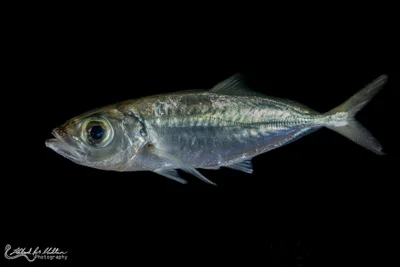
Talang Queenfish
© Brian Gratwicke
Fishes · Bony fishes · Jacks, Amberjacks, Pompanos

Talang Queenfish

Scomberoides commersonnianus Lacepède, 1801
syn. Chorinemus commersonii, Chorinemus commersonnianus, Chorinemus delicatulus, Chorinemus exoletus, Chorinemus leucophthalmus, Chorinemus leucopthalmus +3 more
90 - 120 cm16 Kg1-50 mLeast Concern
1152

Scomberoides commersonnianus, commonly known as the Talang queenfish, is a significant species within the family Carangidae, widespread throughout the western Indo-Pacific region. Known by various names, including giant dart, giant leatherskin, and largemouth queenfish, this species holds substantial value in both commercial and recreational fisheries.

Morphologically, Scomberoides commersonnianus is distinguished by a series of 5-6 prominent dark silvery spots or blotches along its lateral line. It lacks a dark tip on the dorsal fin lobe. The species exhibits a blunt snout and a large mouth equipped with multiple rows of sharp teeth. The anal and dorsal fins are truncated, with the posterior sections tapering to spines, and the caudal fin is notably forked. Coloration includes a bluish grey head and back, complemented by a silvery ventral side. The species can attain a maximum total length of 120 centimeters (47 inches), though individuals more commonly reach about 90 centimeters (35 inches). The maximum recorded weight is 16 kilograms (35 pounds).

The Talang queenfish displays an extensive distribution across the 🌊 Indian Ocean and western 🌊 Pacific Ocean, ranging from 🇿🇦 South Africa, the 🌊 Red Sea, and the 🌊 Persian Gulf in the west, to as far east as 🇳🇨 New Caledonia (🇫🇷 Overseas France), and extending northward to southern 🇯🇵 Japan and southward to Western Australia and New South Wales.

Inhabiting coastal waters, adult Talang queenfish are frequently found near reefs and offshore islands, though they occasionally enter estuarine environments. Typically forming small schools, adults are predatory, preying on fish, cephalopods, small invertebrates, and other pelagic organisms. Juveniles employ rasping teeth to consume the scales and epidermis of other fish.

The species exhibits rapid growth during early life stages, reaching 25 centimeters in their first year and 50 centimeters by their third year. Females achieve sexual maturity at a fork length of approximately 63 centimeters (25 inches) around 4–5 years of age. In 🇦🇺 Australian waters, spawning occurs from August to March, whereas in the 🌊 Persian Gulf, it takes place from March to June. Female fecundity at maturity is estimated between 259,488 to 2,859,935 eggs per spawning event.

As an essential species within its range, the Talang queenfish is recognized by the International Game Fish Association (IGFA), which maintains complete line and tippet class records. The current all-tackle world record is 17.89 kilograms (39 pounds 7 ounces), captured off Umkomaas, 🇿🇦 South Africa, in 2010.

Why it's threatened

Biological resource use
Intentional use: (subsistence/small scale) [harvest] · Intentional use: (large scale) [harvest] · Unintentional effects: (subsistence/small scale) [harvest] · Unintentional effects: (large scale) [harvest]

In the Persian Gulf, Scomberoides commersonnianus is targeted by gill net and trolling fisheries in the Persian Gulf (E. Abdulqader and S. Hartmann pers. comm. 2013). Scomberoides commersonnianus is caught as bycatch in shrimp trawl fisheries in the Persian Gulf (Paighambari and Daliri 2012, Chen et al. 2013).

Threat classification from the IUCN Red List.

Comments

Please, sign in to leave a comment

Continue with a social account — yours will be created automatically.

No comments yet — be the first.

Last Update: June 28, 2026