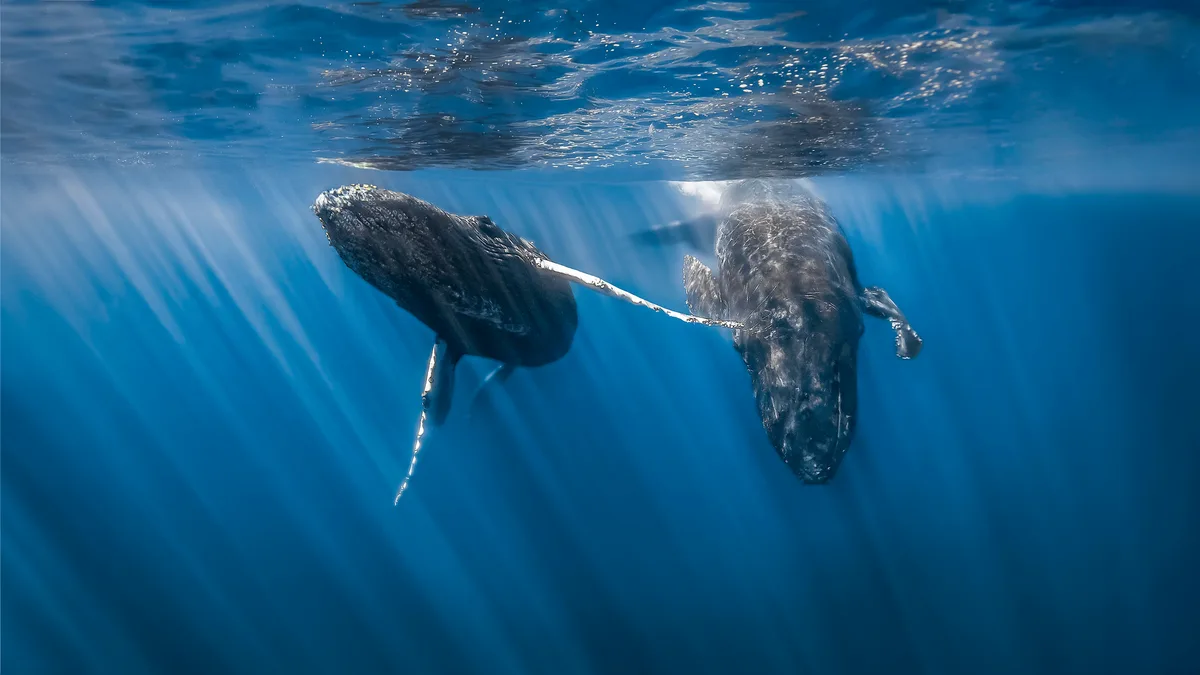
Humpback Whale
Humpback Whale
Humpback Whale
Humpback Whale
© Vincent POMMEYROL
Mammals · Whales

Humpback Whale

Megaptera novaeangliae (Borowski, 1781)
syn. Balaena allamack, Balaena atlanticus, Balaena boops, Balaena gibbosa, Balaena lalandii, Balaena longimana +19 more
14 - 18.9 m35 T1-616 mCITES ILeast Concern
926

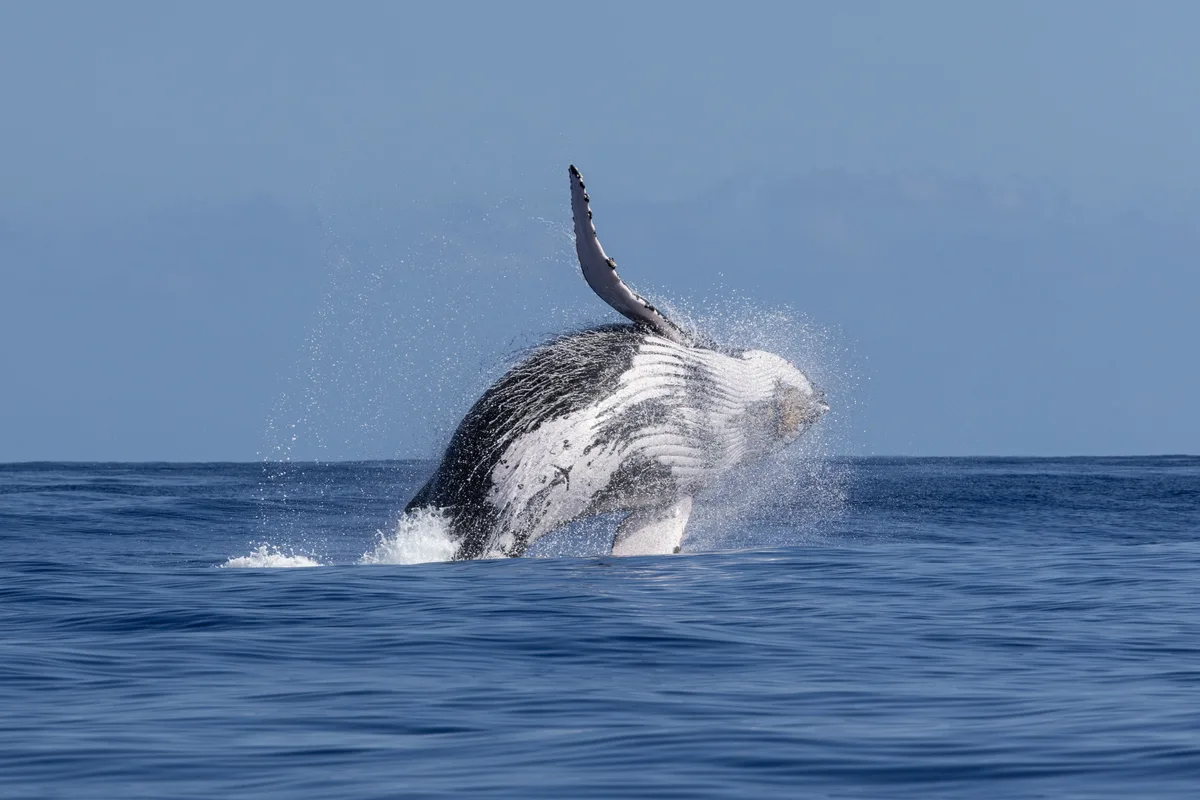
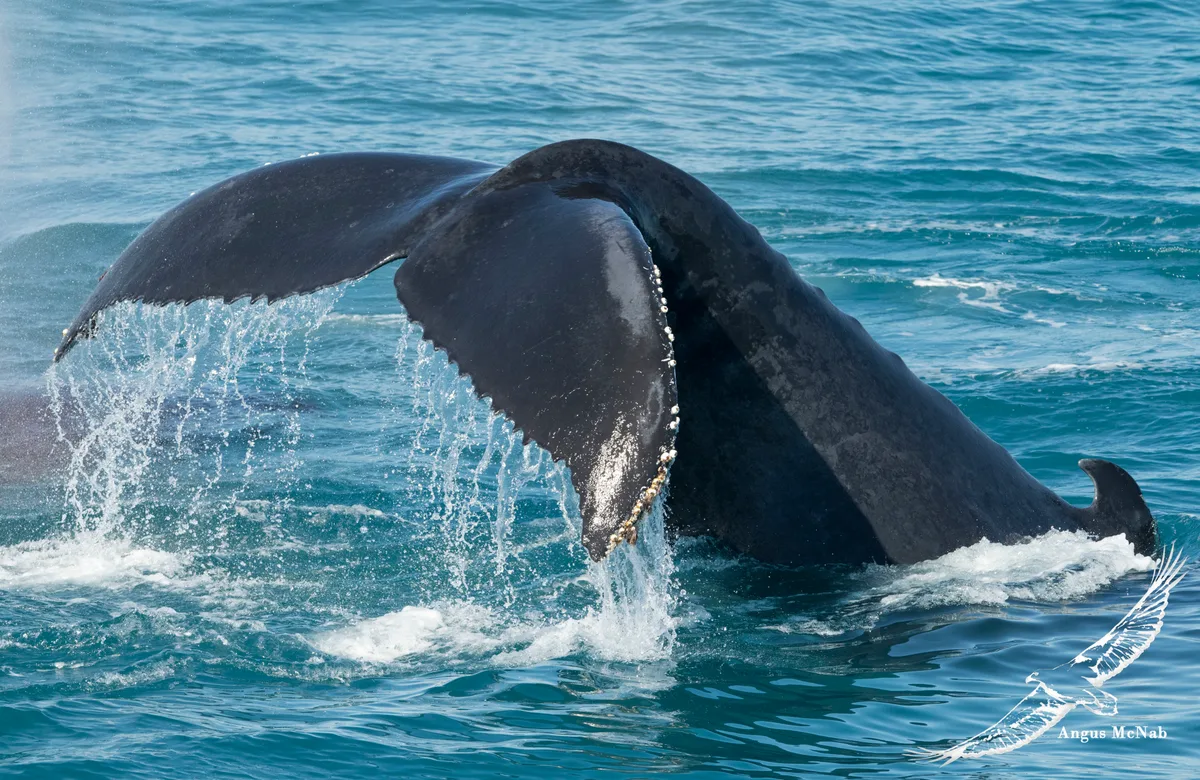
The Humpback Whale (Megaptera novaeangliae) is a remarkable marine mammal known for its worldwide presence across tropical and temperate oceans. These whales are particularly notable for their impressive size, reaching a maximum length of 18.9 meters (62 feet) and weighing up to 35 metric tonnes (approximately 77,000 pounds).

Humpback whales are oceanodromous, meaning they migrate long distances across the oceans. They typically move between tropical breeding grounds and polar or sub-polar feeding areas, traveling through open seas and reaching the ice edges in both hemispheres. During these migrations, they inhabit waters as shallow as 1 meter (3 feet) and as deep as 616 meters (2,021 feet).

Their diet mainly consists of krill and small schooling fish, and they often feed and breed in coastal waters which can be close to human settlements. This contributes to their status as one of the most recognizable large whale species. The Babuyan Islands in the 🇵🇭 Philippines have been confirmed as one of their breeding grounds. During the breeding season, various social structures are observed, such as lone adults, mother-calf pairs, and surface-active mating groups which sometimes include up to four individuals. Males are often seen escorting cows with young calves, displaying aggressive competitive behavior, and singing. Their distinctive songs consist of nine themes, seven of which are common in both the 🇵🇭 Philippines and Hawaii.

Despite their majesty, humpback whales face numerous threats. These include fishing practices like dynamite and cyanide fishing, pollution, and infringement by foreign commercial fishing vessels, particularly from unregulated long-line and drift net activities. There are also unconfirmed reports of pirate whaling. Due to their impressive nature and sociable behavior, these whales also play a significant role in commercial fisheries.

Why it's threatened

Energy production & mining
Oil & gas drilling
Transportation & service corridors
Shipping lanes
Biological resource use
Intentional use: (subsistence/small scale) [harvest] · Intentional use: (large scale) [harvest] · Unintentional effects: (subsistence/small scale) [harvest]
Pollution
Noise pollution

Although modern commercial whaling seriously depleted all Humpback populations, some of which had already been reduced by pre-modern whaling, the species has demonstrated remarkable resilience, and there have been substantial increases in the North Atlantic, North Pacific, and Southern Hemisphere. Humpback whales have been legally protected from commercial whaling worldwide since 1966, and there have been few catches since 1968. It is unclear whether there has been any recovery in the small, isolated population in the Arabian Sea.

Today, small numbers only are taken for local consumption in Greenland (up to 10 annually) and the island of Bequia (St. Vincent and the Grenadines) (up to four annually), with occasional takes elsewhere (IWC 2018b).

Humpback Whales, along with North Atlanatic Right Whales (Eubalaena glacialis), seem to be the most vulnerable of the large whales to becoming accidentally entangled, often fatally, in fishing gear and sometimes other debris. They are also vulnerable to injury by ship strikes, which can also be fatal. In most areas, the majority of entanglements (Robbins et al. 2009), and also the majority of ship strikes, are likely to go undetected, but there is no generally accepted method for extrapolating from the observed events to estimate totals.

State members of the IWC are encouraged to report bycatches and ship strikes annually to the IWC, but few do so. The figures submitted in 2018 for entanglements include: USA 78 (26 in the Atlantic in 2015, 52 in the Pacific in 2016); Australia 46; Greenland 5, Japan 3, and New Zealand, Argentina, Norway, and Spain (1 each) (Hughes 2019). The reported ship strike numbers were: USA 13, Australia 5, and Brazil 1. The figures include some potentially non-fatal incidents (such as whales entangled and released).

Minimum estimates of average annual deaths in US waters are: west coast (2012-16) - 16.7 from entanglement and 2.1 from ship strikes (Carretta et al. 2018); east coast (2010-14) ­– 7.2 from entanglements and 1.8 from ship strikes (Hayes et al. 2017); Alaska and Hawaii (2011-15) − 18 from entanglements in fishing gear, 2.8 from unspecified marine debris, and 4.4 from ship strikes (Muto et al. 2018). Urbán et al. (2017) reported 95 cases of entanglement of Humpback Whales on the Mexican Pacific coast during 2004-2017 of which 42 were released, 6 died and the fate of the others was either unknown or considered not to be severely injured.

In a study of Humpback entanglements in Scottish fishing gear during 1992-2016, Ryan et al. (2016) found that most Humpback Whales spent only brief periods in Scottish waters, but that the entanglement rate per day of whale presence was such that it would be unsustainable for a population that fed regularly in Scottish waters.

The distribution of Humpbacks in the Arabian Sea overlaps that of fisheries known to be dangerous to Humpbacks, and 30-40% of the photographed whales showed entanglement-related scars (Minton et al. 2011).

Threat classification from the IUCN Red List.
Comments

Please, sign in to leave a comment

Continue with a social account — yours will be created automatically.

No comments yet — be the first.

Last Update: June 28, 2026