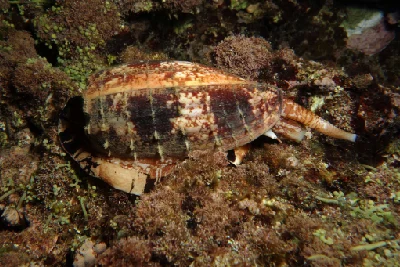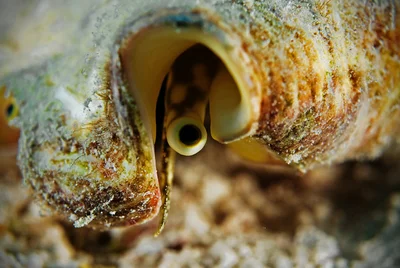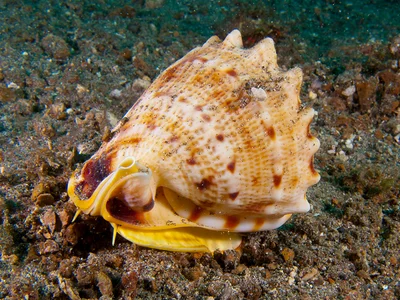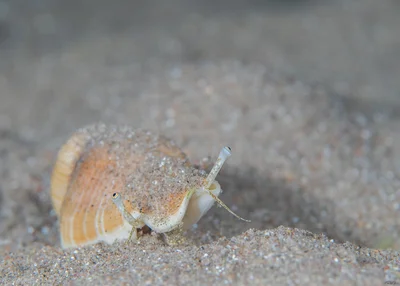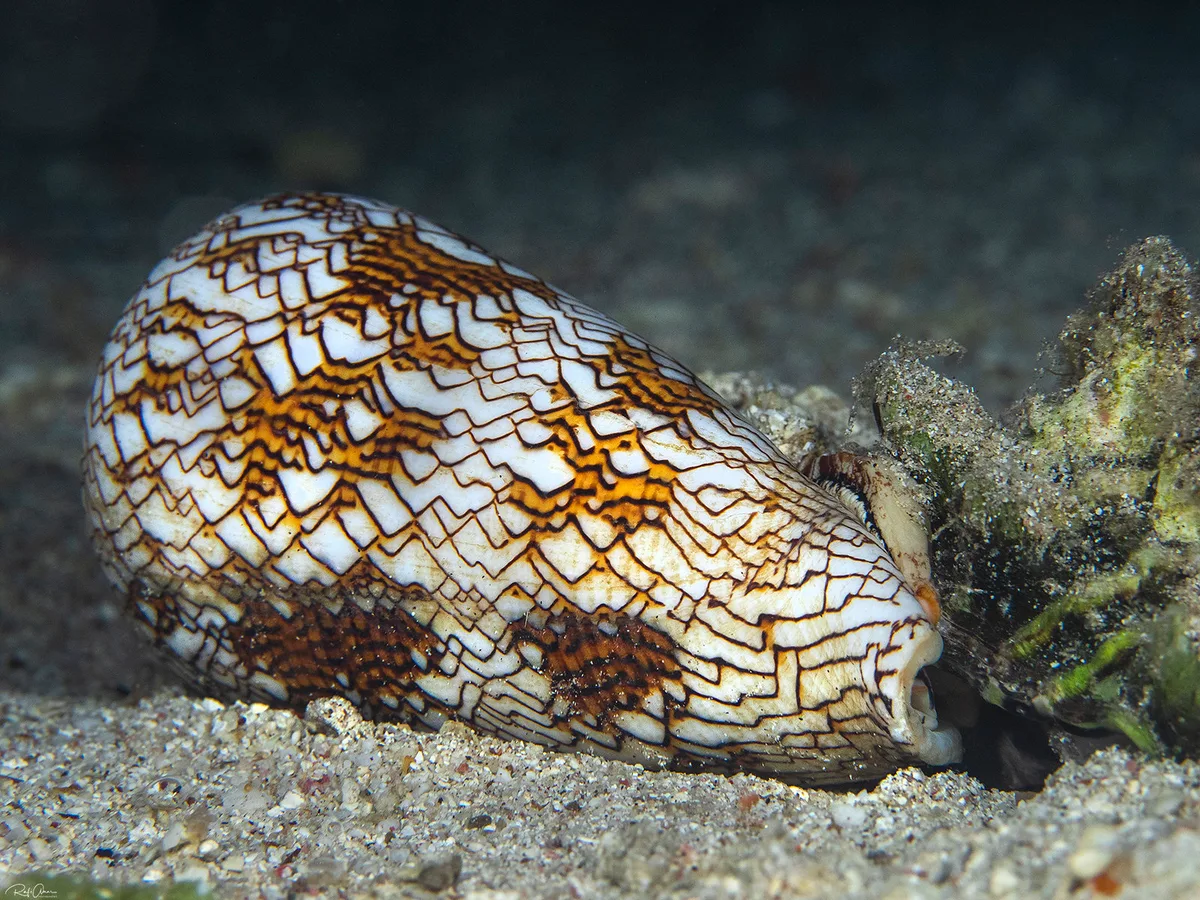
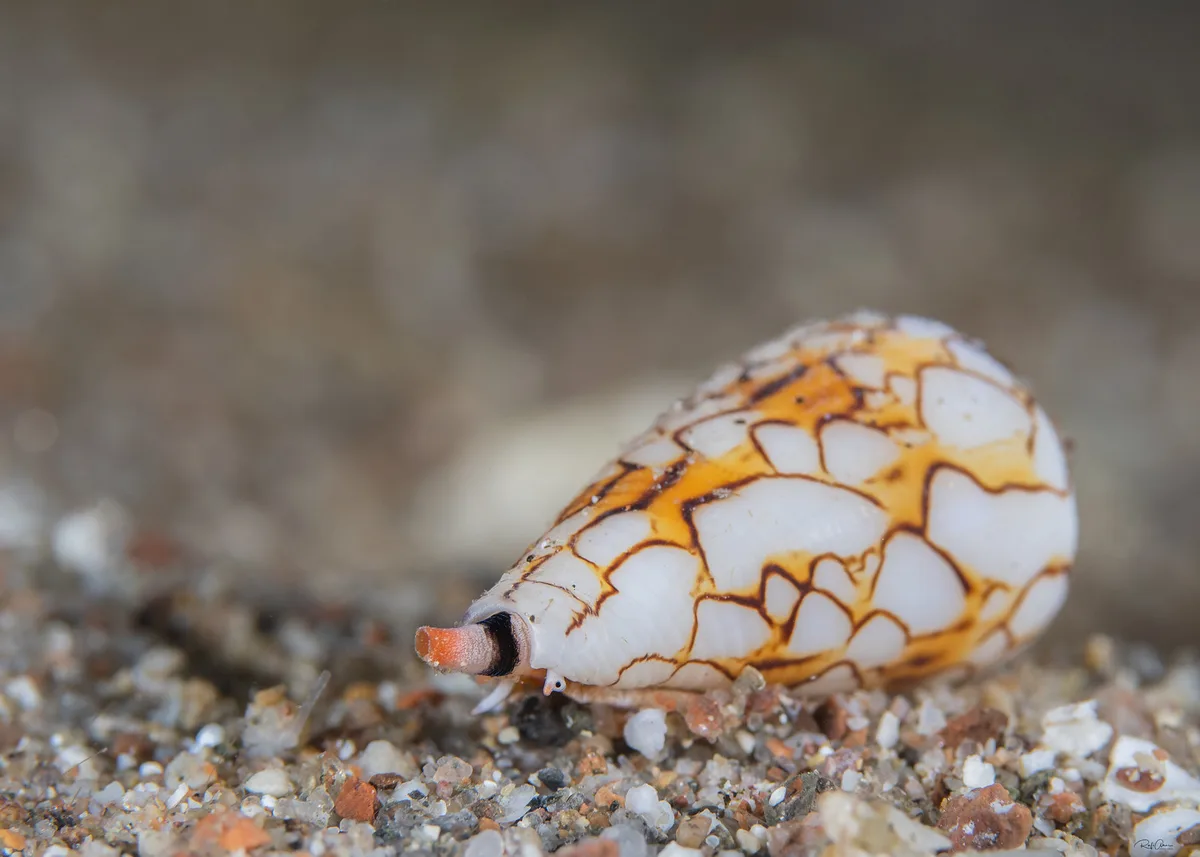
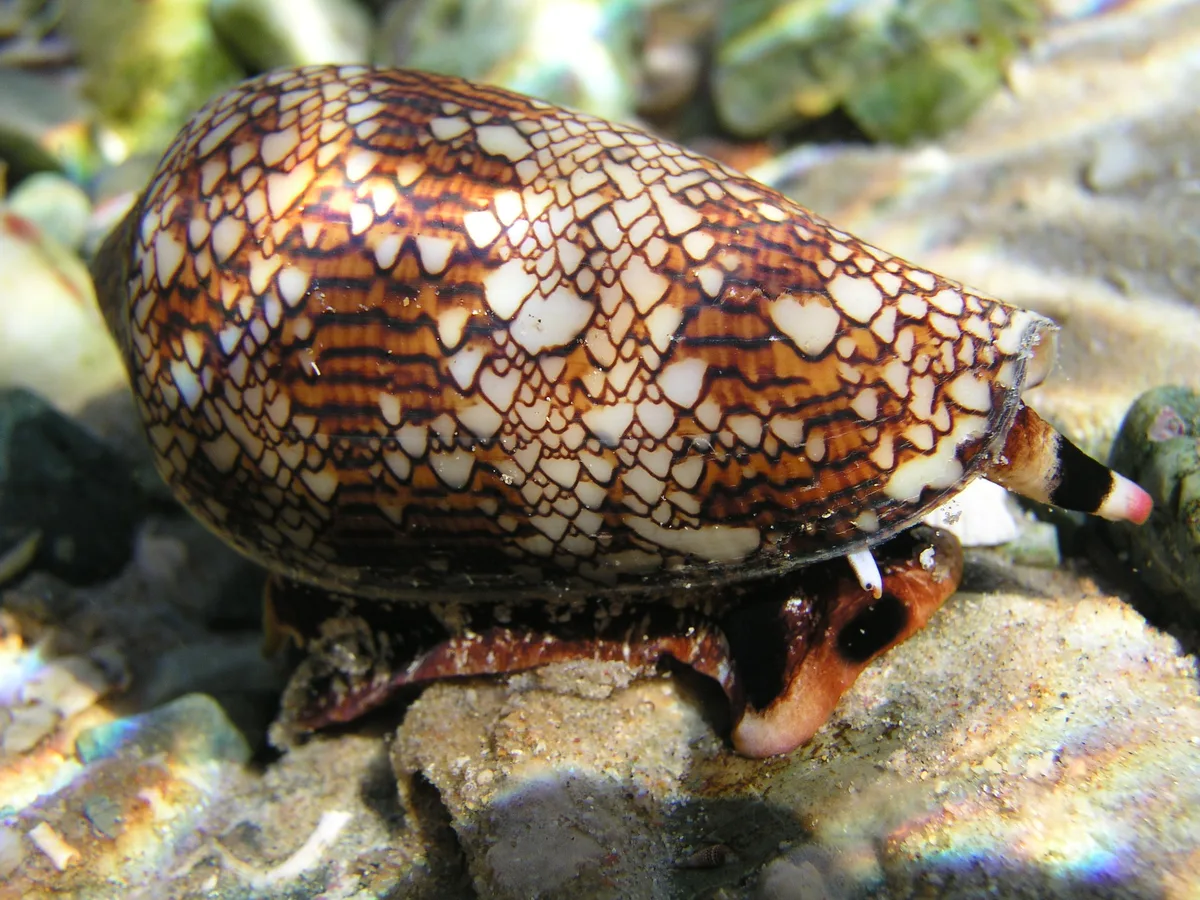
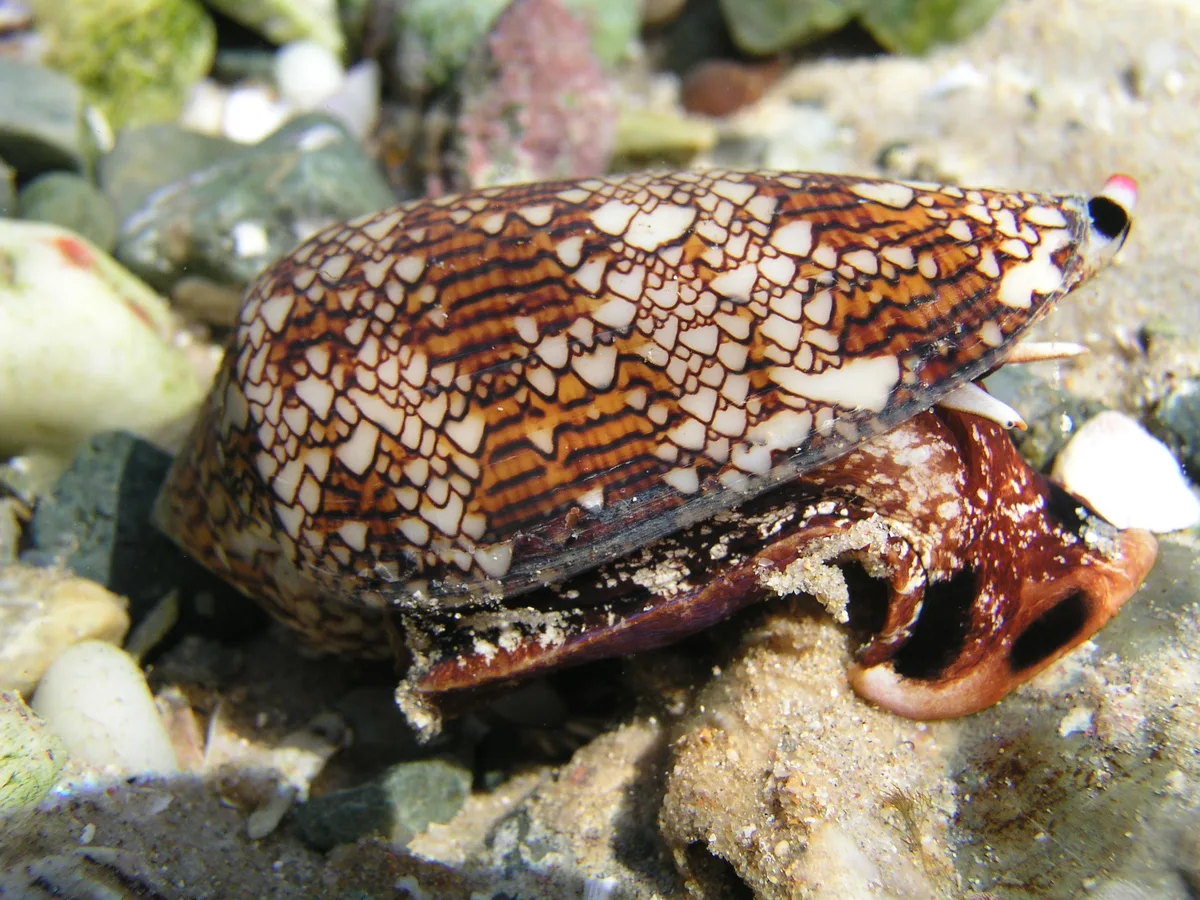
A heavy cone up to 15 cm (6 in), usually nearer 9 cm (3.5 in), covered in white tent shapes outlined in dark brown and crossed by two or three darker spiral bands. By day it lies buried with only the siphon showing. At night it comes out over sand and rubble to hunt, and that is when divers meet it.
The pattern is famous outside biology. Those overlapping triangles are close to what a simple mathematical rule produces when run over and over on a row of cells, and the shell is the standard illustration of the idea in textbooks on complexity. The snail is not doing arithmetic. Each cell along the growing edge of the mantle lays down pigment or does not, based on what its neighbors did a moment earlier, and a pattern nobody designed falls out of a rule with no memory of the whole.
The harpoon
Every cone snail hunts with a modified tooth: hollow, barbed, disposable, and loaded with venom. It sits in a sac like an arrow in a quiver, gets pushed into the proboscis and fired, and the animal keeps a supply of about twenty ready to go. The proboscis is long and flexible enough to reach anywhere on the shell, including the broad end that looks like a safe place to hold it, which is why there is no correct way to pick a cone snail up.
This species hunts other snails, and often other cone snails. It tracks prey by scent across open sand, pins it with the foot, and drives the harpoon in through the shell opening. Prey larger than the hunter is not unusual, and neither is cannibalism.
How dangerous it is
Serious enough to leave alone, and less lethal than its reputation. The venom is tuned to shut down a mollusc, and a sting produces intense local pain, spreading numbness and, in bad cases, muscle weakness. Older poison compendiums list this species among those blamed for human deaths, but the well-documented fatalities belong to the fish-hunting Geography Cone, whose venom is built to stop a vertebrate. Treat this one as capable of putting you in a hospital rather than a morgue, and treat that as reason enough.
If someone is stung: pressure bandage on the limb, keep them still so the venom does not spread, and get them to a hospital that can ventilate. There is no antivenom for any cone snail, and none is coming, because the venom is not one toxin but a hundred or more short peptides, unique to each species.
That last fact is why these animals matter to medicine. A single cone snail carries a private library of molecules, each one shutting down a specific ion channel with a precision no synthetic drug matches, and pharmacologists have been mining that library for decades. The venom of this species alone has yielded compounds used as standard laboratory tools for studying how nerves fire.
- heavy conical shell patterned with white tent shapes outlined in dark brown
- two or three darker spiral bands crossing the tents
- long white siphon raised off the sand, and a mottled foot
- shell to 15 cm, usually around 9 cm
Why it's threatened
This species is widely distributed and there are currently no known major threats. However, it has to be noted that Conus textile vaulberti is highly restricted in its range (F. Lorenz pers. comm. 2025).
Threat classification from the IUCN Red List.