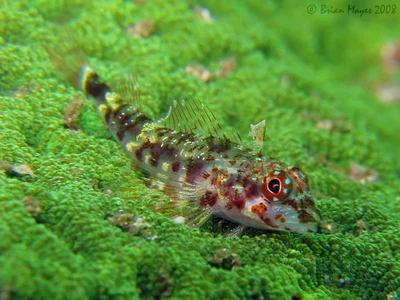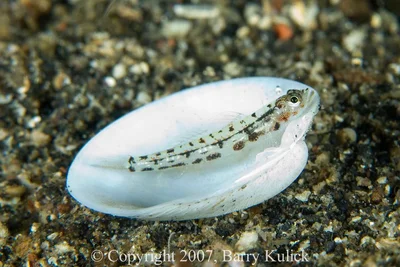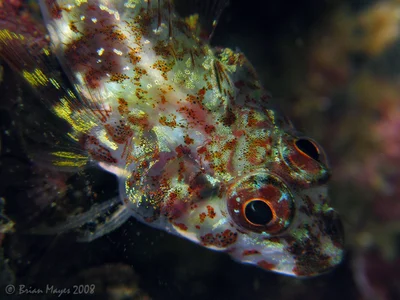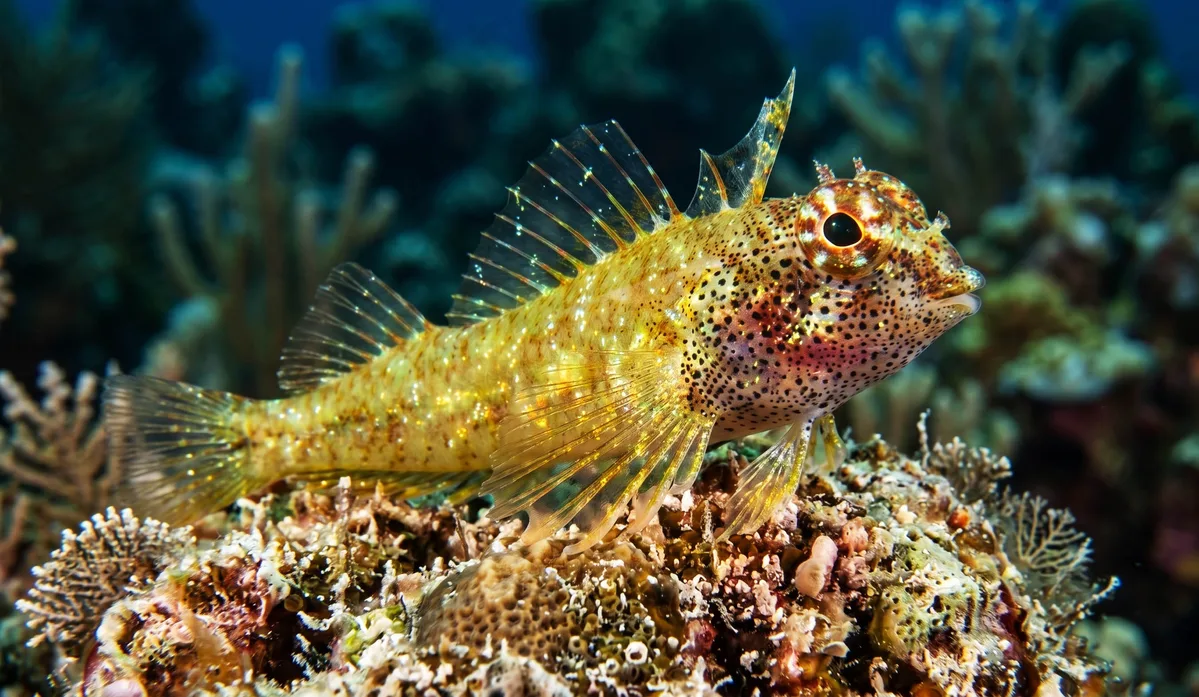

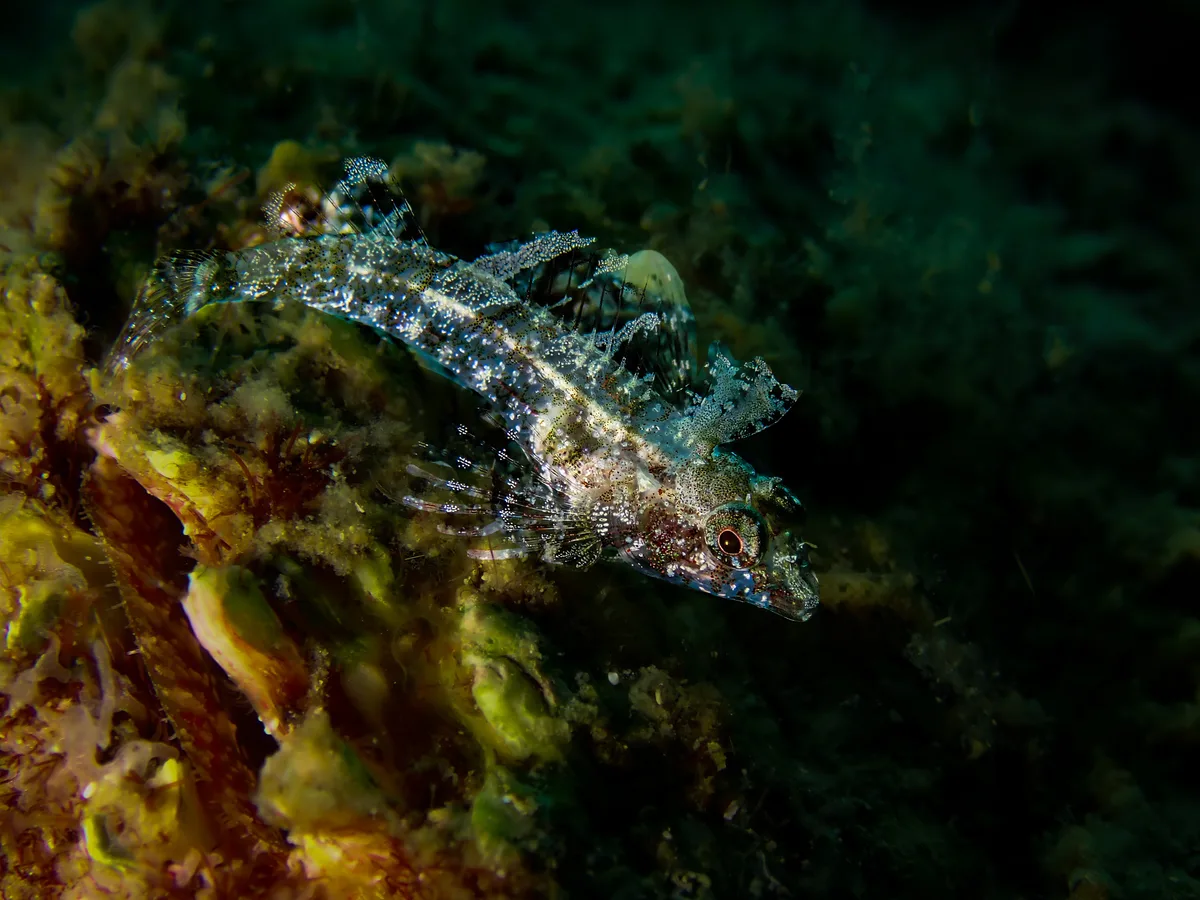
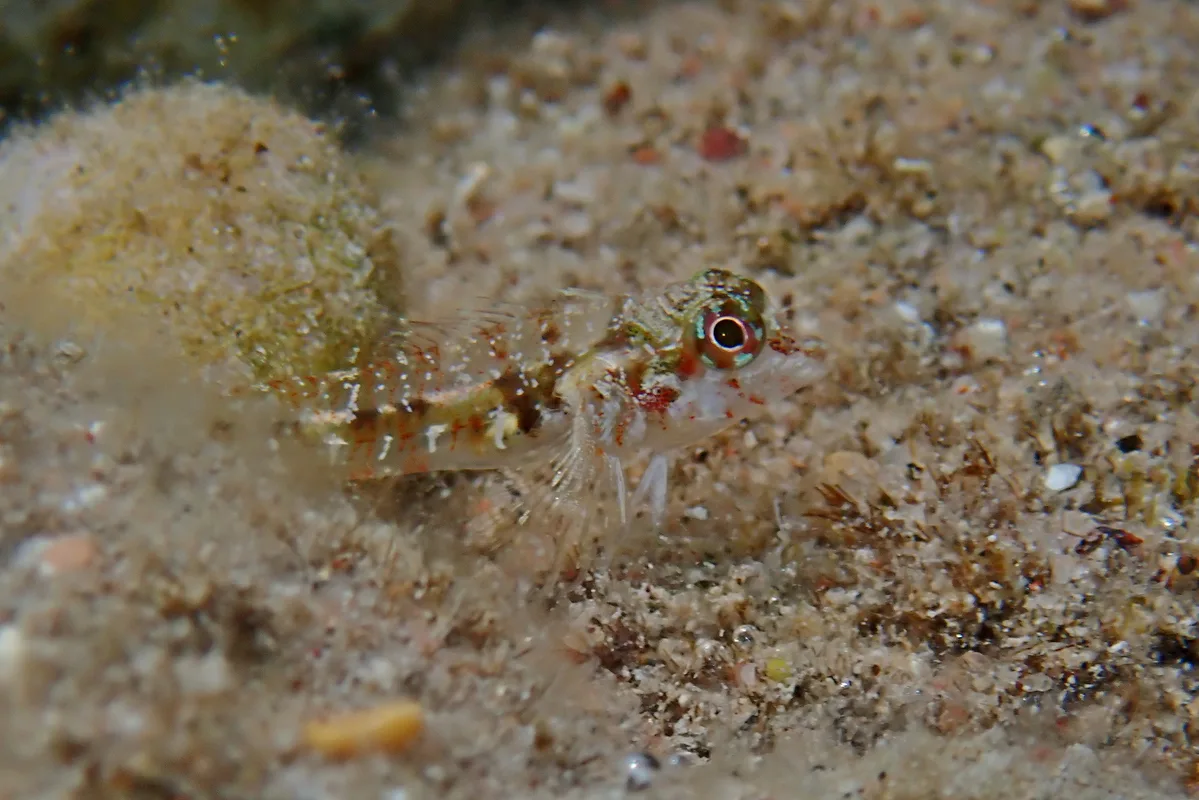
A breeding male triplefin is a different animal from the fish that was sitting on the same rock last week.
Outside the season these are small, pale, barred fish that would not stop anyone. When a male takes a territory he blackens: the head and the front half of the body go dark, sometimes to near-solid black against a red rear, and he sits at the highest point of his patch of coral and displays at everything that passes. Rival males get a raised-fin confrontation. Females get a rapid quivering dance and a tour of the rock he has cleaned for eggs.
He then guards the clutch. Triplefin eggs are stuck to the rock in a flat patch and the male stays with them, fanning and driving off anything that approaches, and he keeps the color for as long as he is defending something.
This is one of the smallest of them, two and a half centimeters, on shallow coral in the top fifteen meters. The three separate dorsal fins are the family's giveaway, and once you have registered them you start noticing triplefins everywhere, because they were always there.
The genus. Enneapterygius Rüppell 1835 - ennea (nine) + pterygion (fin). ETYFish
The species. Enneapterygius abeli (Klausewitz 1960) - Honours Austrian biologist Erich F. Abel. ETYFish
- three separate dorsal fins in a row along the back
- under three centimeters, perched on coral rather than swimming
- females and non-breeding fish pale with reddish bars
- breeding males with the head and forebody blackened
- up to 2.5 cm
Why it's threatened
Due to the small size of the Yellow Triplefin, it is of no commercial value as a food source. It is not used within the aquarium trade.
Threat classification from the IUCN Red List.