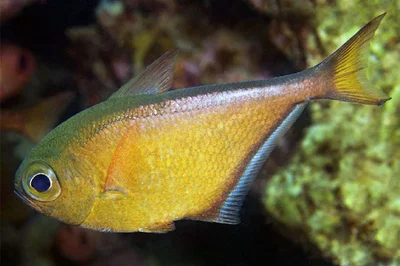
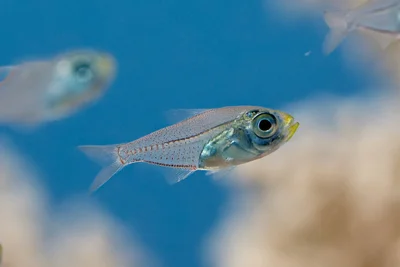
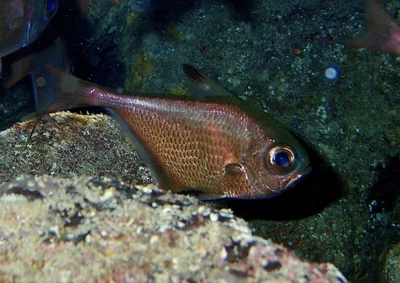
The Sharm Sweeper, Parapriacanthus sharm, is a small, elongate and compressed fish that reaches a maximum length of 6.2 cm (2.4 in). Its body is largely translucent, appearing silvery over the peritoneal areas, and it has a pale-yellow caudal fin. This species has proportionally large eyes. The genus name, Parapriacanthus, derives from Greek, combining "para" (near), "prion" (saw), and "akantha" (thorn). The species name, "sharm," is attributed to its type locality, Sharm el Sheikh, with "sharm" meaning "narrow passage" in Arabic.
The Sharm Sweeper inhabits reef environments, typically found at depths of 10-15 m (33-49 ft). It dwells within caves and other sheltered recesses of reef structures, often forming aggregations during daylight hours. This cryptic behavior, combined with its small size, means it is infrequently observed by divers. Its diet consists primarily of zooplankton, likely consumed during nocturnal foraging. The species is endemic to the 🌊 Red Sea, occurring in the Gulf of Aqaba near the Sinai Peninsula.