
ScombridaeScombridae
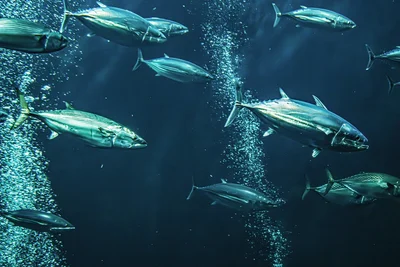
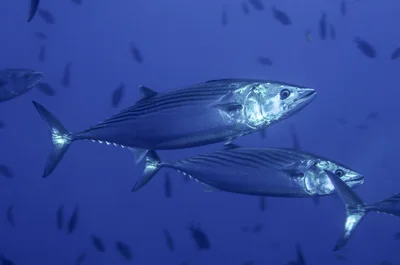
Nothing sticks out. In a tuna the first dorsal fin folds down into a groove along the back, the pectorals lie into depressions in the flank, the pelvics fold flat, and the eye sits flush with the surface of the head. Behind the second dorsal and the anal fin runs a row of small separate finlets, and the tail is a stiff crescent on a peduncle so narrow it is almost a hinge, with a keel either side of it. The body barely bends. In most fish the whole animal flexes to swim; in a tuna the trunk stays rigid and the tail alone does the work, which is the most economical way anything has found to cover distance in water at speed.
Everything else is the bill for that machine. A tuna cannot pump water over its gills the way a resting fish does, so it swims from the day it hatches to the day it dies, and it burns fuel at a rate nothing else its size approaches. Several of them also run their swimming muscle warmer than the water around it, the same trick the mackerel sharks use.
The compensation is growth. Few large fish grow faster: a skipjack can be spawning within a year or so of hatching, a yellowfin within two, and very few of any of them reach ten years old. That turnover is the only reason the fishery has lasted as long as it has, and tuna is the most valuable wild-caught fish on earth, taken by purse seine in quantities that have pulled several stocks down to a fraction of what they were.
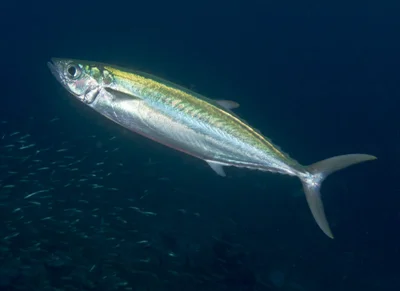
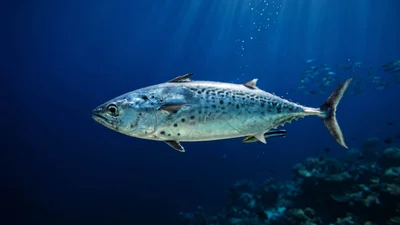
Eight species are listed here, and what a diver actually sees is the small end of the family: kawakawa and Spanish mackerel cutting along a drop-off, Indian mackerel in fast schools over shallow reef. A yellowfin passing a wall is an event rather than a sighting.
- torpedo-shaped, streamlined body
- deeply forked caudal fin
- series of small finlets behind dorsal and anal fins
- distinct keel on caudal peduncle
- dark metallic blue or green back, silvery sides
8 species in Scombridae




Other torpedo-shaped groups
Similar silhouette underwater - worth a look if this was not your animal.


Last Update: August 23, 2026