
PorcupinefishesDiodontidae
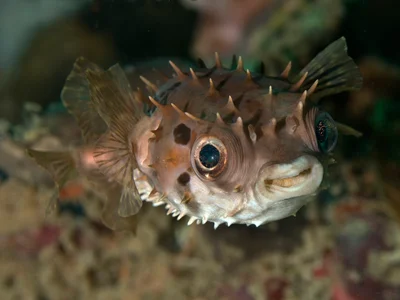
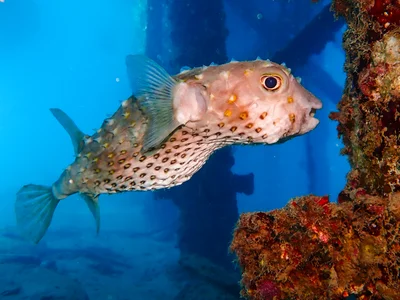
The spines are its scales. Every bony fish carries plates in the skin; this family rebuilt them into spikes, each one anchored on two or three roots buried under the surface so that it cannot simply be pulled out, and laid them in rows over the whole body. On a resting fish they lie flat and look like nothing much. There is only so much loose skin to go around, so when the body swells the rows are levered upright, and an animal that was soft and slow a second earlier is one nothing can close its mouth on.
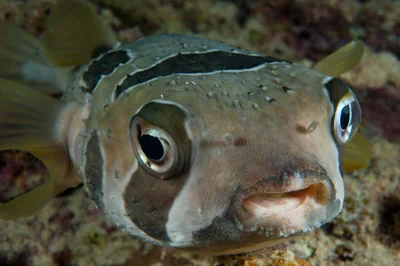
The jaws are the other half of it. Diodontidae means two teeth, and again that is the count: where a puffer's plates are split into four, each jaw here is a single undivided plate, a parrot beak with no seam in it. That is a nutcracker. Sea urchins, thick-shelled snails and hermit crabs still in their shells go in whole, and the container is crushed along with the animal inside. The plates grow throughout life and the diet grinds them back.
The rest of the time this is one of the softest animals on the reef. Porcupinefish pass the day under a ledge, big-eyed and slack, and work the sand at night for anything with a shell on it. They let people get close, which is where the harm comes from: a fish lifted into the air gulps air instead of water, and one that cannot get it out again does not survive the photograph.
Five species are listed here, two of them burrfishes, whose spines are shorter and work differently; their own pages explain the difference. The largest gets close to a meter. Dried in the inflated state they have been sold as curios for well over a century, and in the Gilbert Islands warriors wore a whole porcupinefish skin as a helmet above armor woven from coconut fiber, which is the only case in this catalogue of a reef fish being issued as military equipment.
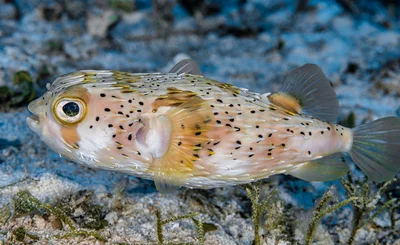
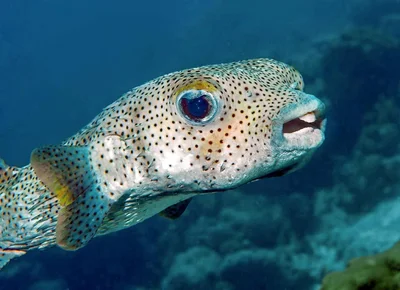
- body covered in prominent, fixed or erectile spines
- robust, somewhat globe-like body capable of rapid inflation
- large, parrot-like beak formed by fused teeth
- absence of pelvic fins
- large eyes and often mottled brown/grey/yellow colour with dark spots
5 species in Porcupinefishes
Other boxy groups
Similar silhouette underwater - worth a look if this was not your animal.


Last Update: August 23, 2026