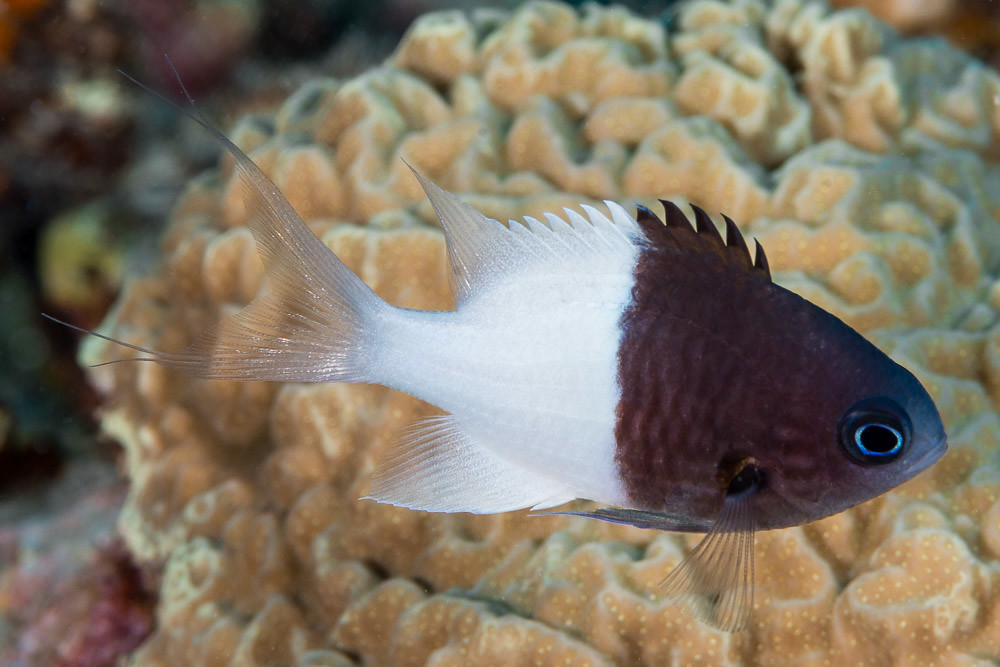
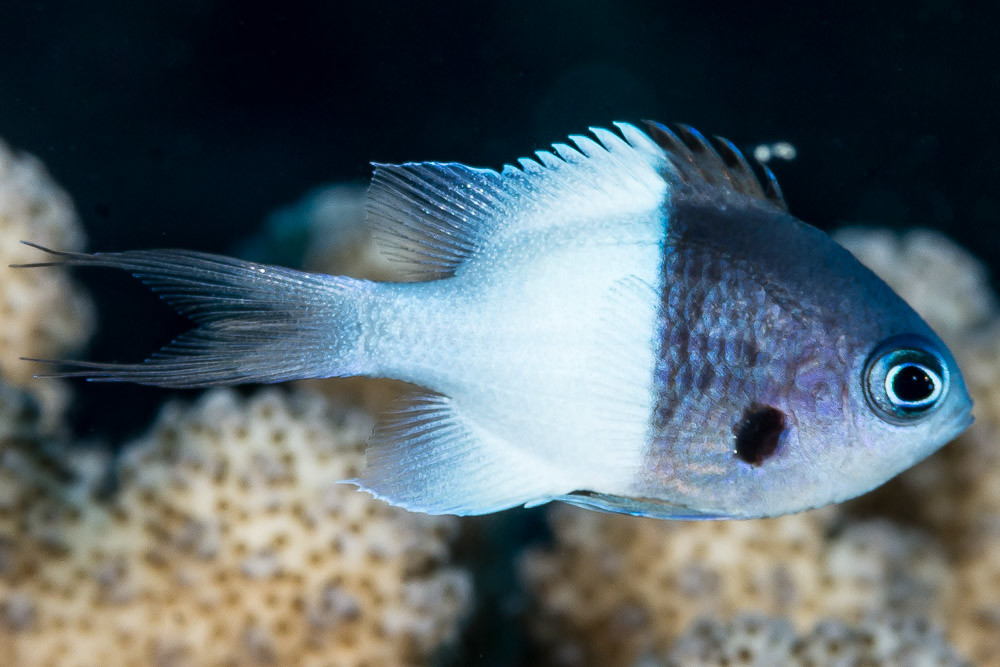
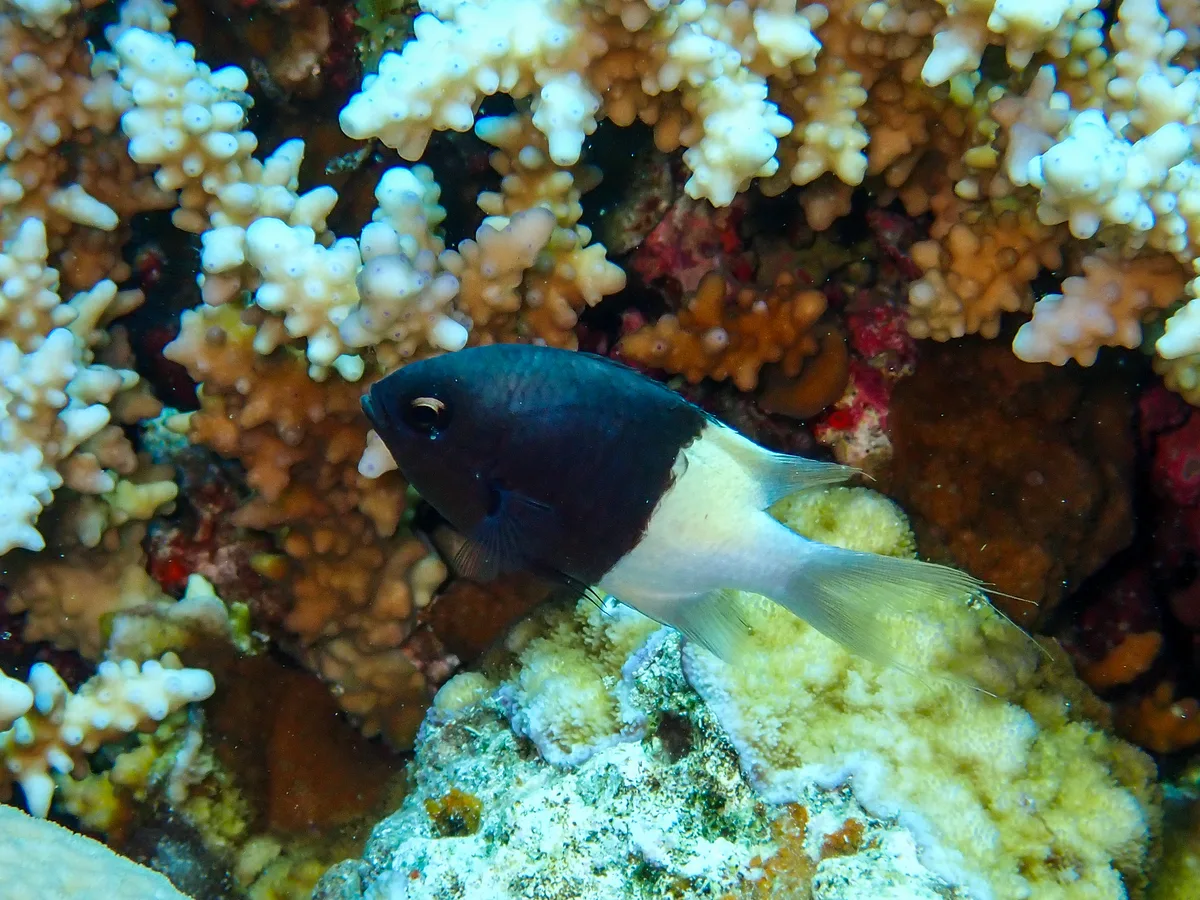
Black in front, white behind, split down the middle by a line so clean it looks painted. Eight centimeters (3 in) of fish that is hard to misidentify and hard to expose properly.
Sharp two-tone patterns like this are common in small reef fish and their function is argued over. The most likely job is confusing a predator's aim: at speed, in a group, the pattern breaks up where one fish ends and the next begins, and a strike aimed at what looks like a fish lands between two of them.
It feeds on plankton in open water off the slope, like the rest of its genus - facing into the current, taking one animal at a time, and dropping back to the reef when something large arrives.
The genus name changed recently: the chromis were split, and a number of species moved to Pycnochromis, so older books and photo captions still file this one under Chromis.
The genus. Pycnochromis Fowler 1941 - pycnos (compact). ETYFish
The species. Pycnochromis iomelas (Jordan & Seale 1906) - io- (perhaps short for iodes) + melas (black). ETYFish
- front half black, rear half and tail abruptly white
- the division is a clean vertical line, not a gradient
- in small groups in midwater off the slope
- length up to 8 cm
Why it's threatened
There are no known major threats.
Threat classification from the IUCN Red List.